

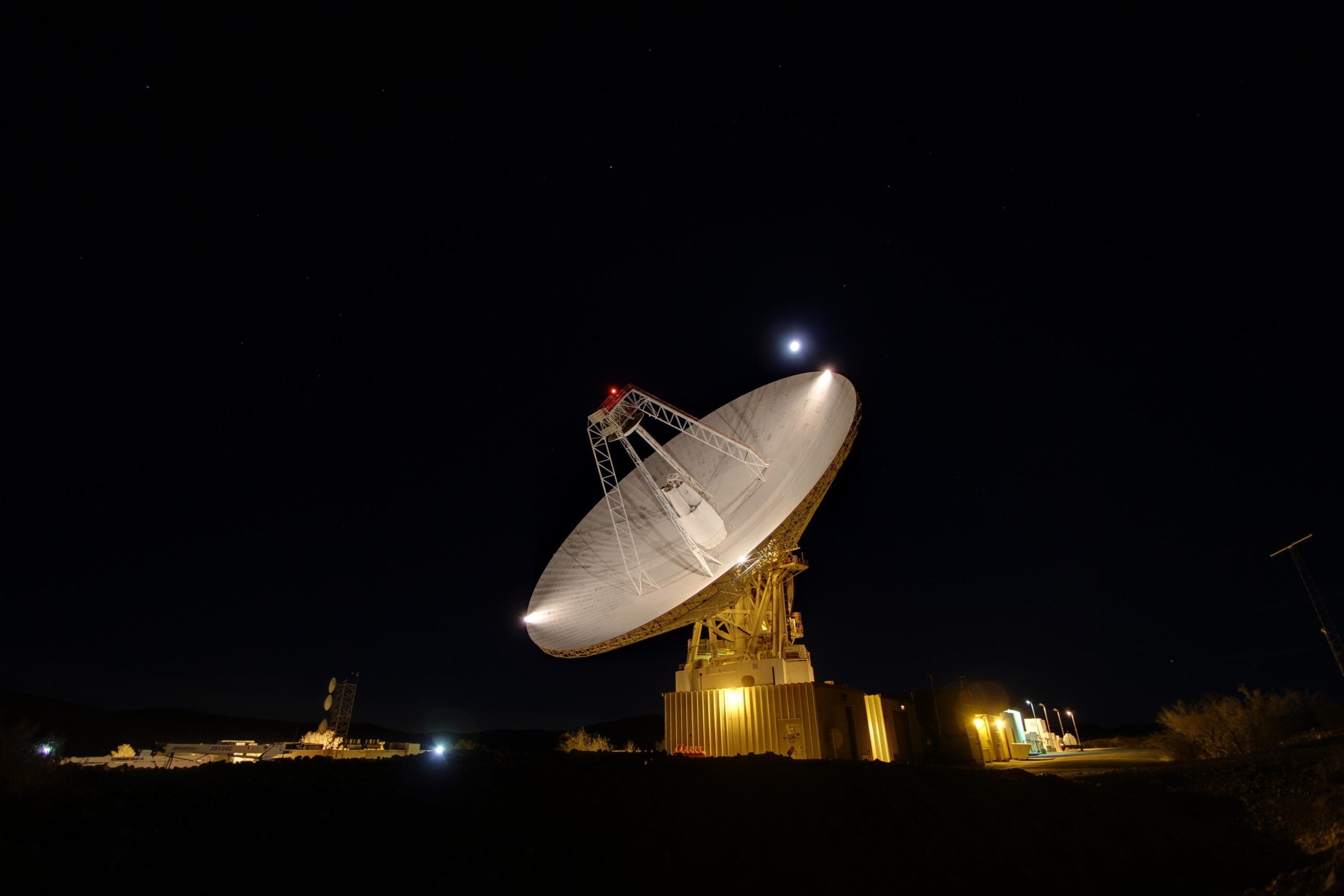
There was no public vote on whether Earth should advertise itself to the stars. No planetary authority weighed the risks, chose a frequency and authorised a greeting. Yet for decades, some of humanity’s strongest persistent radio transmissions have been leaving the Solar System as a by-product of something much less theatrical: keeping in touch with spacecraft at Mars.
A peer-reviewed analysis in The Astrophysical Journal Letters reconstructed where those transmissions went from 1 January 2005 through 31 December 2024. Pinchen Fan of Penn State led the study with Penn State astronomer Jason Wright and T. Joseph W. Lazio of NASA’s Jet Propulsion Laboratory.
The 77 percent in the headline needs careful handling. It is not the probability that extraterrestrials heard Earth, and it says nothing about whether extraterrestrials exist. It is a duty cycle for a very particular piece of sky: a distant observer positioned to see Earth and Mars align would have been inside one of NASA’s deep-space uplink beams 77 percent of the time during the analysed period.
This is one study of one communications network, not settled consensus about Earth’s detectability. Its value lies in replacing a vague idea of radio leakage with a measured pattern, then asking whether the same pattern could guide searches for technology around other stars.
A radio beam does not stop at Mars
The NASA Deep Space Network, or DSN, is an array of large radio antennas at Goldstone in California, near Madrid in Spain and near Canberra in Australia. Their placement roughly 120 degrees apart in longitude lets one complex take over as a spacecraft drops below another’s horizon.
Those dishes carry commands out and bring tracking and scientific data back. The network supports missions spread across the Solar System, from spacecraft at Mars to New Horizons beyond Pluto and observatories around the Sun–Earth Lagrange points.
For an uplink, a DSN dish concentrates radio energy into a narrow cone aimed at a receiver on a spacecraft. Narrow, however, is not the same as perfectly pencil-thin. The 70-metre dishes have a half-power beamwidth of about 0.128 degrees at S band and 0.038 degrees at X band, according to the paper. That is several arcminutes across.
A spacecraft antenna is tiny within that cone. Even Mars usually covers only a small central patch. The craft receives enough energy to recover the command, while most of the wavefront passes around it and continues in the same direction. Nothing in the radio signal knows that Mars was its intended destination.
From sufficiently far away, the geometry compresses. Earth, the spacecraft and Mars appear close together on the sky. An observer almost directly beyond the spacecraft would sit along the continuation of the uplink, like someone standing behind a small target illuminated by a distant spotlight.
Rebuilding 20 years of invisible traffic
The researchers began with public DSN uplink schedules. They matched the target code in each entry to a mission, retrieved spacecraft trajectories from JPL’s Horizons system and reconstructed the beam’s outward direction. They also corrected for light-travel time, because the apparent location used to receive a downlink is not automatically the location toward which an earlier uplink had to be sent.
The resulting map contains 92.5 antenna-years of cumulative transmission time. That total can exceed the 20-year calendar interval because several antennas may transmit at once. The team represented the sky in one-arcminute cells and calculated how long each direction was illuminated.
Ka-band uplinks were excluded because their transmitting power was below one kilowatt and because only a few antennas supported them. Low-Earth-orbit communications were also outside the study. The map is specifically an account of stronger deep-space uplinks in S and X bands, not every artificial radio emission Earth produced.
The logs did not record the actual power of every uplink. That makes this principally a study of timing and direction, not a claim that every beam could be recovered at the same interstellar distance.
Where the 77 percent comes from
Mars emerged as the busiest corridor. For a line of sight within two arcminutes of the planet, the mean duty cycle was 77 percent, equivalent to about 9.4 months of transmission per year. Between two and three arcminutes, it was still about 58 percent. Beyond three arcminutes, it fell quickly.
In the paper’s comparison, the region within two arcminutes of Mars was illuminated about 400,000 times more often than the average direction across the whole sky. The chance associated with an alignment involving a planet other than Mars was about 12 percent, more than 60,000 times the random all-sky case.
So the finding is conditional twice over. First, an observer has to occupy the narrow extension of the Earth–Mars line. Second, the observer has to watch during the alignment. The result does not mean DSN beams have swept 77 percent of the galaxy, that 77 percent of nearby stars received them, or that a recipient noticed them.
It does mean that the choice of where and when to listen can transform the odds. A randomly placed observer at a randomly selected time would be very unlikely to intercept a deep-space uplink. Move that observer onto the Mars line during conjunction, and routine mission operations make the signal present more often than not.
Why Mars became Earth’s accidental transmitter mast
Mars dominates because it has dominated robotic planetary exploration. Over the study period, NASA communicated with orbiters, landers and rovers there through overlapping missions. A command intended for one machine could illuminate a distant background direction even though neither the command nor its content had anything to do with interstellar communication.
The larger map bears the imprint of the Solar System’s flat architecture. Most planets and interplanetary spacecraft remain close to the ecliptic, the plane of Earth’s orbit. The team found that 79 percent of total DSN transmission time stayed within five degrees of that plane. Eighty-four percent of one-arcminute sky cells in the band were illuminated at least once, compared with fewer than 3 percent outside it.
The Earth Transit Zone is narrower still. This is the strip from which a distant observer could see Earth cross the Sun. Its average DSN duty cycle was about 13 minutes per year, 20 times the 0.65-minute average across all ecliptic latitudes. A system able to notice Earth by transit therefore also has a better-than-random position from which to encounter its deep-space radio traffic.
Two other concentrations appeared toward and directly away from the Sun. They reflect communications with spacecraft around the Sun–Earth L1 and L2 points. The anti-solar peak grew fourfold in the 2022 to 2024 subset, which the authors attribute largely to transmissions directed toward the James Webb Space Telescope around L2.
Being in a beam is not the same as hearing it
The authors estimated that a typical DSN transmission could be detected by present-day human radio technology from roughly seven parsecs, or 23 light-years. There are 128 known star or brown-dwarf systems within that distance. The estimate is a useful scale, not a census of systems that actually received a particular uplink.
Detection would require a receiver with sufficient sensitivity, observing at the right frequency and time. The signal weakens with distance. Interstellar plasma can affect it. A civilisation would also have to distinguish an engineered transmission from local and astronomical radio noise. Recognising a carrier as artificial is not the same as decoding a command designed for a NASA spacecraft.
The absent power values add another uncertainty. The study identifies when a location was illuminated, but not whether an instrument at that location could recover every event. Fan and colleagues explicitly separate those questions.
SpaceDaily’s earlier account of Earth’s broader technological visibility found that powerful planetary-radar emissions can be detectable across much greater distances, potentially thousands of light-years. Those radar events are exceptional. The interest of the DSN pattern is different: persistent, repeated and tightly connected to the ordinary work of exploring nearby worlds.
The search strategy reflected back at Earth
The study is less an audit of who might have overheard NASA than a proposal for using Earth’s behaviour as a search template. SETI cannot know how another technological species would communicate. It can, however, test a modest assumption: an early spacefaring civilisation may build a network for commanding probes before it builds an intentional interstellar beacon.
If that civilisation’s planets orbit in a common plane, its transmissions should cluster near that plane. Systems seen edge-on from Earth become attractive because planetary transits reveal the orientation. Observations can then be scheduled when one exoplanet passes in front of another, or when a planet and its star align from the telescope’s perspective.
This is not just a theoretical suggestion. SpaceDaily previously covered a 28-hour radio search of the TRAPPIST-1 system timed around planet-planet occultations. It found no extraterrestrial signal among the candidates, but it demonstrated how alignment windows can narrow a search. The DSN analysis now supplies an empirical baseline: had the same logic been applied to Earth and Mars, the improvement over random timing would have been enormous.
Optical communications may eventually complicate the comparison. Lasers can carry deep-space data through far tighter beams, creating much less spillover and sometimes allowing the target planet to block the signal. Yet the alignment logic remains: when leakage exists, the line connecting inhabited and explored worlds is still the sensible place to look.
What the map leaves out
NASA operates only one of Earth’s deep-space networks. China, Europe, Russia, India and Japan also communicate with distant missions. The authors argue that NASA’s record is a reasonable first approximation because of its large share of deep-space activity, but a complete planetary map would require logs from other operators.
The 20-year interval is also a snapshot of one phase in spaceflight. Future lunar infrastructure, Mars sample return, crewed exploration or long-lived planetary networks could alter the direction, duration and power of transmissions. More optical links might make leakage harder to intercept even as total traffic grows.
No claim in the paper establishes a recipient. No star was identified as having detected a beam, and no reply was found. The result does not turn a communications schedule into evidence for extraterrestrial life.
There is also a necessary qualification to the opening premise. Small groups have intentionally transmitted interstellar messages, including the Arecibo message in 1974. What humanity never made was a collective decision to announce the planet. The signals in this study were not greetings at all. They were operational commands sent to machines.
A civilisation may leak before it speaks
The study’s most durable idea is not that Earth has loudly broadcast itself in every direction. It is almost the opposite. Technological leakage has structure. It gathers around the destinations a civilisation cares enough to explore, and around the directions its planetary system makes easy to reach.
That structure creates both a vulnerability and an observing strategy. A nearby listener in the wrong part of the sky would almost never encounter a DSN uplink. A listener on the Earth–Mars line could have been washed by them repeatedly, without any human operator intending to send so much as a greeting.
The first recognisable sign of another spacefaring society may therefore be neither a monument nor a message. It may be the quiet, repetitive infrastructure required to keep a probe on course. Earth has already shown how such a signature can form: one command at a time, aimed at Mars, with the rest of the beam continuing into the dark.