
An astronomical alert is not yet a discovery. It may mark a supernova, a variable star or an asteroid, but it may also be a cosmic-ray strike, a diffraction spike, a detector defect or a slight mismatch between two images. Before a telescope can turn elsewhere for follow-up, somebody or something has to decide which possibility deserves attention.
A 2025 Nature Astronomy study tested an unusually lightweight way to make that first cut. Researchers associated with Oxford, Google Cloud and Radboud University gave Gemini 1.5 Pro a written guide and 15 annotated examples for each of three optical surveys. Across Pan-STARRS, MeerLICHT and ATLAS, it classified previously labelled candidates as real or bogus with 93 per cent average accuracy while producing a description and follow-up priority for every case.
The result is promising, but the details matter. Fifteen examples did not retrain Gemini from scratch. They guided an already-developed commercial multimodal model within its prompt. The 93 per cent is an average across retrospective datasets, not a live discovery rate. The explanations describe visible evidence, but they are generated text rather than a guaranteed account of the model’s hidden computation. And the paper itself says today’s large models remain too slow and expensive to sit at the front of a survey producing millions of alerts each night.
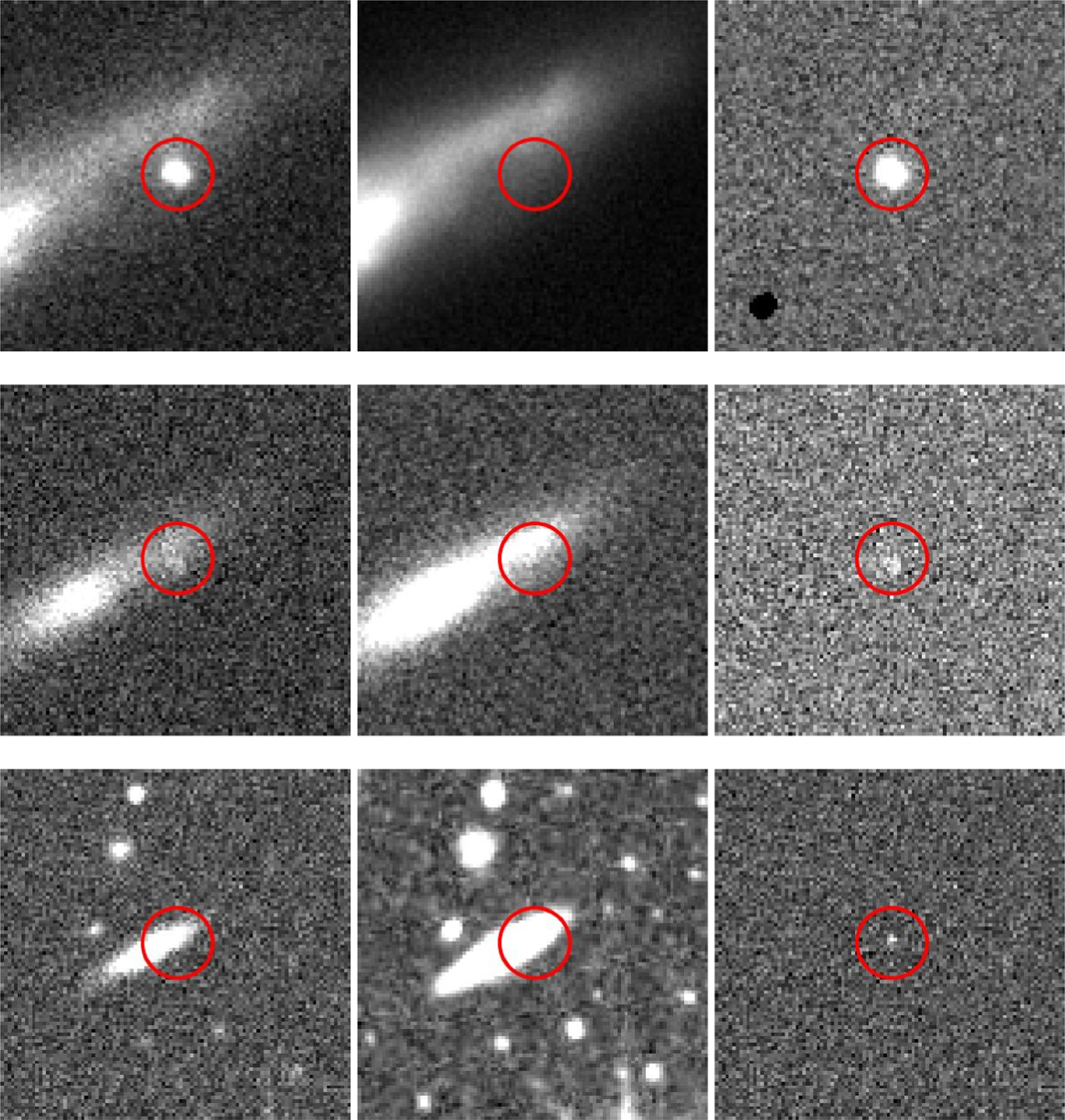
A candidate arrives as three images
Time-domain surveys repeatedly photograph the same sky. A new exposure is aligned with an older reference, then the reference is subtracted. Ideally, constant stars and galaxies disappear from the difference image, leaving only what changed. A newly appeared point source should remain as a compact positive spot. A source that faded can leave a negative residual.
In practice, subtraction is unforgiving. A cosmic ray can light a few detector pixels. A bright star can throw a diffraction spike across the frame. A satellite or aeroplane can leave a trail. Imperfect alignment can produce a paired positive-and-negative pattern around an unchanged star. Pan-STARRS also has gaps within its multi-chip camera. All of these can generate a candidate alert without representing an astrophysical event.
For every candidate, Gemini received a 100-by-100-pixel new image, reference image and difference image. The stamps represented the same location but covered different areas of sky depending on the survey’s pixel scale. A red circle marked the expected source position.
The instructions told the model to examine whether the central feature was circular or elongated, positive or negative, aligned or displaced. Its structured output contained a real-or-bogus label, a description of what it saw and an interest score. Explosive events could be marked high interest, variable sources low interest and artefacts no interest.
Fifteen examples did not mean conventional training
The researchers used gemini-1.5-pro-002 through Google Cloud. For each survey, astronomers selected 15 representative image triplets covering real and bogus morphologies and wrote expert descriptions. Those examples sat inside the prompt alongside the task instructions.
This is few-shot prompting, not fine-tuning. The model’s parameters were not updated on the 15 cases. It used them as an in-context guide for how to interpret the next images and how to format its response. Across all three survey-specific applications there were 45 guide triplets, 15 per survey, rather than one universal set of 15 that was applied unchanged to every telescope.
The distinction matters. A specialised convolutional neural network may be trained on hundreds of thousands of labelled images. Gemini arrived with extensive general image-and-language capabilities already embedded. The experiment showed that those capabilities could be directed toward a specialised astronomical task with little new labelled material. It did not show that astronomical expertise can be built from 15 images alone.
Nor were the examples selected blindly. Astronomers chose a representative balance and included common morphological problems. That expert curation is much smaller than constructing a traditional training set, but it is still scientific labour. If the guide omits an artefact peculiar to a new camera, the model has less help recognizing it.
The team tested the effect of reducing the MeerLICHT guide. Relative to 15 triplets, 12 lowered accuracy by about 0.5 percentage points, six by about 1.4 points and three by roughly 6.9 points. Performance improved with additional examples and appeared to level off near 15 for this task. That is evidence for the chosen number, not a universal law that every scientific classifier needs exactly 15 demonstrations.
Three surveys made the test meaningfully different
The three datasets differed in camera architecture and angular scale. Pan-STARRS used a 1.8-metre telescope and sampled 0.25 arcseconds per pixel. MeerLICHT used a 0.65-metre telescope at 0.56 arcseconds per pixel. ATLAS used a 0.5-metre telescope at 1.8 arcseconds per pixel. A source therefore occupied a different visual context in stamps that had the same number of pixels.
MeerLICHT supplied about 3,200 candidates, including explosive events, variable stars and artefacts. The ATLAS and Pan-STARRS samples contained 2,000 candidates each. The latter two treated genuine explosive transients as real, while MeerLICHT’s real category also included variable stars.
Pan-STARRS introduced another useful stress test. Its Gigapixel Camera 1 contains 60 CCDs, each divided into subcells, so chip-gap artefacts occur in a way they do not for the monolithic detectors used by MeerLICHT and ATLAS. A model that merely memorized the appearance of one survey’s noise would struggle to transfer.
The open Zenodo dataset contains the image triplets, labels and results of the human evaluation. The researchers also released the prompting and analysis code. That makes the experimental design inspectable and allows others to rerun it, although exact reproduction still depends on access to a commercial model whose underlying service can change.
What the 93 per cent figure means
Accuracy counted the share of candidates whose real-or-bogus label matched the stored ground truth, then the paper reported a 93 per cent average across the three surveys. It is not the percentage of alerts that became confirmed cosmic discoveries, and it is not a precision figure for one particular telescope.
For MeerLICHT, expert astronomers had manually assigned the ground-truth labels. In the ATLAS and Pan-STARRS sets, roughly half the examples, representing the real transients, were manually classified; bogus cases came from the surveys’ rejected-candidate lists. The evaluation was therefore retrospective. Gemini was judged against decisions already available to the researchers.
A 93 per cent average is substantial from a 15-example guide, but it is not the best accuracy available at any cost. The paper notes that established convolutional neural networks commonly exceed 98 per cent on real-bogus classification. Gemini’s value proposition is the combination of fast adaptation, little new labelled material and readable output, not a claim that it has displaced every specialised model on raw performance.
Accuracy also hides the practical difference between errors. Missing a rare, rapidly fading event can be more costly than sending an artefact for human review. Precision asks what share of predicted real candidates were actually real; recall asks what share of all real candidates the system recovered. The researchers examined both, but no single threshold is ideal for every observing programme.
The interest scores require similar restraint. They demonstrated how the output might support follow-up triage, but Gemini did not autonomously command telescopes in this experiment. A high-interest label was a simulated recommendation, not an observation request executed in the field.
Plain English helps, but it is not proof of reasoning
Gemini could say that a feature was circular and appeared only in the new and difference images, supporting a real transient. It could describe an elongated streak as a likely cosmic ray, or identify the positive-and-negative shape left by a misaligned subtraction. This gives an astronomer something to check against the pixels instead of only a probability score.
The University of Oxford’s account of the study emphasized that explanations accompanied every classification. The researchers did not simply assume that fluency made them valid. Twelve professional astronomers reviewed descriptions for 200 randomly selected MeerLICHT candidates through the Zooniverse platform.
On a scale from zero for a complete hallucination to five for perfect coherence, the mean score exceeded four. About 120 of the 200 cases received complete agreement among evaluators, and disagreement across the remainder was generally modest. Correct classifications also tended to receive higher coherence scores.
That validation is meaningful, but limited. It covered 200 examples from one survey, not every explanation across all three datasets. The scale asked whether the text coherently described visible features; it did not prove that the prose faithfully exposed every internal factor responsible for the label.
The paper itself warns that language models mimic expert reasoning by detecting patterns and do not possess genuine understanding or awareness. A fluent explanation can still rationalize a wrong answer. The safest description is a human-readable, externally checkable justification, not transparent access to machine thought.
The model could flag some of its own weak cases
The team then asked Gemini to score the coherence of its earlier outputs. Lower self-assigned coherence correlated with more misclassifications. This suggests a practical human-in-the-loop rule: allow clear routine cases to pass to the next automated stage, while directing people toward cases the model itself finds inconsistent.
By reviewing difficult examples and adding a small number to the guide set, the researchers increased MeerLICHT accuracy from about 93.4 to 96.7 per cent. The improvement came from targeted refinement of the prompt examples, not autonomous learning during routine operation. Humans still decided which difficult cases should teach the next run.
The self-score is also not an independent audit. It was generated by the same model family that produced the classification. Its correlation with error is useful evidence, but a deployed system would still need external monitoring for confidently wrong answers and shifts in new data.
A six-month repeatability exercise exposed another concern. The commercial Gemini endpoint had changed even though the model name remained stable. Across repeated runs and five new 15-example sets, the method showed low variability and the updated endpoint performed better on average. Yet the authors concluded that scientific pipelines built on commercial models should expect periodic revalidation.
Open data and code cannot fully freeze a remotely hosted model. This is a broader issue for reproducible science: a paper’s method may remain public while the service executing a central part of it evolves behind an API.
Where the hours could be saved, and where they cannot yet
Space Daily reported the original result in 2025. The deeper, credible near-term interpretation is not that one LLM should replace every existing alert filter. It is that a research group could stand up a readable classifier for a new instrument, a changed camera or an unusual candidate stream without first labelling an enormous training set.
That could remove hours of looking through routine thumbnails, especially for a targeted batch after faster software has already reduced the stream. It could also make a catalogue searchable by descriptions: candidates near galaxies, isolated events, circular positive residuals, or suspicious streaks. The study did not run a controlled time-and-motion trial, however, so it did not directly measure a number of astronomer-hours saved.
Scale remains the hard boundary. The Nature Astronomy paper says large language models generally required several seconds per query, while conventional neural networks can process individual images in milliseconds on graphics processors. Running a commercial LLM across millions of nightly alerts was described as impractical, with potential costs reaching thousands of dollars per night.
Since that paper appeared, the alert problem has become less abstract. As Space Daily’s recent Rubin Observatory explainer details, the operational survey can issue up to seven million alerts a night as it repeatedly scans the southern sky. An alert is merely a detected change, not a discovery, and the stream must be served to specialist brokers within minutes. A several-second language-model call for every alert would immediately become a bottleneck. It is not a viable front line.
The credible architecture is layered. Survey software aligns and subtracts images. Fast, specialised models reject obvious failures. Brokers add catalogue and light-curve context. A multimodal assistant can then handle a smaller ambiguous set, describing visible evidence and flagging uncertainty. Humans remain responsible for rare, consequential and genuinely unfamiliar cases.
This is also different from using language models to classify stellar light curves, an approach Space Daily has covered in the StarWhisper project. The Gemini experiment worked directly with new, reference and difference image stamps and focused on whether an alert was real, not on assigning a confirmed source to a detailed astronomical class.
Fifteen annotated triplets per survey were enough to make a general model surprisingly useful. They were not enough to remove the need for specialist pipelines, careful benchmarks or astronomers. The practical gain is narrower and still important: spend less human time rejecting familiar image failures, and preserve more of it for the candidate that does not look like anything the guide set has seen.