

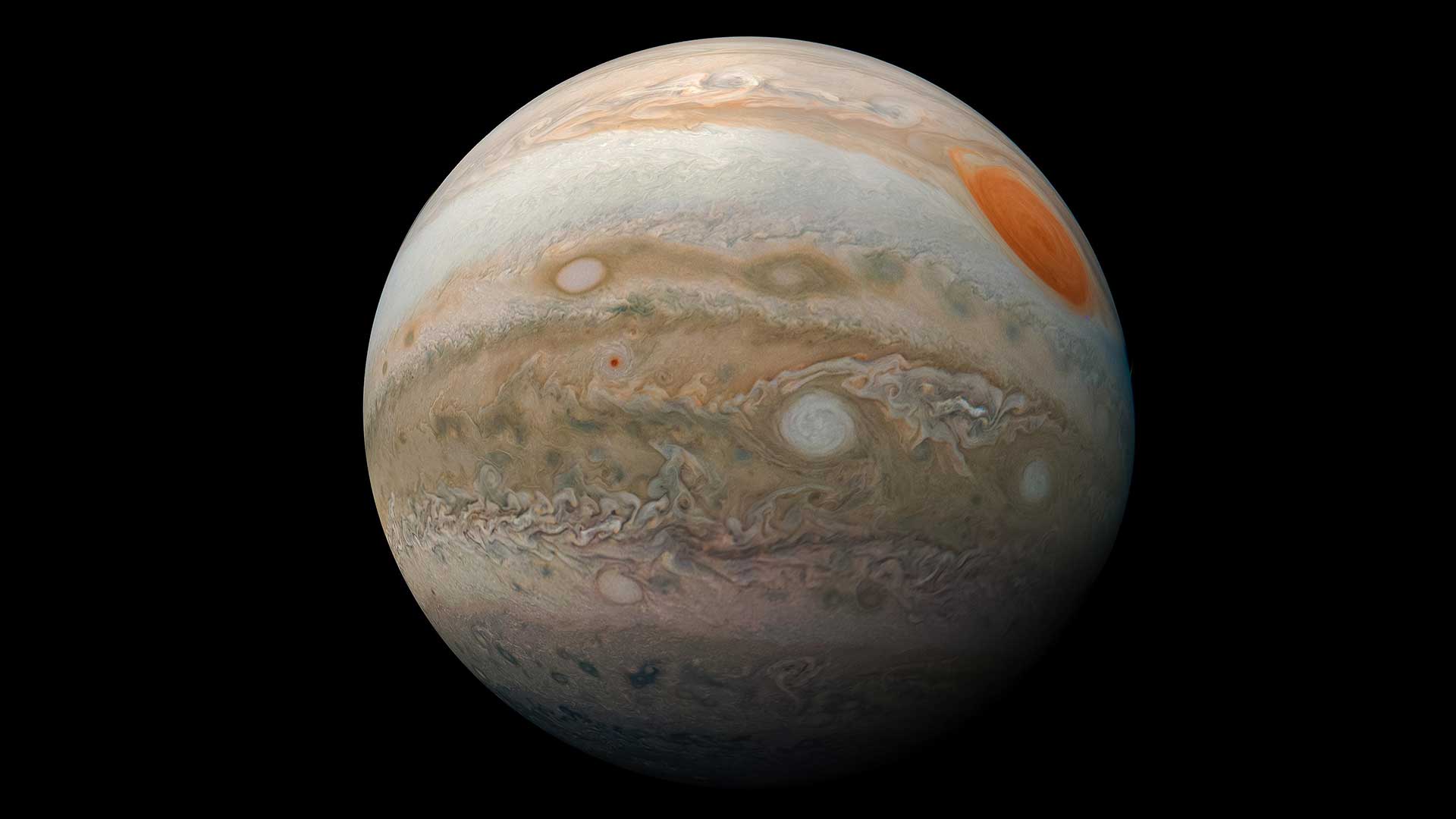
Jupiter left no photograph of its infancy. It did, however, leave a dynamical problem in two small moons that circle close to the planet.
Amalthea and Thebe travel on orbits tilted slightly away from Jupiter’s equatorial plane. The angles are only about 0.36 degrees for Amalthea and 1.09 degrees for Thebe, but they are large enough to require an explanation. In a 2025 Nature Astronomy study, Caltech planetary scientists Konstantin Batygin and Fred C. Adams treated those tilts as surviving traces of resonances that swept across the moons after the gas around young Jupiter disappeared.
Their reconstruction placed Jupiter at between about 2.0 and 2.56 times its present radius 3.8 million years after the first solar-system solids formed. A separate dynamo scaling then implied a characteristic surface magnetic field near 21 millitesla, roughly 50 times today’s value. These are model-based inferences, not direct measurements of an ancient planet. Understanding the result means following a chain that runs from two small moons, through Io’s orbital migration and the edge of a vanished disk, to Jupiter’s contraction and magnetic interior.
The small tilts that survived
Amalthea is an irregular body with a mean radius of roughly 84 kilometres, orbiting about 181,400 kilometres from Jupiter’s centre in just under 12 hours. Thebe is smaller, with a mean radius near 49 kilometres, and completes an orbit beyond Amalthea in a little over 16 hours. Both move in Jupiter’s inner satellite system, where the planet’s equatorial bulge normally tends to organize nearby orbits close to its equator.
The important evidence is not their size or irregular shape, but their modest orbital inclinations. Batygin and Adams asked whether those angles could have been imparted when gravitational resonances with Io moved past them. A resonance occurs when orbital frequencies enter a simple numerical relationship. Under the right conditions, a passing resonance can change an orbit’s inclination rather than merely moving a moon inward or outward.
The researchers numerically followed several relevant second-order inclination resonances. Amalthea’s present inclination was consistent with a resonance crossing as Io migrated outward. Thebe’s larger tilt could be reproduced through a sequence involving the 6:4, 5:3 and 4:2 resonances. The exercise did not turn either moon into a perfect recorder. Collisions, tides and long-term orbital evolution complicate any ancient signal. It did, however, narrow the range of plausible places from which Io began its post-nebular migration.
That approach is unusual because Amalthea and Thebe are not normally treated as precision instruments. They are small, dark and irregular, and each helps supply material to Jupiter’s faint gossamer rings. In this case, their value lies in geometry. A fraction of a degree retained across billions of years can carry information about a much larger moon’s movement at an epoch no spacecraft could observe.
Io was the moving ruler
The model placed Io at roughly 4.02 to 4.98 present Jupiter radii from the planet’s centre when the surrounding nebular gas dispersed. The lower end, around 4.02 to 4.06 radii, was favoured in simulations where Thebe encountered several resonances in sequence. Those numbers describe Io at a particular transition, not necessarily where the moon first condensed.
While the circum-Jovian gas disk still existed, Io could migrate inward through it. The study’s model has the moon stop near the disk’s magnetically cleared inner edge. Once the disk vanished, tidal exchange with Jupiter reversed the direction of the story, and Io gradually moved outward. Its resonances moved with it, crossing the orbits of Amalthea and Thebe and leaving the inclination kicks that the study sought to reproduce.
That same tidal exchange continues to shape Io. As Space Daily recently explained in its account of Io’s 100-metre rock tides, the moon is flexed throughout every orbit, dissipating energy as heat while angular momentum moves through the system. The orbital migration used in the 2025 study is the long-term counterpart to that active, dissipative relationship.
This is the first important boundary on the headline result: Amalthea and Thebe do not directly measure Jupiter’s ancient diameter. They constrain an old Io orbit. That orbit helps identify a disk boundary. The disk boundary, combined with how Jupiter’s rotation evolved, then constrains the young planet’s size. Every link is physical, but the result remains a reconstruction.
A vanished disk connects the moons to Jupiter
Young Jupiter was surrounded by a disk of gas and solids from which the Galilean moons were assembled. Close to the planet, Jupiter’s magnetic field could disrupt the ionized portion of that disk and force gas to follow magnetic field lines. The resulting inner cavity supplied a natural parking place for a moon migrating inward.
Batygin and Adams calculated that Io’s equilibrium position would have sat at about 1.13 times the disk’s truncation radius. Working backward from the resonance-constrained Io orbit placed that inner disk edge at about 3.6 to 4.4 present Jupiter radii. This did more than locate missing gas. The interaction between Jupiter’s magnetic field and the disk also regulated how quickly the young planet rotated.
As material approached the magnetically controlled edge, it exchanged angular momentum with Jupiter. The disk therefore acted as a brake while it existed. When the nebular gas dispersed, the brake disappeared. Jupiter could then contract and spin faster while retaining approximately the same total angular momentum, much as a spinning skater turns faster after drawing in their arms.
The authors worked backward from Jupiter’s present spin and angular momentum. Their hydrostatic calculations used the MESA stellar-evolution code to represent a young hydrogen-helium planet with a 25-Earth-mass heavy-element core. They examined models spanning roughly 1.5 to 3 present Jupiter radii. The exact primordial interior cannot be recovered, but varying the assumptions did not erase the central radius result. The geometry of the moon system provided an external anchor that an isolated cooling calculation would lack.
Why the answer is roughly twice today’s radius
Combining the disk-edge constraint with angular-momentum conservation yielded an early radius between about 2.0 and 2.56 times Jupiter’s current radius. The analytical calculation and the more detailed interior models agreed to about one percent, according to the paper. That internal consistency strengthens the reconstruction, although it does not remove uncertainty in the underlying assumptions.
The word radius matters. A planet twice as wide from centre to cloud tops occupies eight times the volume if both are approximated as spheres. At 2.5 times the radius, the volume ratio would be nearly 16. The study is not saying Jupiter possessed eight or 16 times its current mass. It describes a hot, distended world that had not yet radiated away enough energy to settle into its present dimensions.
Space Daily reported the result when it was published in 2025. The distinctive part of the work was its route to those numbers. Rather than choosing a generic cooling curve and asking how large Jupiter might have been, it used the architecture of the inner moon system to anchor the planet’s physical state near the end of the gas-disk era.
The authors also inferred that gas was still reaching Jupiter at approximately 1.2 to 2.4 Jupiter masses per million years. That figure is easy to misread. It is an instantaneous accretion rate at the reconstructed epoch, not a forecast that Jupiter then acquired several more Jupiter masses over a full million years. The surrounding reservoir was disappearing, so the high rate describes a brief endpoint of accretion rather than a long period of unchecked growth.
Nor does the result demand a radically different formation mechanism. Batygin and Adams concluded that the inferred state is compatible with core accretion, the broad model in which a solid planetary core forms and subsequently captures a massive gaseous envelope. The calculation adds a physically constrained snapshot within that history.
Where 3.8 million years comes from
The date is counted from calcium-aluminium-rich inclusions, usually abbreviated CAIs. These refractory grains in meteorites are the oldest dated solids known from the solar system and provide the conventional time zero for early chronology. The statement does not mean Jupiter suddenly formed 3.8 million years after them. By this point it was already substantially assembled, hot, rotating and interacting with its own disk.
The timing is tied to separate evidence that the solar nebula had dispersed. A meteorite paleomagnetism study examined volcanic angrites dated to about 4,563.5 million years ago, around 3.8 million years after CAIs. Their recorded field was weaker than about 0.6 microtesla. The near-absence of a nebular magnetic field supported the conclusion that the gas disk associated with it had largely disappeared by then.
Batygin and Adams used that end-of-nebula chronology to date the Jovian configuration they reconstructed. The moon dynamics supplied spatial constraints, while the meteorites supplied the clock. A model of Jupiter’s disk and interior joined the two. None of the three ingredients alone would yield the full headline.
This also explains why the epoch is reported with apparent precision. It is not a direct radiometric age for Amalthea, Thebe or Io. It is the estimated lifetime of the larger solar nebula, attached to the moment when the circum-Jovian disk could no longer control Io’s position or Jupiter’s spin in the same way.
The stronger field is another inference
Once Jupiter’s size and thermal state were constrained, the researchers applied dynamo scaling relations. Convection inside an electrically conducting region can sustain a planetary magnetic field. The heat flowing through a young, still-contracting Jupiter would have supplied much more convective power than the planet releases now.
The calculation produced a characteristic surface field of about 21 millitesla, or roughly 210 gauss. That is approximately 50 times the comparable present value. The expanded planet’s cloud-level surface lay farther from its conducting interior, which weakens the field with distance, yet the energetic early dynamo was strong enough in the model to more than compensate.
This value was not read from the orbital tilts, and no surviving rock sat on Jupiter to record it. It follows from assumptions about convective heat flux, dynamo efficiency and how an interior field maps to the surface. The open version of the paper discusses those choices and notes that some estimates may be effective lower bounds. The phrase “about 50 times” is therefore more appropriate than treating 21 millitesla as an instrument reading.
For contrast, Juno’s direct measurements of present-day Jupiter revealed a spatially uneven magnetic field, including local departures from a simple dipole. The primordial figure is a model’s characteristic surface strength, not a detailed magnetic map. Comparing it with today’s characteristic field is useful, but comparing it with the strongest local Juno measurement would mix different quantities.
What the reconstruction does and does not establish
The study offers a coherent picture. Near the end of the solar nebula’s life, Jupiter was at least about twice its present radius and still accreting. Its field truncated a circumplanetary disk and helped regulate its rotation. Io sat near that inner boundary. When the gas vanished, Jupiter contracted, Io migrated outward, and resonances passed Amalthea and Thebe. Two slight orbital tilts survived as evidence of the sequence.
There are still open assumptions. The exact tidal history of Io is not known. The disk need not have behaved as a perfectly steady structure. The orbital inclinations could have been influenced by events not included in the preferred scenario. The interior and dynamo calculations necessarily simplify a planet whose deep structure is still being investigated today. A different viable history could shift the inferred disk edge and propagate through the radius and field estimates.
That uncertainty is not a flaw hidden beneath the striking numbers. It is the nature of reconstructing a planetary state that disappeared more than 4.5 billion years ago. The strength of the work is that its links are explicit and testable. Better satellite dynamics, improved tidal models, new constraints on Jupiter’s interior or a revised chronology for nebular dispersal can all be carried through the chain.
The result also shows why small moons can matter disproportionately. Amalthea and Thebe are not pristine time capsules. They are battered bodies embedded in a complicated ring and satellite system. Yet a fraction of a degree in each orbit contains information that Jupiter’s present radius and luminosity cannot supply on their own.
The measured reading is therefore the most interesting one. Roughly 3.8 million years after the first dated solar-system solids formed, Jupiter was probably still between about 2.0 and 2.56 times its present radius. A surface field roughly 50 times stronger is the associated dynamo estimate. The tiny inner moons did not directly reveal a diameter or magnetic strength, but their surviving tilts supplied the unexpected observational foothold from which the young planet could be reconstructed.