

The universe is expanding faster today than it did in the past. That observation does not guarantee it will expand forever.
Eternal expansion follows from the simplest standard cosmological model because its dark energy is represented by a positive cosmological constant. The density of matter falls as space grows; the energy assigned to empty space does not. Acceleration therefore continues, distant unbound galaxies disappear beyond view, and there is no final moment when the expansion turns around.
A Cornell-led team has calculated a very different future inside a model built to reproduce recent hints that dark energy may evolve. Its dark energy has two hidden parts: a positive contribution from an ultralight axion-like field and a negative cosmological constant. The positive field dominates for now, so their sum still accelerates the universe. As that field rolls down its potential and loses influence, the negative constant is exposed.
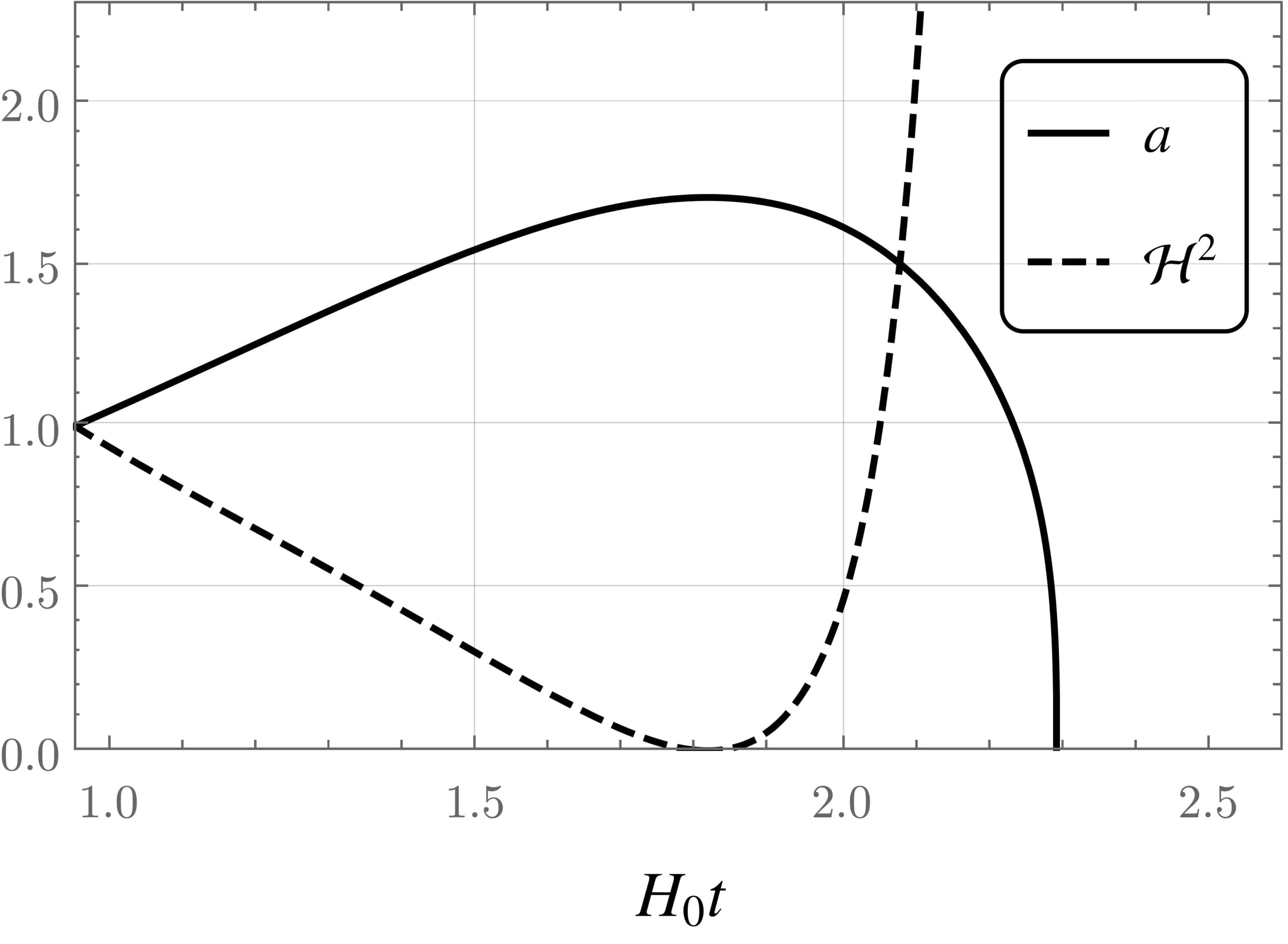
For one best-fit set of parameters, the cosmic scale factor grows to about 1.69 times its present value, reaches its maximum roughly 11 billion years from now and then reverses. Contraction ends when the model universe reaches a total age of 33.3 billion years. Subtract its current age of about 13.8 billion years and the Big Crunch lies approximately 20 billion years ahead.
Those numbers are not an official forecast from the Dark Energy Spectroscopic Instrument, or DESI. They are not an observed countdown. They are the output of one proposed physical model, evaluated at one benchmark point in a broad range of allowed parameters.
The distinction is the article.
Why endless expansion became the standard ending
For much of the 20th century, cosmologists expected gravity to slow the expansion that began with the Big Bang. Whether the universe would coast forever or eventually collapse appeared to depend largely on how much matter it contained.
That picture changed in 1998. Two teams using Type Ia supernovae found that the expansion was not slowing as expected but accelerating. The simplest explanation was a cosmological constant, represented by the Greek letter lambda, Λ, in Einstein’s equations.
ΛCDM, the standard model that combines that constant with cold dark matter, describes the dark-energy equation of state with the parameter w. A cosmological constant has w equal to minus one. Its effective density stays fixed even as every cubic megaparsec of space grows. Matter and radiation dilute, but Λ does not.
If Λ is positive and truly constant, it eventually overwhelms every component that thins with expansion. Structures already bound by gravity, such as a galaxy, do not expand internally. Unbound structures separate at an accelerating rate. Over inconceivably long times, the likely destination is a cold and sparse universe often called heat death, not a collapse.
That default rested on an economical model that has passed many tests, not on direct knowledge of what dark energy is. As Space Daily has noted in its survey of the 95 per cent of the cosmic budget labelled dark, neither dark energy nor dark matter has a confirmed physical identity.
DESI changed the question without deciding the answer
Dark energy cannot be placed in a laboratory container. Cosmologists study it by reconstructing how the universe expanded and how cosmic structure grew.
DESI uses galaxies and quasars to measure baryon acoustic oscillations, or BAO. These are the surviving imprints of sound waves that moved through the hot plasma of the early universe. Their known scale acts as a standard ruler at different epochs.
The DESI three-year analysis used more than 14 million galaxy and quasar tracers. DESI’s BAO results alone remained well described by a flat ΛCDM model. The tension appeared when the preferred parameters were compared and combined with cosmic-microwave-background and Type Ia supernova measurements.
A flexible model written as w0waCDM provided a better joint fit. Depending on which supernova compilation was included, the preference over ΛCDM ranged from 2.8 to 4.2 standard deviations. Space Daily’s earlier account of DESI’s evolving-dark-energy hint examined why the result attracted so much attention.
Even 4.2 sigma is below the five-sigma convention normally used before particle physicists and cosmologists claim a discovery. More importantly, the number changes with the supernova dataset and the model used to describe evolution. DESI measured distances. It did not measure an axion or a negative cosmological constant.
The evidence has continued to move. The full six-year Dark Energy Survey analysis released in 2026 found a 2.2-sigma departure from a cosmological constant using its own combined probes. Adding DESI BAO and primary CMB information raised various combinations into a range of roughly 2.3 to 3.2 sigma, which the collaboration described as a weak preference.
In July 2026, a more precise DESI analysis of the Lyman-alpha forest shifted toward ΛCDM. The collaboration said this could mean the evolving-dark-energy hints will fade, or that a more complex model will be needed to fit all measurements together. That is the current backdrop for any proposed cosmic ending.
How a positive field can conceal a negative constant
Hoang Nhan Luu, Yu-Cheng Qiu and Cornell physicist S.-H. Henry Tye developed what they call the axion dark-energy, or aDE, model. Their paper, published in the Journal of Cosmology and Astroparticle Physics, combines an ultralight axion-like field with Λ.
An axion is a hypothetical particle associated with a field. The version used here is not the better-known axion originally proposed to solve a problem in particle physics, and it is far lighter than common axion dark-matter candidates. The benchmark mass is about 2.93 times 10 to the minus 33 electronvolts, comparable to the present Hubble expansion scale.
While cosmic expansion is rapid compared with that tiny mass scale, friction from the expansion holds the field almost stationary high on its potential. A nearly frozen field has pressure and density resembling dark energy with w near minus one. Later it begins to roll toward the bottom.
The surprising part of the benchmark is the accounting. Expressed relative to today’s critical density, the axion field contributes about positive 2.33 while the cosmological constant contributes minus 1.61. They add to positive 0.72, approximately the total dark-energy fraction required today.
These are not claims that 233 per cent and minus 161 per cent can be independently inventoried. The components are internal terms in the model whose large positive and negative values cancel. That cancellation lets the universe accelerate now while preserving a negative vacuum underneath.
As the axion field rolls and begins to oscillate, its energy becomes increasingly matter-like. Matter density falls with the cube of the scale factor. The negative cosmological constant does not dilute. Once enough positive energy has faded, the balance controlling expansion changes sign.
The turnaround begins when the Hubble rate reaches zero
The team numerically evolved the benchmark model forward from the present. The scale factor, conventionally set to one today, continued rising until it reached approximately 1.69. At the same point, about 11 billion years from now, the Hubble parameter fell to zero.
A zero Hubble parameter means the overall expansion has stopped at that instant. It does not mean every galaxy freezes in place or every local orbit stops. The Hubble rate describes the average scale of the homogeneous universe. Galaxies, clusters and other bound structures have their own motions.
After the maximum, the Hubble parameter becomes negative. The scale factor shrinks and matter grows denser. The calculation is stopped numerically when the scale factor falls to one-thousandth of its present value, close enough to the singular end that changing the cutoff makes no meaningful difference at the quoted precision.
The resulting total lifespan is 33.3 billion years. Because 13.8 billion years have already elapsed, roughly 19.5 billion remain, conventionally rounded to about 20 billion. The contraction begins much sooner, in 11 billion years, and occupies only about a quarter of the model universe’s total lifetime.
The crunching phase is not a film of cosmic history played backward. The axion’s motion and changing energy make the evolution asymmetric. The model says how its scale factor behaves; it does not supply a tested quantum theory of the final singularity.
The 33.3-billion-year lifespan is a benchmark, not a measured deadline
The authors are explicit about the uncertainty. Their aDE parameter space is highly degenerate, meaning substantially different combinations can fit current observations. The best-fit negative cosmological-constant value lies well away from the mean of its skewed probability distribution.
At the mean values quoted in the paper, the model universe lasts 40.3 billion years rather than 33.3 billion. A zero cosmological constant also remained consistent with the data used in the analysis, even though negative values produced a better fit in the chosen region. If Λ were zero rather than negative, this particular route to a Big Crunch would disappear.
There is another boundary. The benchmark parameters came primarily from fitting the authors’ aDE model to Dark Energy Survey BAO and supernova data together with constraints from the CMB, primordial nucleosynthesis and cosmic age. They compared the resulting curve with DESI’s binned equation-of-state information. This is not the same as a full official DESI fit establishing the aDE model or the 33.3-billion-year lifetime.
The recent Space Daily feature on why ACT still supports a 13.8-billion-year-old universe makes a parallel point about model inference. A time derived inside a cosmological model can be rigorous and useful, but the number inherits the assumptions and uncertainties of that model. Here the extrapolation is more extreme because observations cover the past and present while the calculation projects tens of billions of years beyond them.
Evolving dark energy does not automatically mean a Big Crunch
Suppose future observations establish that w changes with time. That discovery would be profound, but it would not select one ending by itself.
A dynamical field might settle at a small positive energy, preserving endless acceleration. It might decay toward zero, leaving expansion to continue at a slowing rate. A negative residual vacuum energy can force recollapse, as it does in the Cornell-led benchmark. A more exotic component with w below minus one could instead increase in density and produce a Big Rip.
Even the popular w0wa parameterisation used to quantify the current hint is mainly a convenient description of recent expansion history. Extrapolating that two-parameter curve arbitrarily far into the future is not a physical theory. A particle model supplies dynamics, but many particle models can pass through similar values of w during the limited period observations sample.
That is why the Big Crunch is one model consistent with the hints, not the fate implied by the hints.
There is useful historical perspective in Space Daily’s 2002 report that a different scalar-field model could reverse a runaway universe on a similarly humanly comprehensible cosmological timescale. That work and the new aDE calculation use different data and dynamics. Together they show that accelerated expansion has never logically guaranteed eternal expansion unless the agent causing it remains positive and stable forever.
The observations will change long before the universe does
The decisive work is not another calculation at the same benchmark. It is better measurement of dark energy across cosmic time.
DESI has completed its main five-year observing programme, with a full dark-energy analysis expected after its final data processing. Euclid is surveying the geometry and growth of structure from space. The Vera C. Rubin Observatory will build an enormous time-domain and weak-lensing dataset. NASA’s Roman Space Telescope is designed to measure supernovae, galaxy clustering and weak lensing with a different instrument and selection effects.
Agreement among standard rulers, standard candles, gravitational lensing, galaxy clustering and the CMB will matter more than the most dramatic number from any one combination. So will systematic checks of low-redshift supernova calibration, which currently changes the apparent significance of evolving dark energy.
The Cornell-led model is valuable because it translates a hidden negative Λ into a concrete, calculable history. It shows how a universe can accelerate today, grow for another 11 billion years and still end in a crunch about 20 billion years from now. That makes the assumptions testable.
It does not make the ending scheduled.