

The universe may contain unresolved tensions, but its age is not currently split between two equally supported clocks.
The Atacama Cosmology Telescope’s final measurements of the cosmic microwave background fit a universe about 13.8 billion years old. They agree with the European Space Agency’s Planck satellite and sit inside a much larger web of evidence connecting primordial light, galaxy clustering, light-element abundances and cosmic expansion.
The alternative figure, 26.7 billion years, comes from a very different exercise. Rajendra Gupta, an adjunct professor of physics at the University of Ottawa, changed the model used to convert redshift into distance and time. He combined an expanding universe with a tired-light effect and allowed several quantities normally treated as physical constants to vary together.
Gupta’s proposal was published in a peer-reviewed journal. It is therefore worth explaining accurately. Peer review does not mean that two cosmic ages now stand on equal observational ground. The 26.7-billion-year figure is the output of one unconventional model, not a second direct measurement of the universe’s birthday.
ACT photographed a pattern, not an age label
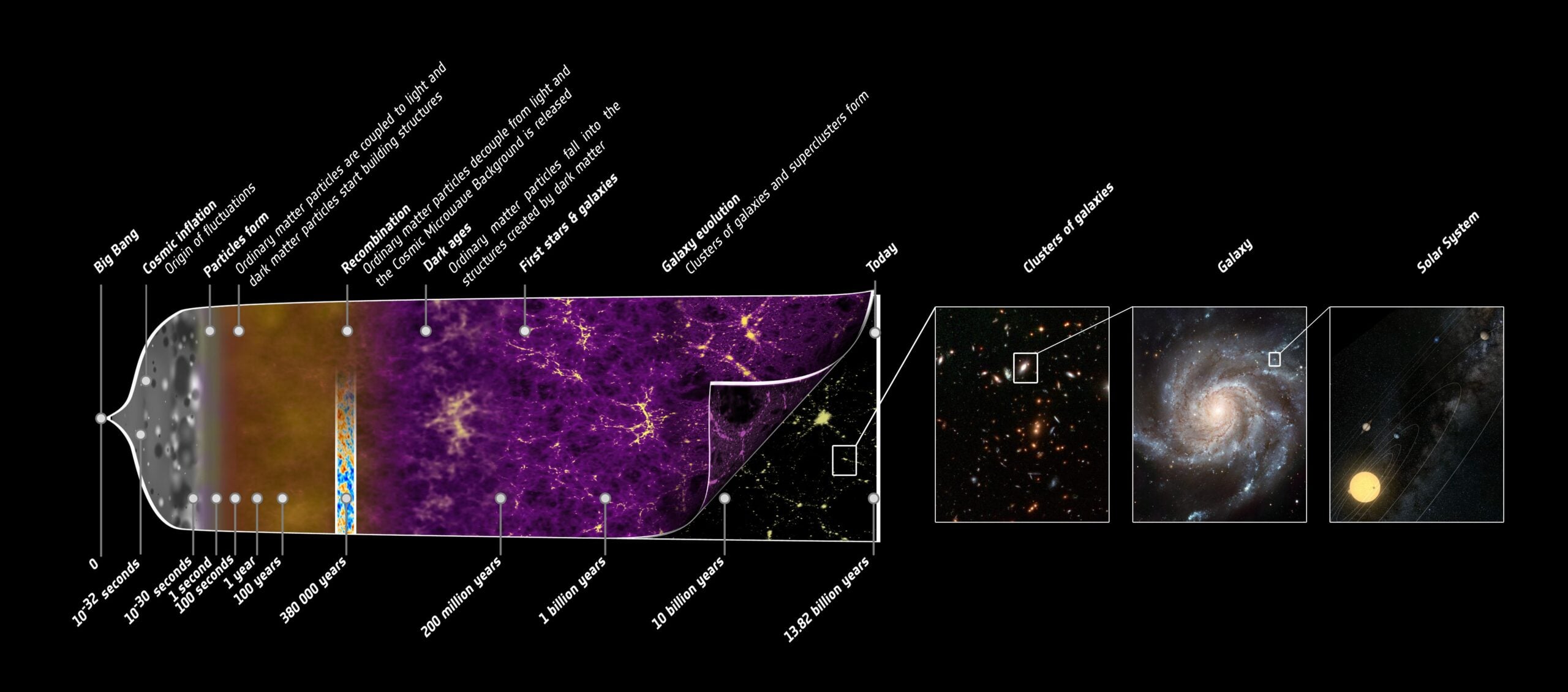
The oldest light accessible to ordinary telescopes is the cosmic microwave background, or CMB. It was released when the universe was roughly 380,000 years old, after the primordial plasma cooled enough for electrons to bind to nuclei. Space became transparent, allowing photons to travel freely rather than scatter constantly from charged particles.
Those photons have since been stretched into microwaves. Their average temperature is now about 2.7 kelvins, but they are not perfectly uniform. Tiny variations mark regions that were slightly denser or thinner than average. Gravity eventually amplified those initial differences into the large-scale structure of galaxies and clusters.
The six-metre Atacama Cosmology Telescope operated high in the Chilean Andes from 2007 until 2022. Its final release mapped 19,000 square degrees in frequency bands centred on 98, 150 and 220 gigahertz. The instrument measured temperature and polarisation, including a faint directional signal that reveals how the early plasma moved.
In March 2025, the collaboration released what Princeton described as its clearest images of the infant universe. ACT had about five times Planck’s angular resolution and lower polarisation noise over the scales it targeted. That allowed it to follow the microwave background’s acoustic pattern into finer detail.
Yet no part of that map literally says “13.8 billion years”. The age comes from asking which combination of ingredients and expansion history would produce the observed pattern today.
The acoustic peaks turn early sound into a cosmic clock
Before recombination, ordinary matter and radiation formed a coupled plasma. Gravity pulled material into denser regions while radiation pressure resisted compression. The result was a set of sound waves moving through the young universe. Recombination stopped that motion and preserved a snapshot of it in the CMB.
Cosmologists describe the pattern using angular power spectra. Rather than concentrating on one hot or cold patch, they measure how strongly temperature and polarisation vary across different angular scales. The sequence of peaks is sensitive to the density of ordinary matter, the density of dark matter, the geometry of space and the distance the CMB light has travelled.
The ACT DR6 power-spectrum analysis found that the standard six-parameter Lambda cold-dark-matter model, abbreviated ΛCDM, described the measurements well. ACT’s results were consistent whether compared with Planck or combined with the earlier WMAP satellite, and whether much of the information came from temperature or polarisation.
Adding CMB lensing and the first-year baryon-acoustic-oscillation measurements from DESI produced a Hubble constant of 68.22 plus or minus 0.36 kilometres per second per megaparsec. The combined fit retained an age close to 13.8 billion years. Princeton’s public summary put the uncertainty on that age at about 0.1 per cent.
Space Daily’s recent explanation of how a 13.8-billion-year-old universe can be about 93 billion light-years across deals with a related consequence. The age is elapsed cosmic time in the fitted expansion history. The observable diameter includes the continuing expansion of space while ancient light travelled toward Earth.
Model dependence does not mean the number is freely chosen
It is fair to say that 13.8 billion years is model-dependent. ACT did not date a rock or watch a clock run from the Big Bang. Researchers inferred parameters by fitting data within ΛCDM, a framework that assumes general relativity on cosmic scales, a nearly flat universe, cold dark matter and dark energy behaving as a cosmological constant.
That qualification is important, but “model-dependent” does not mean arbitrary. The same small set of parameters must reproduce the positions and relative heights of several acoustic peaks, polarisation patterns, gravitational lensing and the damping of fluctuations at small scales. It must also remain compatible with measurements that were not all taken by the same instrument.
The independent checks include primordial helium and deuterium produced during Big Bang nucleosynthesis, the standard-ruler pattern preserved in galaxy clustering, supernova distances and the growth of structure. The model has known problems and tensions, but it succeeds across phenomena spanning more than 13 billion years.
ACT’s separate analysis of extensions to ΛCDM searched for departures including early dark energy, modified recombination, extra relativistic particles and early variation in fundamental constants. It found no statistically significant preference for leaving the baseline model.
That does not prove ΛCDM is the final description of the universe. It means a proposed replacement has to explain an unusually large body of mutually connected measurements, not just one puzzling population of galaxies.
Gupta reaches 26.7 billion years by changing two assumptions
Gupta’s 2023 paper in Monthly Notices of the Royal Astronomical Society combined two ideas. The first was tired light, originally proposed in 1929 by Fritz Zwicky. In its simplest form, tired light says photons gradually lose energy while travelling, shifting toward redder wavelengths without requiring all of that redshift to come from the expansion of space.
The second was Gupta’s covarying coupling constants framework. In this model, the speed of light, gravitational constant, Planck constant and Boltzmann constant change together over cosmic time in a prescribed relationship. Altering those quantities modifies the equations that connect density, expansion and age.
Gupta did not propose a static tired-light universe. He created a hybrid, labelled CCC+TL, in which cosmic expansion and tired light both contribute to the observed redshift. He fitted parameters using the Pantheon+ catalogue of Type Ia supernovae, then applied the resulting redshift-time relation to the early universe.
The altered relation provides much more time at a given high redshift. The model’s present age becomes 26.7 billion years, about 1.93 times the standard value. An object seen at redshift 10 or 15 is still extremely remote and early relative to today, but it is no longer confined to the first few hundred million years in the same way.
The University of Ottawa’s account of the proposal emphasised that added formation time. The number is therefore not based on finding a 26-billion-year-old star. It emerges after the cosmological conversion from redshift to time has been rewritten.
Webb supplied a real puzzle, but not an independent cosmic age
The motivation was not invented. Webb’s early deep-field observations found more bright galaxies at high redshift than many pre-launch forecasts expected. Several appeared massive, chemically enriched or structurally organised at epochs when standard models left little time for them to develop.
As Space Daily discussed in its overview of four years of unexpectedly productive early galaxies, the immediate pressure falls on galaxy-formation physics within ΛCDM. Gas may have formed stars more efficiently in dense early environments. Bursty star formation can make a small galaxy unusually bright. Dust and strong emission lines can imitate the colours used to select distant objects. Light from an accreting black hole can be mistaken for stellar mass.
The first wave of Webb claims also relied heavily on photometric redshifts, which infer distance from colours. Spectroscopy later moved some extreme candidates much closer. It confirmed others as genuinely early, preserving the broader problem while changing individual masses and number counts.
Even for a securely measured redshift, age and stellar mass require population models. Astronomers choose a star-formation history, dust law, chemical composition and distribution of stellar masses, then calculate which mixture best reproduces the spectrum. A galaxy described as “mature” has features that models associate with substantial prior evolution. It is not carrying a model-independent birth certificate.
NASA’s current Webb overview takes the restrained position: the observations have exposed processes that still need explanation, but have not contradicted the current best cosmological models. That statement may change with evidence, but it captures the distinction between revising galaxy physics and doubling cosmic age.
Tired light has to survive observations of time itself
The most direct difficulty for tired light is cosmological time dilation. If space expands while a distant supernova emits light, the interval between arriving photons is stretched along with their wavelength. An event at redshift z should appear slowed by a factor of one plus z.
A simple photon-energy-loss process produces redshift without automatically stretching the event’s duration. Observations do show the expected dilation. A Dark Energy Survey analysis of about 1,500 Type Ia supernovae measured it across redshifts from roughly 0.1 to 1.2. Quasar variability and spectral evolution offer additional tests at greater distances.
Gupta’s model retains expansion, so it is not ruled out by the same one-line argument used against a purely static tired-light universe. But the hybrid creates a quantitative obligation. If only part of the redshift comes from expansion, the model must still reproduce how much time dilation is observed at each redshift while fitting supernova brightness, CMB structure and galaxy sizes.
Covarying constants face a different set of constraints. Atomic spectra from distant quasars, the operation of nuclear reactions, primordial nucleosynthesis and the CMB all respond to changes in fundamental physics. ACT’s null result for early variation does not constitute a dedicated fit of every detail in CCC+TL. It does show that high-precision oldest-light data leave limited room for broad changes.
There is also no published demonstration that the 26.7-billion-year model fits ACT DR6’s full temperature and polarisation spectra, the DESI acoustic scale, nucleosynthesis and modern time-dilation data at a level competitive with ΛCDM. Fitting selected datasets is the beginning of that comparison, not the end.
The standard model can be troubled without being twice the wrong age
None of this turns present cosmology into a closed case. Local measurements of the Hubble constant remain higher than the value inferred from the early universe under ΛCDM. DESI has strengthened hints that dark energy may evolve rather than remain constant. Space Daily has separately examined that evidence from nearly 15 million galaxies and quasars.
Those tensions matter because the age depends on the expansion history. A future model that resolves them could shift the inferred number. A small change, however, is not the same as a doubling. Reaching 26.7 billion years requires a substantially different account of redshift and the laws governing cosmic evolution.
The responsible comparison is therefore asymmetric. ACT’s 13.8-billion-year result is an inference within a model, but that model has survived detailed tests across many independent observations. Gupta’s 26.7-billion-year result is also an inference within a model, one constructed partly to give early galaxies more time, but it has not reproduced the same observational network with comparable precision.
Webb has made the young universe look busier, brighter and more chemically developed than many astronomers expected. ACT has simultaneously shown that the oldest observable light remains strikingly consistent with a 13.8-billion-year cosmic history. Holding those findings together does not require pretending that one of them is unreal. It requires locating the uncertainty in the right place.
For now, the harder question is not whether a mature-looking galaxy can overrule the microwave background. It is how stars, gas and black holes assembled so quickly inside the time that the microwave background, expansion and large-scale structure jointly allow.