
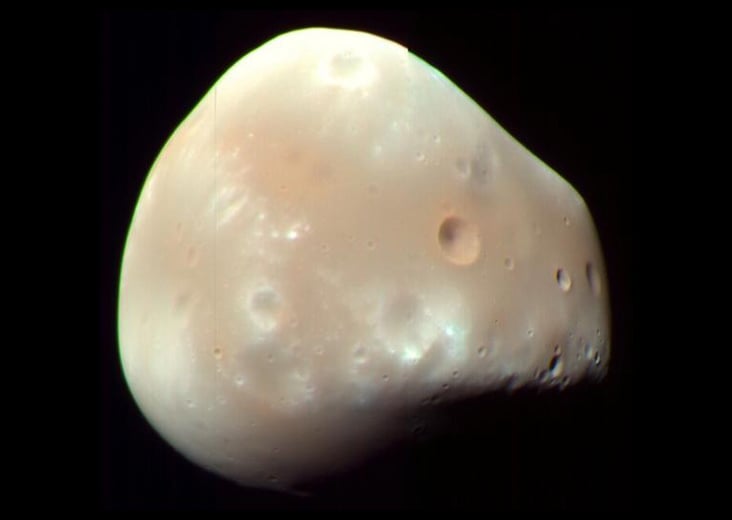
Deimos has the surface of a world that seems to have been gently dusted over and the silhouette of one that almost came apart.
Mars’s smaller, outer moon is only about 12 kilometres in diameter. A broad depression at its south pole spans roughly 10 kilometres, yet much of the remaining terrain looks strangely smooth. Old craters are shallow, plains are muted and bright streaks run downslope through a thick layer of loose material.
A study published in Nature Astronomy on August 18, 2026 proposes that the apparent contradiction has one cause. A 320-metre asteroid struck the south polar region at an oblique angle, excavating the enormous cavity while throwing debris around the entire moon. Most of that material fell back. The same collision that made Deimos’s largest wound may have buried its older scars.
Reproducing both effects required a target that was exceptionally weak, porous and able to absorb a shock by crushing its internal voids. The simulations suggest Deimos is not a miniature solid boulder. Mechanically, it resembles the rubble-pile asteroids Bennu, Ryugu and Dimorphos.
The depression is almost as wide as Deimos
Phobos, Mars’s inner moon, is about 22 kilometres wide and visibly battered by craters and grooves. Deimos is roughly half that diameter, more rounded and covered by fine regolith. Its dominant landform is a shallow bowl at the south pole about 10 kilometres from rim to rim and only a few hundred metres deep.
Sabina Raducan of the University of Bern and her colleagues began with a three-dimensional shape model resolving features at scales of about 100 metres. They computationally filled the missing volume of the depression to create a plausible pre-impact moon, then used the Bern smoothed-particle hydrodynamics code to strike that reconstructed body under different conditions.
The projectiles ranged from 300 to 360 metres across. Impact angles extended from 60 degrees on one side of vertical to 60 degrees on the other, with different lateral offsets to reproduce the cavity’s asymmetry. The assumed speed was 8.2 kilometres per second, an estimated average impact velocity at Deimos.
Two independent comparisons converged on the same answer: an asteroid 320 ± 25 metres in diameter, arriving about 45 ± 15 degrees from the local surface normal and offset laterally by 2.0 ± 0.5 kilometres. The best run reproduced the observed cross-sectional profiles with an average vertical mismatch of only about two metres.
A more central or head-on blow left the wrong shape. Larger projectiles delivered enough energy to fragment Deimos completely in some runs. The preferred event sits just below that threshold, a subcatastrophic collision violent enough to remodel the moon while leaving it in one gravitationally connected piece.
The debris did not simply escape
A tiny body’s gravity changes the meaning of an impact. Material can travel around the world on long, slow arcs, and a crater can keep collapsing long after an equivalent structure on a larger, stronger body would have stabilized.
The team evolved each main simulation for eight hours, allowing the cavity to open and ejecta either to escape or return. In the best-fitting case, no more than about 1% of Deimos’s mass reached escape speed. Between 10 and 20% was redistributed over the surface.
The fallback formed a blanket at least several metres thick globally and up to about 200 metres thick on the Mars-facing hemisphere. The asymmetric strike preferentially launched debris in that direction, although the moon’s exact orientation at the unknown time of impact changes the detailed pattern.
Crater measurements support a similarly deep burial. The researchers identified 14 craters wider than 450 metres. Their systematically shallow profiles imply that older structures sit beneath roughly 100 to 150 metres of regolith, consistent with a global debris layer near 120 metres.
This gives one event enough reach to explain several features at once: the south-polar cavity, subdued plains, infilled craters, a bright ring around the depression and streamers where loose material appears to have moved downslope.
A crater wall becomes a strength test
The south-polar feature is surprisingly shallow for its width. In the model, its final shape depended less on the initial excavation than on what happened next. Weak crater rims collapsed inward and rubble slumped into the bowl. Stronger material retained steep walls and a deeper cavity that does not resemble Deimos.
The preferred simulations used surface cohesion around one pascal. At 100 pascals, the crater remained roughly 300 metres deep with walls that were too steep. The methods analysis concludes that the regolith may possess only a few pascals of cohesion, although the numerical resolution prevents a finer estimate.
Lunar regolith, by comparison, has cohesion on the order of kilopascals. Deimos’s upper layer behaves less like compacted lunar soil and more like an extremely loose granular aggregate. Its average surface slope is about 10 degrees, with a maximum near 35 degrees, comparable with the angles found on small asteroids.
Half-empty rock can survive by crushing
Deimos’s low bulk density supplies another clue. The best current estimate is about 1,465 ± 51 kilograms per cubic metre. Depending on the assumed grain material, that corresponds to roughly 40–50% porosity. A large fraction of the moon’s volume may be empty space between and within fragments.
Porosity does more than lower density. Under impact pressure, voids collapse. That compaction consumes energy that would otherwise travel through the moon as a destructive shock.
ESA’s Hera spacecraft supplied a useful test when it passed Deimos during a March 2025 Mars gravity assist. As SpaceDaily reported after the flyby, Hera imaged the moon’s less-seen far side from about 1,000 kilometres away. The new views revealed a roughly three-kilometre circular depression that appears to predate the proposed south-polar strike.
The researchers placed a comparable older feature into their simulated pre-impact shape. A stiff lunar-regolith analogue transmitted the shock efficiently and erased it. An intermediate sand-like interior damaged it. A highly porous, easily crushed analogue absorbed enough energy for the depression to survive recognizably.
That preservation is why “rubble pile” is more than a visual metaphor here. Deimos appears dissipative: a pressure wave spends itself compacting gaps rather than breaking a coherent monolith from one side to the other.
The impact fits the orbit that remains
A collision large enough to excavate most of a moon’s width should also change the way that moon moves. The researchers therefore checked whether their preferred event was compatible with Deimos’s present orbit and synchronous rotation.
Ejecta recoil amplified the projectile’s push by a factor between 1.7 and 2.6 in the simulations. Even at the upper end, the resulting velocity change was about 35 centimetres per second, small beside Deimos’s orbital speed of 1.35 kilometres per second. The maximum predicted changes to eccentricity and inclination remain compatible with the orbit observed today.
The impact would have delivered torque and could briefly have made Deimos librate or tumble. Mars’s tides should have damped that disturbance and restored synchronous rotation within roughly 200 to 20,000 years, a moment compared with Solar System history.
This contrasts usefully with Mars’s other moon. SpaceDaily recently examined how Phobos is spiralling inward and may eventually be torn apart. Deimos is farther out and slowly moving away. The proposed impact could scar and resurface it without changing that broader tidal destiny.
Dimorphos showed what weak bodies do under impact
The comparison with Dimorphos is especially close. NASA deliberately hit the 150-metre asteroid moonlet with the DART spacecraft in 2022. Subsequent models suggested the target was so weak that the impact may have deformed much of the body instead of carving a conventional, contained crater.
SpaceDaily’s earlier report on the possible global reshaping of Dimorphos described it as a rubble pile held together mainly by feeble gravity. Several authors of that work also contributed to the Deimos study. The same modelling tools now connect an observed collision at one asteroid moon with a hypothesized ancient collision at a Martian moon.
There is an important difference. DART was a spacecraft roughly half a tonne in mass, while the Deimos projectile was a natural asteroid hundreds of metres wide. The parallel lies in the target response. When gravity and cohesion are both tiny, ejecta recoil, whole-body deformation, reaccretion and pore crushing can matter as much as the initial hole.
Rubble pile does not mean captured asteroid
Phobos and Deimos are dark, irregular and superficially asteroid-like. One long-standing origin story makes them captured objects from the asteroid belt. Another forms them from debris placed in orbit when a large impact struck ancient Mars.
The new result does not decide between those histories. Mechanical state is not a birth certificate. A moon assembled from Martian impact debris could be fragmented, repeatedly battered and porous enough to behave like Bennu or Ryugu billions of years later. The paper’s broader suggestion is that small dark moons and asteroids may converge on similar physical structures even when their origins differ.
Nor does one successful simulation prove that one impact did everything. Ejecta exchanged with Phobos or Mars, fallout from a disrupted precursor moon, ordinary impact gardening, seismic shaking and thermal cycling may all have helped smooth Deimos. The numerical runs follow only the first eight to ten hours after the proposed collision, not its long geological afterlife.
The hypothesis is testable. Future high-resolution images and topographic maps can look for the asymmetric signature of an oblique south-polar impact. Better crater depth measurements can test the predicted global ejecta thickness, while spectral mapping can check whether bright rings and streaks follow the modelled paths of reworked material.
For now, the study offers an economical explanation for Deimos’s strangest combination. Its smoothness may not mean it escaped violence. It may be what violence looks like on a moon loose enough to catch most of itself when the debris falls home.