

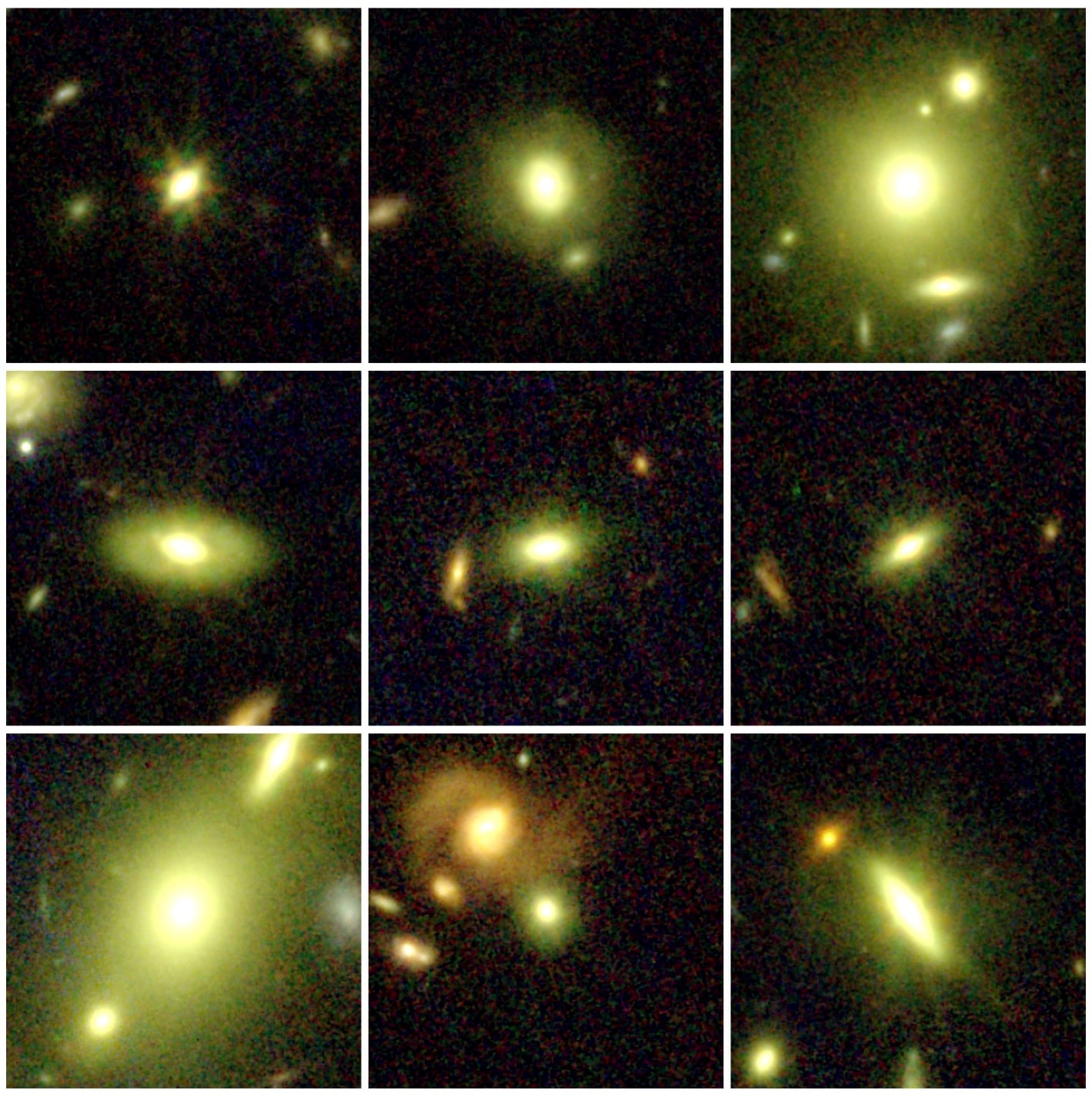
A galaxy can hide most of its stellar weight in the stars that contribute least to its light.
That is the unsettling result of a new James Webb Space Telescope study of nine massive, quiescent galaxies. Their exceptionally deep spectra contain the faint collective fingerprints of far more low-mass stars than astronomers would expect if these systems were scaled-up versions of the Milky Way. In the oldest case, the inferred stellar population could make the galaxy’s early progenitor roughly four times more massive than estimates based on the usual assumption.
The finding, published in Nature Astronomy on August 18, 2026, sharpens one of Webb’s most persistent puzzles. Massive galaxies already appear to have assembled remarkably quickly in the young universe. If some of them also concealed an enormous population of small, dim stars, the amount of matter they turned into stars may have been substantially underestimated.
There is an important timing distinction. Webb did not directly count dwarf stars inside a galaxy photographed during the first 1.5 billion years after the Big Bang. The telescope observed later descendants at a redshift of about 0.7, seen as they were roughly seven billion years ago. The oldest system contains stars whose formation history reaches back to the early universe. The fourfold figure is the implication for that earlier progenitor if the measured stellar population was built during its ancient formation episode.
Light is an imperfect scale
For a nearby star, astronomers can measure brightness, temperature and motion, then estimate its mass. A distant galaxy is different. Even Webb usually sees its stars blended into one unresolved glow. Researchers divide that glow into a spectrum and compare it with synthetic populations containing different ages, elements and mixtures of stellar masses.
The hidden assumption is called the initial mass function, or IMF. It describes the relative numbers of stars born at different masses. In the Milky Way, low-mass stars greatly outnumber Sun-like and massive stars. They live for a very long time and retain much of a galaxy’s stellar mass, but each one is faint. A small number of luminous giants can therefore dominate the light while a much larger population of dim stars carries the weight.
When astronomers estimate the mass of a remote galaxy, they normally extrapolate below what the telescope can easily detect using a Milky Way-like IMF. That is reasonable as a baseline, but it is not a directly observed law of nature. If another galaxy formed proportionally more small stars, the same amount of light would correspond to much more mass.
Webb found the dwarf stars through absorption, not photographs
The international team, led by Chloe Cheng and Mariska Kriek of Leiden University, selected massive galaxies that had already stopped making significant numbers of new stars. That quiescence matters. The intense ultraviolet output, glowing gas and dust of active star formation can drown out the quiet spectral details needed to study an old low-mass population.
The JWST-IMFERNO program used NIRSpec’s microshutter array to collect extremely deep near-infrared spectra. Researchers combined them with bluer optical spectra from the Very Large Telescope’s Large Early Galaxy Astrophysics Census, or LEGA-C. Together the observations covered subtle absorption features that respond to the balance of stellar masses, including sodium lines, the calcium triplet and the iron-hydride Wing-Ford band.
None is a simple dwarf-star counter. The strength of an absorption feature can also change with stellar age and chemical composition. The team therefore fitted broad stretches of each spectrum at once, allowing the age, 18 elemental abundances and two low-mass slopes of the IMF to vary. They also tested a more complicated two-burst star-formation history and obtained results consistent with the simpler single-age model.
Several galaxies preferred what astronomers call a bottom-heavy IMF: a distribution weighted more strongly toward low-mass stars than the Milky Way’s. The researchers compared the effect to houses hidden behind a city’s skyscrapers. The bright stars announce the galaxy from a distance, but the far more numerous small stars determine how much structure is really there.
The oldest system carries the largest early-universe consequence
The paper describes the mass excess through an IMF mismatch parameter. This compares the mass-to-light ratio from the freely fitted IMF with the ratio obtained by forcing the galaxy to have a Milky Way IMF. Because the observed luminosity is unchanged, a higher ratio translates directly into more inferred stellar mass.
The oldest galaxy in the sample has a formation redshift above five. In ordinary terms, its main stellar population appears to have formed when the universe was less than about 1.5 billion years old. The peer-reviewed paper estimates that applying its measured bottom-heavy IMF to the early progenitor would raise that progenitor’s stellar mass by a factor of approximately 4, with an uncertainty of about 1.
The preprint discussed the two oldest systems as plausible direct descendants of the massive, apparently mature galaxies Webb has revealed at early epochs. This is a form of galactic archaeology. Astronomers are reading a population that survived and aged, then using it to reconstruct the system that formed those stars billions of years earlier.
That approach is powerful precisely because low-mass stars endure. It is also indirect. The study does not show that every star now present was already in place at the earliest possible formation time, and it does not measure the IMF of a cosmic-dawn galaxy in situ. The authors’ next goal is to push the technique to earlier observed redshifts.
A second scale supports most of the added mass
A spectral model that adds faint stars should face an independent check: does the galaxy possess enough gravity to contain them?
The researchers compared their stellar masses with virial masses inferred from each galaxy’s size and the speeds of its stars. Under a Milky Way IMF, the mismatch between stellar and virial mass became larger in the more massive systems. Correcting for the measured IMF generally brought the two estimates into agreement. The revised stellar masses did not exceed the virial masses within the uncertainties for most of the sample.
One galaxy, catalogued as 1158527, was an outlier. Its fitted mass excess was exceptionally large, but its virial estimate may be too low if the object is a nearly face-on disc whose line-of-sight stellar speeds do not capture its full gravitational support. The paper treats that case cautiously rather than using it as the central evidence.
The comparison also probes only the compact central regions represented by the measurements. With a median effective radius of about 5.4 kiloparsecs, those regions are expected to be dominated by stars. Agreement there does not mean the galaxies contain no dark matter or gas farther out.
Four times heavier is not a correction for every Webb galaxy
The result applies to a deliberately selected sample of nine massive, quiet galaxies. It does not establish a universal IMF for the early universe, and the factor of four should not be multiplied across Webb’s galaxy catalog.
In fact, other observations and models have pointed in the opposite direction for some young, actively star-forming systems. A top-heavy IMF, with proportionally more massive luminous stars, would produce more light per unit of stellar mass and could reduce some early-galaxy mass estimates. Both patterns may be real if the IMF depends on density, pressure, temperature, metal content or the mode of star formation.
That tension is scientifically useful. The question is no longer only whether astronomers chose the correct universal conversion between light and mass. It may be whether a universal conversion exists at all.
The galaxy-formation puzzle becomes more specific
SpaceDaily’s recent look at four years of Webb early-galaxy results separated two related problems. Some early galaxies are brighter and more numerous than pre-Webb forecasts. A smaller set also appears to contain surprising amounts of stellar mass or to have stopped forming stars unusually soon.
Extra low-mass stars bear most directly on the second problem. Dwarf stars are poor light producers, so a bottom-heavy IMF requires more gas to be locked into stars to create the observed spectrum. A formation model must then assemble a sufficiently massive dark-matter halo, deliver and cool the gas, convert it into stars with high efficiency, and produce an unusual mass distribution before feedback from radiation, winds, supernovae and black holes shuts the process down.
The result does not identify which step is missing from current simulations. It could point to poorly modelled fragmentation in the dense birth clouds of massive galaxies. It might reveal an IMF that changes with environment. Or the descendants selected for this study could represent an uncommon formation channel rather than the normal route taken by early galaxies.
No galaxy is older than the universe in this result
The phrase “formed early” can easily be confused with “observed early.” As SpaceDaily has explained in its guide to Webb’s apparent age paradoxes, redshift tells astronomers when the observed light left a galaxy, while population models estimate when its stars formed. Those are different points on one valid cosmic timeline.
Here the galaxies are observed at redshift about 0.7, long after their oldest stars formed. The ancient formation history fits inside the universe’s 13.8-billion-year age. What is difficult is not finding extra time. It is explaining how a young cosmos converted so much material into long-lived stars so efficiently.
The study therefore presses on the astrophysics of galaxy formation, not on the foundations of the Big Bang by itself. It does not overturn the standard cosmological model, and it does not prove that all early mass estimates were wrong in the same direction.
Its contribution is narrower and, for galaxy models, potentially more troublesome. Webb has made the faint stars visible without resolving them one by one. If the bottom-heavy signature survives larger samples and reaches galaxies observed closer to cosmic dawn, some of the first giants were not merely brighter and faster-growing than expected. They were carrying much more hidden weight all along.