

At 18:17 UTC on 22 September 2021, a pattern of light appeared inside a cubic kilometre of instrumented Antarctic ice. The IceCube Neutrino Observatory reconstructed it as a track left by a high-energy neutrino candidate and sent an alert to observatories around the world.
The event, IC 210922A, carried an estimated energy of about 750 teraelectronvolts. It did not arrive with a photograph of its birthplace. IceCube could provide a direction and an uncertainty region, leaving astronomers to search that part of the sky for something capable of launching such an elusive particle.
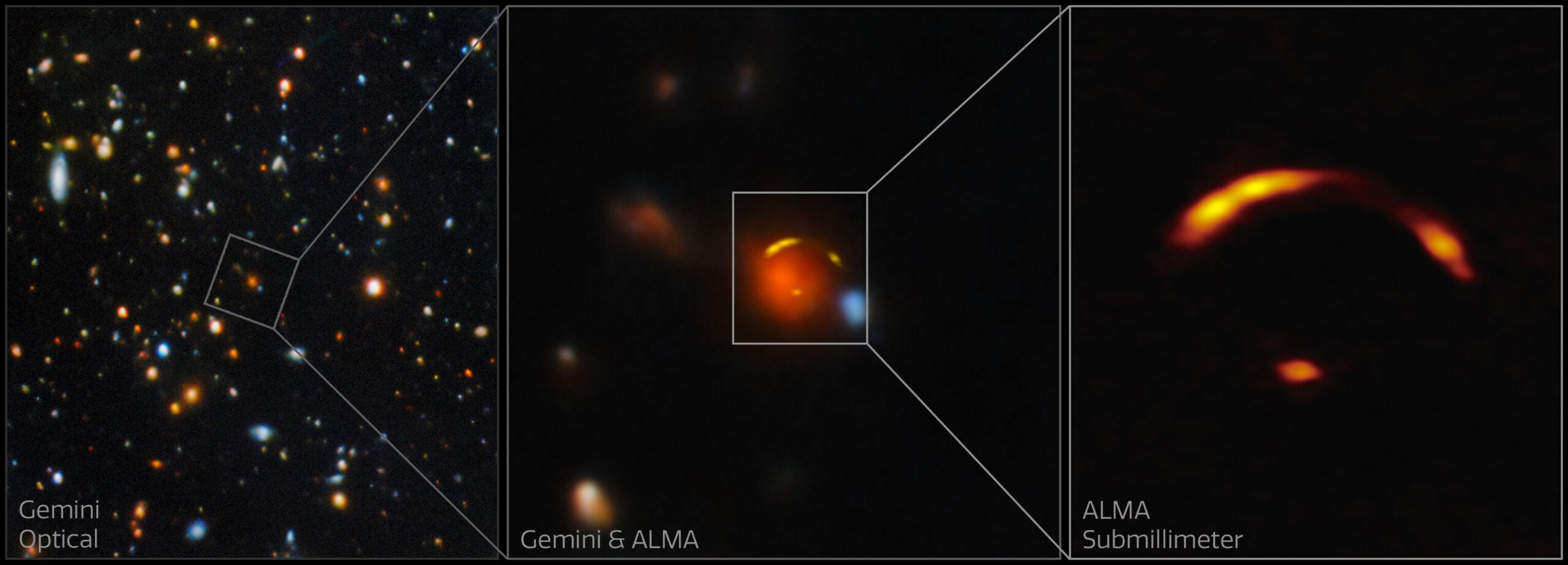
Nearly five years later, a team led by Yuji Urata reported its best candidate: JCMT0402−0424, a dust-obscured starburst seen as it was roughly 11 billion years ago. The team nicknamed it Shadow Blaster. A closer galaxy happens to stand almost directly in front of it, bending and magnifying its light into four yellow arcs.
The study published in Nature Astronomy in June 2026 describes Shadow Blaster as the most plausible electromagnetic counterpart candidate within the IceCube localization. Candidate is doing important work in that sentence. The researchers have assembled an unusually suggestive alignment, not proved the origin of this individual neutrino.
This is one study, not settled consensus. Its real achievement is to connect one well-observed particle alert with a type of distant, dusty galaxy that may have been undercounted in the search for cosmic neutrino sources.
IceCube detected a direction, not a photograph
Neutrinos have no electric charge and interact only weakly with ordinary matter. That makes them excellent astronomical messengers. They can escape dense environments that absorb light and travel through stars, planets and interstellar material without being deflected by magnetic fields. It also makes them exceptionally difficult to detect.
IceCube turns the clear ice beneath the South Pole into both target and viewing medium. Its 5,160 digital optical modules are attached to 86 strings descending as far as 2.45 kilometres below the surface. When a neutrino happens to interact in or near the detector, it can create a charged particle moving through the ice faster than light travels through that material. The result is a faint cone of blue Cherenkov radiation.
By comparing when that light reaches different sensors, researchers reconstruct the particle’s track. SpaceDaily has previously looked inside this unusual instrument and explained how Antarctic ice becomes a telescope for particles passing through Earth.
IC 210922A was a track-like event, the useful kind for pointing because its charged secondary leaves a comparatively long trail. Even so, IceCube’s position was not a celestial street address. The original alert and follow-up record gave a 90 per cent containment region with an area of about 1.2 square degrees. That is roughly six times the full Moon’s apparent area and contains many possible objects.
The first searches found mostly absence
A real-time neutrino alert begins a relay. Gamma-ray, X-ray, optical and radio observatories look quickly for a flare or transient inside the localization, hoping that light and particle came from the same physical event.
For IC 210922A, the obvious counterparts did not appear. Fermi found no significant new gamma-ray source. The High-Altitude Water Cherenkov Observatory found no significant gamma-ray detection. Swift covered most of the central IceCube region and reported no X-ray candidate. The Zwicky Transient Facility observed most of the localization in visible light and found no convincing transient. IceCube itself found no additional track-like neutrinos from the direction in a two-day search around the alert.
These null results narrowed the story without ending it. Many candidate neutrino factories are active galactic nuclei whose jets make them bright in gamma rays or X-rays. But a dense source can also hide the electromagnetic products associated with particle collisions. A dark field at familiar wavelengths may therefore be a clue about the environment, not evidence that nothing happened.
A telescope sensitive to cold dust found what visible light missed
On 24 September, less than two days after the alert, the James Clerk Maxwell Telescope on Mauna Kea began mapping the region with its SCUBA-2 camera. It found one exceptionally bright source at a wavelength of 850 micrometres. At the time, ordinary optical images showed no obvious object at the same position.
That contrast is characteristic of a dusty star-forming galaxy. Young, massive stars emit strongly in ultraviolet and visible light, but surrounding dust grains absorb much of that radiation. The grains warm and reradiate the energy at far-infrared and submillimetre wavelengths. What looks inconspicuous in an optical survey can blaze in the part of the spectrum traced by SCUBA-2.
The source received the catalogue designation JCMT0402−0424. A Submillimeter Array observation refined its coordinates and linked it with previously catalogued infrared and radio emission. Yet the early data could not show what kind of object it was, how far away it lay, or whether one bright patch concealed several components.
ALMA discovered that four arcs were one galaxy
The Atacama Large Millimeter/submillimeter Array changed the spatial picture. Its high-resolution continuum observations split the source into four distinct images arranged around a foreground elliptical galaxy.
Those four arcs are not four starbursts. They are four distorted views of the same background galaxy. The nearer galaxy’s mass curves spacetime, forcing light from Shadow Blaster to reach Earth along multiple paths. When the foreground mass, background source and observer are aligned closely enough, strong gravitational lensing can multiply and magnify a source.
SpaceDaily has covered the same optical trick in another deep-universe system, where gravity revealed four magnified images of the 8 O’Clock Arc. In both cases the lens is a natural telescope, though not a simple magnifying glass. It stretches the image unevenly. Astronomers must model the foreground galaxy’s mass and reverse the distortion to infer the true size and shape of the source behind it.
Using all four images with optical and infrared measurements of the lens, Urata’s team reconstructed an extended star-forming region roughly 1,700 light-years across, accompanied by an even smaller unresolved component. Without the extra magnification, resolving that structure at this distance would have been substantially harder.
The spectral lines fixed Shadow Blaster in the distant past
ALMA observed several rotational emission lines from carbon monoxide as well as a line from neutral atomic carbon. All yielded the same redshift, 2.988. That agreement provides a secure spectroscopic distance rather than an estimate based only on the galaxy’s colours.
At that redshift, the light has travelled for roughly 11 billion years. Astronomers see the galaxy during cosmic noon, the broad period when the universe was only a few billion years old and the overall rate of star formation reached its peak.
The phrase young galaxy needs some care. It does not mean the researchers have measured the age of every star and found a newly assembled system. It means that Shadow Blaster is being observed at an early stage of cosmic history, when galaxies were growing and forming stars much more rapidly than the present-day average.
After accounting for lensing, the team estimates that the galaxy forms hundreds of solar masses of stars each year. Large stores of molecular gas and dust are packed into its centre. The observations show no clear evidence that a powerful active galactic nucleus dominates its energy output, so the researchers favour an intense compact starburst as the main engine visible in the data.
Dense gas can turn a starburst into a cosmic-ray calorimeter
Star formation does not create a 750-TeV neutrino directly. The proposed chain begins with stellar death. Massive stars burn quickly and end as supernovae, whose expanding shocks can accelerate protons and atomic nuclei to enormous energies. Those charged particles are cosmic rays.
In an ordinary galaxy, many cosmic rays can escape before hitting much material. In the dense core of a compact starburst, gas and tangled magnetic fields can hold them for longer. Repeated proton collisions produce unstable particles called pions. Charged pions decay through pathways that make neutrinos, while neutral pions make gamma rays.
A system efficient at trapping cosmic rays and converting their energy into secondary particles is called a cosmic-ray calorimeter. Shadow Blaster’s compact, gas-rich core is consistent with that role. The ALMA account of the observations stresses that this is a physical plausibility argument. The expected neutrino output from any single dusty star-forming galaxy remains modest.
The missing gamma rays do not automatically weaken the idea. Dense radiation fields and matter can absorb or reprocess gamma rays before they escape, while neutrinos pass out almost untouched. That makes dusty starbursts plausible hidden accelerators, but it also makes them difficult to confirm by the usual comparison of simultaneous gamma-ray and neutrino flares.
The gravitational lens helped the photons, not the identification of the neutrino
The foreground lens was crucial to understanding Shadow Blaster. It magnified the millimetre and submillimetre photons enough for ALMA to resolve the compact structure. The study does not claim that the foreground galaxy similarly focused IC 210922A, or that the neutrino followed one of the visible arcs.
The two parts of the case are separate. IceCube supplied a broad arrival direction. Telescopes then found a rare, physically interesting galaxy within that area. Spectroscopy established that the galaxy was distant, and lens modelling revealed its compact core. The lens made the candidate easier to study; it did not turn IceCube’s localization into a direct line back to the source.
The headline distance needs the same distinction. Astronomers did not search a three-dimensional corridor extending across 11 billion light-years. They searched a two-dimensional patch of sky, then measured a large redshift for one source inside it. The 11-billion-light-year description refers to how long the galaxy’s observed light has been travelling, not the size of the error box.
A one per cent coincidence estimate is not 99 per cent proof
Several facts make the association interesting. Shadow Blaster lies inside the event’s 90 per cent containment region. It is an unusually bright submillimetre source. Its reconstructed core is compact and gas rich. Searches did not find an equally plausible alternative in the field.
Combining the source’s rarity with the positional agreement, the researchers estimate a chance-coincidence probability of no more than about one per cent for such an extreme submillimetre object. In plain language, randomly placing an IceCube region on the sky should not often capture a source this bright.
But that number is not the posterior probability that Shadow Blaster made the neutrino. It depends on how the source class, brightness threshold and search region are defined. The neutrino event and its reconstruction carry their own uncertainties. A faint or electromagnetically hidden source could remain unrecognized, and one surprising alignment can still occur by chance.
That is why the paper says most plausible counterpart candidate, not confirmed source. A repeat neutrino from the same direction, a population-level excess around similar galaxies, or a characteristic time relationship with the galaxy’s activity would make the case stronger.
The population argument is bigger than this one particle
The team’s model asks what would happen if compact-core dusty starbursts at cosmic noon form a real population of neutrino emitters. In the scenarios considered, they could account for roughly 15 per cent of the diffuse astrophysical neutrino flux, with an upper contribution around 20 per cent across energies from tens of teraelectronvolts into the petaelectronvolt range.
That is a meaningful share, but still a subdominant one. It leaves room for active galaxies, tidal disruption events and other cosmic accelerators. The neutrino sky may be a mixture rather than a mystery with one universal answer.
The next test is statistical. More IceCube alerts must be followed deeply at submillimetre wavelengths, including fields where no bright optical or gamma-ray counterpart appears. Researchers can then ask whether compact dusty starbursts occur inside those regions more often than random sky positions would predict. One candidate begins the question. A controlled sample can answer it.
For now, Shadow Blaster is a careful piece of multi-messenger detective work. One particle triggered a worldwide search. Cold dust revealed a galaxy that visible light had largely missed. A foreground galaxy turned into a natural telescope, and ALMA reconstructed a compact stellar factory from four bent images. The result does not close the case, but it expands the list of places where the universe may be making its most penetrating messengers.