

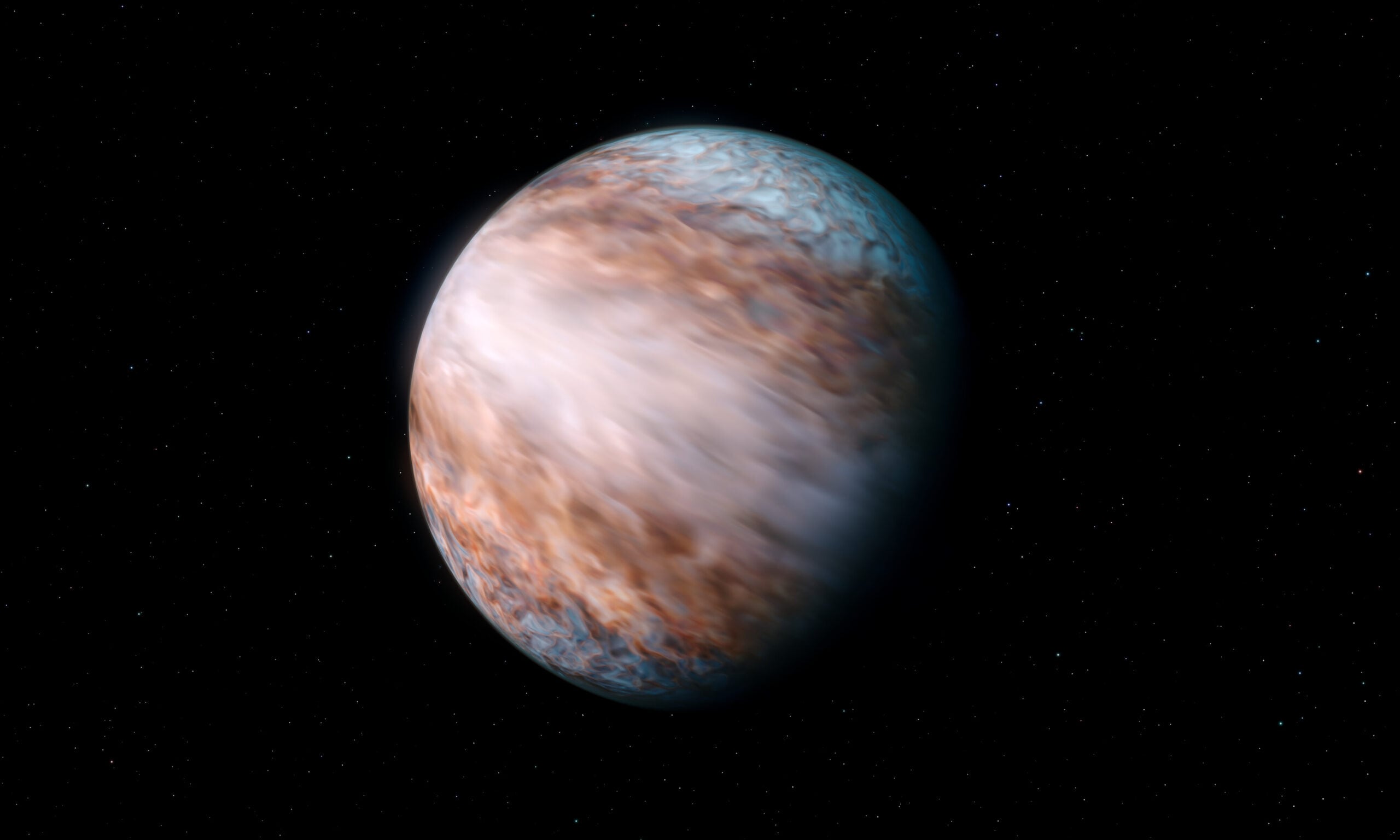
For 28 days in early 2025, WASP-127b held one of planetary science’s most striking records. Atmospheric material around the equator of this distant gas giant was inferred to be moving at close to 9 kilometres per second, or approximately 33,000 kilometres per hour.
That is around 16 times the strongest winds commonly quoted for Neptune, the Solar System’s wind champion. It is fast enough to travel from Sydney to London in well under an hour, if there were a straight path and the moving gas somehow maintained its speed.
Then the record was overtaken. On 18 February 2025, only four weeks after the WASP-127b announcement, another observing team reported a faster equatorial flow in a different exoplanet’s atmosphere.
The short life of the record does not diminish the result. It helps reveal why a list of the “fastest winds” can conceal as much as it explains. No telescope watched a cloud cross WASP-127b. The two 2025 studies traced different atoms and molecules, at different heights, on planets with very different temperatures. Their speeds were recovered from spectral lines and physical models, not from a distant weather camera.
The more consequential achievement was learning that a planet 520 light-years away could be treated as a place with an equator, two limbs and apparently different polar conditions, even though it remains far too small for the telescope to resolve as a disc.
A giant planet with very little mass for its size
WASP-127b was discovered in 2016. It circles a Sun-like star in the constellation Sextans, completing a year every 4.18 Earth days. Its orbit is only about 0.048 astronomical units from the star, roughly one-eighth of Mercury’s average distance from the Sun.
The planet is physically peculiar. NASA’s exoplanet catalogue gives it a radius about 1.31 times Jupiter’s, but a mass of only 0.165 Jupiters. Put another way, it is wider than Jupiter while carrying only about one-sixth as much material. Its average density is roughly one-tenth that of water.
This inflated structure is one reason astronomers can study it so effectively. When WASP-127b passes in front of its star, a small fraction of starlight filters through a broad annulus of gas around the planet. A larger, puffier atmosphere blocks more light than a compact one, strengthening the molecular fingerprints embedded in the transit.
The planet probably has no sharply defined surface beneath its weather. Nor should the artist’s impressions be read as photographs of visible bands. The measured region is a high atmospheric shell where pressure, temperature and composition can differ substantially from layers farther down.
The telescope did not watch clouds move
The observing team used CRIRES+, a high-resolution infrared spectrograph on the European Southern Observatory’s Very Large Telescope in Chile. The instrument followed WASP-127b through one transit and dispersed the incoming light into a finely divided spectrum.
Water vapour and carbon monoxide absorb characteristic groups of infrared wavelengths. Their combined pattern works like a molecular barcode. If the absorbing gas moves towards Earth, the entire pattern shifts slightly towards shorter, bluer wavelengths. Gas moving away shifts it towards longer, redder wavelengths. The principle is the same Doppler effect that changes the pitch of a passing siren, expressed in light rather than sound.
Extracting the planet’s signal is harder than that description suggests. The spectrum is dominated by the host star, while Earth’s atmosphere adds its own absorption. During the observation, the planet also moves rapidly along its orbit. Researchers must remove or model those much larger components before combining hundreds or thousands of faint molecular lines into a detectable cross-correlation signal.
The result was not a single peak centred on the planet’s expected velocity. Both water and carbon monoxide showed two distinct peaks. One atmospheric component was moving towards the observer while another moved away by a comparable amount.
That symmetry is the core observation. The team interpreted it as the opposite edges of an eastward, or superrotating, equatorial jet. One limb carries gas partly towards us; the other carries gas partly away. The planet and star still appear essentially as points, but velocity separates regions that angular resolution cannot.
Where the 33,000-kilometre figure comes from
The peer-reviewed analysis in Astronomy & Astrophysics calculated a jet velocity of 7.7 plus or minus 0.2 kilometres per second from the split peaks. That converts to about 27,700 kilometres per hour. A more detailed retrieval, which allowed the equatorial region, morning and evening limbs and poles to make different contributions, placed equatorial atmospheric motion near 9 kilometres per second. This became the rounded public figure of 33,000 kilometres per hour.
Those values are related, not contradictory. One is derived more directly from the separation of the two cross-correlation peaks. The other emerges from a model that fits the spatially distinct atmospheric components. “Approaching 33,000 kilometres per hour” is therefore more accurate than implying a conventional anemometer returned an exact reading.
The planet’s rotation must also be separated from its wind. WASP-127b is expected to be tidally locked because it orbits extremely close to its star. If one rotation takes the same 4.18 days as one orbit, its equator turns at roughly 1.6 kilometres per second. The inferred atmospheric motion is nearly six times that estimated rotational speed.
Tidal locking is a well-supported expectation, not a direct movie of the planet turning. Atmospheric studies depend on such boundary assumptions, and their uncertainties should travel with the dramatic headline number. SpaceDaily’s initial report on WASP-127b’s winds set out the record and the molecular detection. The deeper point is how several layers of modelling turn that spectrum into a geographical claim.
Why scientists call the jet supersonic
“Supersonic” does not compare the flow with sound moving through room-temperature air on Earth. The local speed of sound depends on temperature, chemical composition and thermodynamic conditions. WASP-127b’s upper atmosphere is hot and dominated by light gases, giving it a different sound speed from Earth’s lower atmosphere or Neptune’s visible cloud layers.
Even under those alien conditions, a flow of 7.7 to 9 kilometres per second is comfortably above the expected local sound speed. That can create shocks, frictional heating and strong interactions with waves or magnetic drag. It does not mean a continuous thunderclap would be audible. There is no solid equatorial surface and no observer standing beneath the jet.
Nor does speed alone tell us how destructive a wind would be. Dynamic pressure depends on density as well as velocity. A very fast flow in an extremely tenuous upper atmosphere can exert far less force than the same speed near a dense surface. The WASP-127b result concerns atmospheric circulation and energy transport, not a forecast for buildings.
Around 16 times Neptune, or more than 18?
The comparison in the headline needs a small but useful footnote. NASA says Neptune’s winds exceed 2,000 kilometres per hour, while the strongest figures are often rounded to about 2,100. Dividing 33,000 by 2,100 gives 15.7, hence “around 16 times”.
ESO’s January 2025 announcement used 1,800 kilometres per hour for Neptune. Against that reference, WASP-127b’s equatorial motion is just over 18 times faster. Both ratios convey the scale honestly; they simply start from different rounded Neptune values.
There is a more important mismatch. Neptune is a resolved planet. Many of its wind estimates come from following visible cloud features from one image to the next. WASP-127b is unresolved, and its velocity came from molecular absorption in a particular high atmospheric region.
The distinction is familiar to planetary scientists. SpaceDaily previously covered VLT Doppler measurements of Jupiter’s winds, where reflected sunlight was used to measure motion across a visible planetary disc. That work also had to separate atmospheric winds from a rapidly rotating gas giant. WASP-127b applies related velocity logic at a distance where the disc itself disappears.
The spectrum hinted at weather beyond the jet
The split molecular peaks were the clearest result, but the retrieval offered a tentative map of temperature and clouds. It suggested that the morning terminator may be about 175 kelvins cooler than the evening terminator. The uncertainty was large enough that this difference should be treated as evidence, not a settled thermometer reading.
The polar contribution was also muted. Cooler polar gas could weaken the molecular signal, as could a high cloud deck that blocks the deeper atmospheric path. The data did not uniquely choose between those possibilities. What mattered was that a uniform atmosphere did not describe the observations as well as one divided by latitude and limb.
This is part of a wider shift in exoplanet science. A transit spectrum used to be discussed as though it were one representative atmospheric column. In reality, the starlight enters through both the morning and evening boundaries, where gas has arrived from very different thermal histories.
Recent observations have made that asymmetry explicit. In SpaceDaily’s report on WASP-94A b, Webb separated a cooler, cloudy morning limb from a hotter, clearer evening limb. WASP-127b’s velocity splitting approaches the same problem from another direction: high spectral resolution uses motion to pull an unresolved atmosphere apart.
The record moved to a different planet four weeks later
On 18 February 2025, astronomers announced the first three-dimensional map of atmospheric flows on WASP-121b, also called Tylos. This is a much hotter and more massive world about 900 light-years away. It completes an orbit in roughly 30 hours and keeps one hemisphere facing its star.
For that study, ESPRESSO combined light collected by all four 8.2-metre units of the VLT. Different chemical tracers sampled different atmospheric heights. Iron showed a deeper flow from the intensely heated dayside towards the nightside. Sodium revealed a high, superrotating equatorial jet. Hydrogen traced an even higher escaping layer.
The sodium jet accelerated as it crossed the dayside and exceeded WASP-127b’s January figure. SpaceDaily’s contemporary coverage of the Tylos map reported winds reaching about 70,000 kilometres per hour. The ESO account of the study emphasised the structure: an equatorial jet above a separate day-to-night circulation that current models struggled to reproduce.
Calling Tylos the new record-holder is reasonable. It should not imply that two calibrated weather stations measured the same thing. The WASP-127b result followed water and carbon monoxide around a broad equatorial region. The Tylos result used sodium to probe an intermediate atmospheric layer whose speed changed across the dayside. Pressure, temperature, tracer and retrieval geometry all differ.
Exoplanet wind records will become more qualified as observations improve, not less. One planet may have the fastest sodium jet at one pressure, another the largest limb-to-limb molecular separation, and another the fastest escaping hydrogen. The complexity is progress because it replaces a single average atmosphere with a vertical and horizontal circulation system.
The record was temporary; the technique is the story
A speed of 33,000 kilometres per hour deserves attention, but it is not the most durable part of the WASP-127b result. Records are vulnerable to the next sensitive instrument, the next favourable target and the next definition. This one lasted less than a month.
The durable achievement is spatial information recovered without a spatial image. Two Doppler peaks revealed opposing limbs. Their separation constrained an equatorial current. The absence of equally strong polar peaks suggested latitudinal variation. Relative signal strengths offered clues, though not final answers, about clouds and temperature.
Future high-resolution instruments will repeat this kind of measurement across more transits and more wavelengths. Multiple nights can test whether the flow is stable. Different molecular and atomic tracers can sample different heights. Combining ground-based velocity precision with Webb’s broad infrared chemistry can connect composition, temperature and motion rather than averaging them into one spectrum.
WASP-127b therefore keeps an important distinction even after losing the speed record. It showed that the weather of an unresolved world can leave a directional signature in light. At 520 light-years, astronomers did not see the jet. They separated the molecules coming towards us from those moving away, and from that sliver of information began to map a planet no camera can yet show.