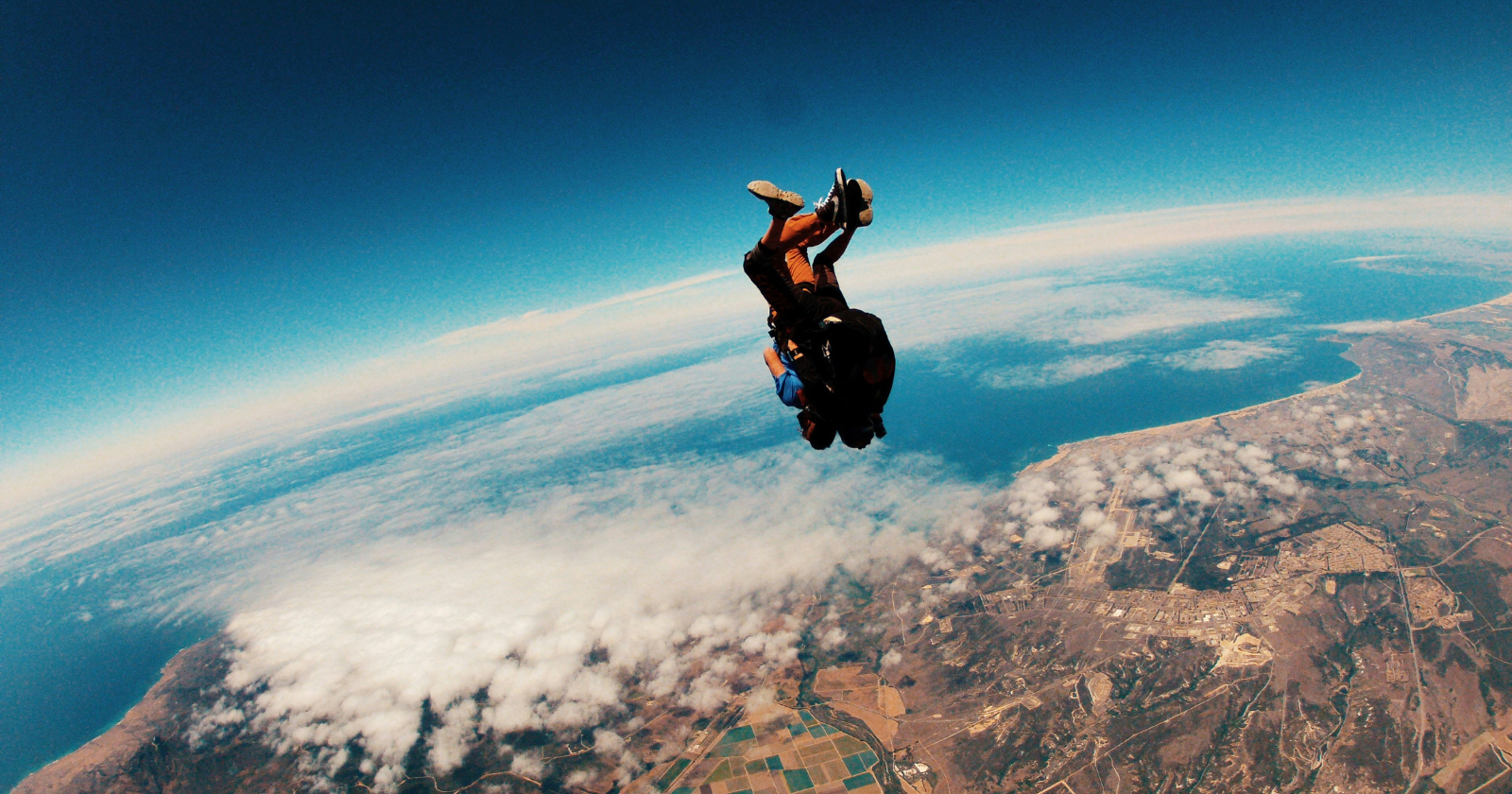
Picture the inside of a gondola a mile past 100,000 feet, the curve of the Earth already visible through a small window, and one glove on your pressure suit starting to fail. Do you radio it in and risk having the whole flight scrubbed with the record still out of reach, or do you keep quiet and see how far you can still get?
That wasn’t a hypothetical for Joe Kittinger. On August 16, 1960, as part of the Air Force’s Project Excelsior, he was riding a helium balloon toward an altitude of 102,800 feet, well past the point where an unprotected human body starts to fail. Partway up, the pressure seal in his right glove gave out, and his bare hand swelled to roughly twice its normal size inside the near-vacuum outside his suit. He kept climbing. Then he jumped anyway.
I keep circling back to this story less for the jump itself, spectacular as it was, than for the hour before it, when one man’s own body had already started telling him something his equipment couldn’t fix. What his glove failure shows, set against a NASA engineer’s full-body accident six years later, is where the real danger line actually sits, and how much smaller a single hand’s worth of vacuum exposure is than it sounds.
A hand alone at the edge of space
By 102,800 feet, Kittinger was already nearly 40,000 feet above the altitude where the water in an exposed human body starts to boil at its own temperature. His suit and helmet kept the rest of him pressurized and breathing supplemental oxygen normally. His right hand had no such protection. Gas trapped in the tissue of his hand expanded against nothing pushing back, and by the time he reached jump altitude, the swelling was bad enough that he could no longer trust his fingers to work.
The swelling turned out to matter more than the pain alone. According to the Smithsonian’s own retrospective on the jump, published in Air & Space Quarterly, Kittinger’s swollen hand meant he could not manually pull his own reserve ripcord, so he fell back on his suit’s automatic barometric trigger to open his main parachute instead, a piece of backup engineering doing the job his hand no longer could.
We spent a good part of an entire video on exactly this kind of vacuum exposure, the ten-second oxygen shift that makes a whole-body decompression so dangerous, the roughly ninety-second rescue window that decides who walks away, and the account a NASA engineer gave in his own words after his full pressure suit failed a few years after Kittinger’s jump, about as close as anyone’s come to describing what the fast version of this actually feels like.
Why a hand isn’t the same emergency as a whole body
It’s worth being precise about what this injury actually was, because the popular telling of Kittinger’s jump tends to blur it into the same category as a full decompression. His hand alone met a near-vacuum. The rest of him, lungs included, stayed pressurized and supplied with oxygen the whole time, which changes the physics completely.
That distinction matters because a full decompression kills primarily through oxygen reversing direction, leaving the blood and diffusing backward into collapsed, unpressurized lungs, a process that can cause unconsciousness in as little as ten seconds, boiling saliva aside. None of that applies to an isolated hand still attached to a body breathing normally. A hand can swell, hurt, and temporarily stop working, without any of the oxygen-reversal chain that makes whole-body exposure so dangerous.
The choice, and the disagreement over how it’s told
Here’s where the story gets genuinely murky, and it’s worth saying so plainly rather than picking whichever version sounds better. Some retrospectives, including the Smithsonian’s own Air & Space Quarterly, describe Kittinger keeping the glove failure to himself, worried that ground control would scrub the flight if they knew. At least one other detailed account, published in Air & Space Forces Magazine, describes him reporting the swollen hand to his ground crew before he jumped, with the team deciding to proceed anyway. What isn’t in dispute in either version is that nobody aborted the flight, and Kittinger stepped out of the gondola at 102,800 feet with a hand that was already twice its normal size.
Smithsonian historian Doug Lantry has said of the decision, “I’m sure Joe made a mental calculation about how long he could go” with the injury before it became a real problem. Kittinger himself, describing what it takes to fly into that kind of risk at all, put it in three parts: “In any dangerous flight, you must have three things, faith in your equipment, faith in your team, and faith in yourself. If you’ve got those, you’ll be OK.” He added the flip side without softening it: if any of those are missing, you’re in trouble.
What his choice still says, next to the ones who had none
Kittinger’s hand was back to its normal size about three hours after he landed in the New Mexico desert. That’s the entire scale of the injury, a painful, swollen hand that healed in an afternoon, next to a jump that set world records for altitude and freefall speed that stood for decades.
It’s a genuinely different story from the one six years later, when a NASA engineer’s entire suit failed inside a Houston vacuum chamber and every second mattered because his whole body, not just one hand, had lost its pressure. It’s a different story again from three Soviet cosmonauts a decade after that, who met the same physics with no suits, no warning, and nobody positioned to bring their pressure back in time. Kittinger’s accident sits closest to the survivable end of that range, mostly because a glove is a much smaller thing to lose than an entire suit.
The detail I keep coming back to in this story has less to do with the freefall record, impressive as that is, and more to do with the quieter part beforehand, a man running his own private math on how much time a swollen hand had bought him, and choosing to keep going rather than call it. That’s a smaller, stranger kind of courage than the jump itself, and it’s the part most retellings skip past on their way to the more dramatic fall that came after.