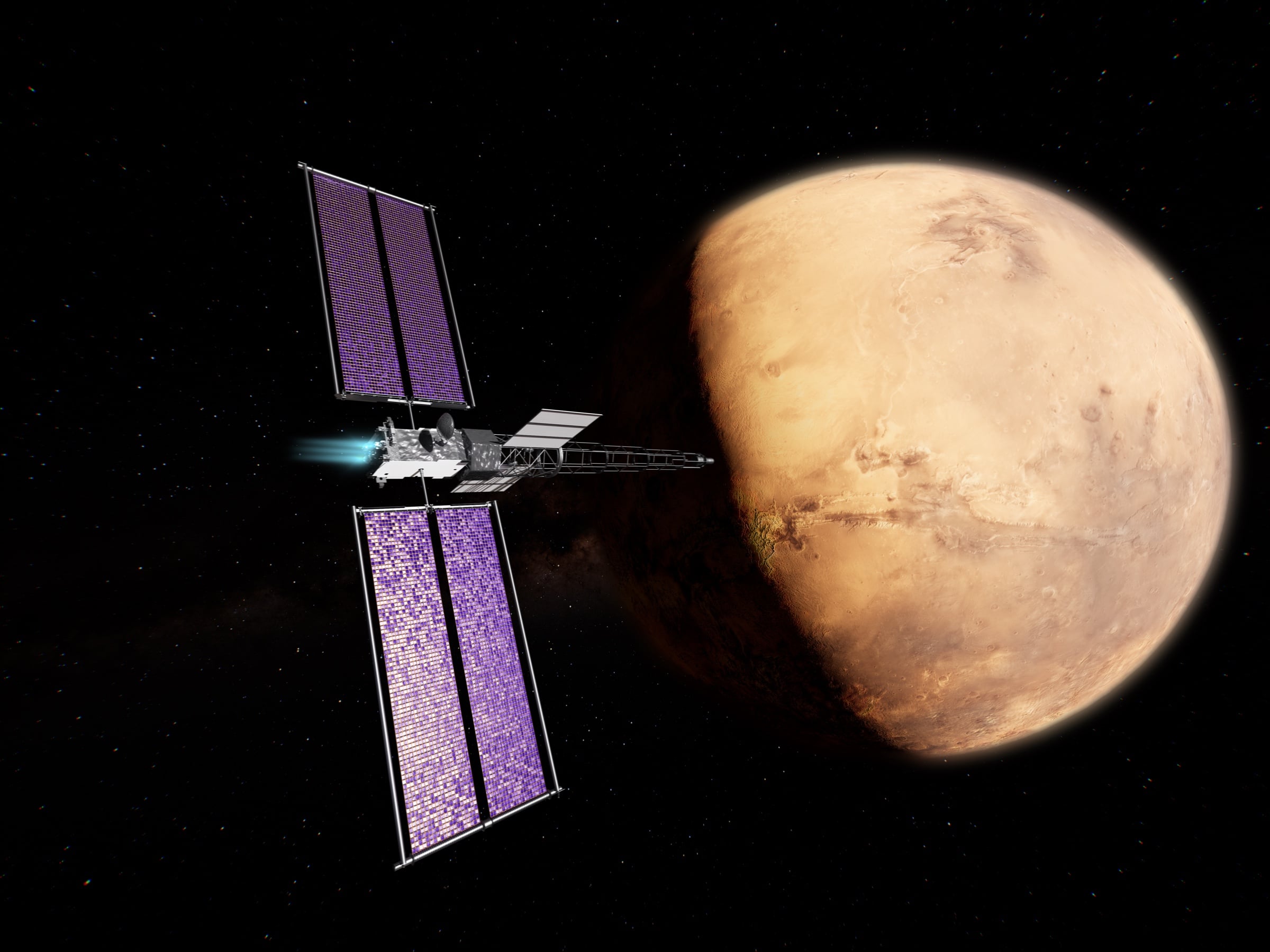
NASA has put a date on an idea that the United States has studied for more than six decades without sending beyond Earth orbit. The agency is targeting late 2028 for Space Reactor-1 Freedom, a roughly 12-tonne spacecraft that would leave Earth, start a uranium fission reactor in deep space and use the resulting electricity to run electric propulsion on the way to Mars.
The mission is a plan, not a booked launch with a named rocket and completed spacecraft. NASA lists SR-1 Freedom as a future mission, with a 2028 launch and a 2029 Mars encounter. Its central experiment is nevertheless specific: operate a coupled reactor, power-conversion system and Hall-effect thruster beyond Earth orbit, then keep the reactor running long enough to establish useful flight experience.
That wording matters. NASA is not putting a reactor on the Martian surface in 2028, and the spacecraft is not a crewed prototype. It is a flyby, payload-delivery and technology-demonstration mission intended to prove the parts future vehicles would need.
Late 2028 is a target tied to Mars geometry
The current NASA mission page says SR-1 will target late 2028, with the agency’s more detailed programme material identifying December. The date exploits a favourable Earth-Mars alignment. Similar launch opportunities recur about every 26 months, which makes a delay more consequential than an ordinary slip of several weeks.
NASA describes the mission as a Mars flyby and science-payload deployment. The spacecraft is expected to weigh about 12,000 kilograms, communicate through the Deep Space Network in X-band and deliver its payload at a Mars intercept. The agency has not said that the main nuclear spacecraft will land or settle into a permanent Mars orbit.
The schedule is exceptionally compressed. NASA is repurposing the Power and Propulsion Element developed for the Gateway lunar station, working with the Department of Energy on the reactor and drawing on electric-propulsion hardware already far along in testing. SpaceDaily’s earlier examination of SR-1’s architecture focused on this merger of two programmes that were not originally designed to meet.
Reuse is the reason a 2028 attempt can be discussed at all. It is not the same as having a finished system. The reactor, converter, radiators, shielding, spacecraft bus and thruster still have to work as one vehicle.
This is a reactor, not a nuclear battery
Many spacecraft have carried nuclear power before. Voyager, New Horizons, Curiosity and Perseverance use radioisotope power systems that collect heat from the natural decay of plutonium-238. The Department of Energy describes those devices as long-lived space batteries. They contain no controlled chain reaction.
SR-1 is different. Its reactor is intended to split uranium atoms in a sustained fission process. NASA lists high-assay low-enriched uranium, or HALEU, as the fuel and a 20-kilowatt-electric closed Brayton-cycle power system. Twenty kilowatts is tiny beside a terrestrial power station but substantial for a compact reactor that must survive launch and operate unattended.
The distinction also narrows NASA’s claim of a first. The United States placed the SNAP-10A fission reactor in Earth orbit in 1965, and fission reactors have flown in Earth orbit since. No reactor has powered a spacecraft on an interplanetary trajectory beyond Earth orbit. SR-1 is intended to cross that boundary.
This idea has been in the SpaceDaily archive for a long time. A 2001 article on nuclear power in the outer Solar System described the same underlying attraction: an ion drive supplied by a compact reactor can keep operating where sunlight becomes too weak for practical high-power solar propulsion.
How splitting uranium becomes thrust
SR-1 uses nuclear electric propulsion. The reactor produces heat. A closed Brayton system circulates a working fluid through a turbine and generator, converting part of that heat into electricity. Radiator panels dispose of the remaining heat because vacuum offers no surrounding air or water to carry it away.
The electricity then drives a Hall-effect thruster. Electric and magnetic fields ionise a gas such as xenon and accelerate the charged particles out of the engine. The exhaust leaves at very high speed, allowing the spacecraft to obtain far more momentum from each kilogram of propellant than a conventional chemical rocket.
The trade-off is thrust. A Hall thruster does not shove a 12-tonne spacecraft away from Earth like a launch rocket. Its force is small, but it can continue for months. NASA’s electric-propulsion explainer compares chemical propulsion with a short drag race and electric propulsion with a long drive that keeps changing speed and direction.
This is not nuclear thermal propulsion. A nuclear thermal engine passes propellant through a very hot reactor and expels the heated gas through a nozzle, producing much higher thrust. SpaceDaily recently revisited NASA’s ground-tested NERVA-era nuclear rockets. SR-1 follows the other branch of the family tree: reactor heat becomes electricity first, and electricity powers a low-thrust ionised exhaust.
Gateway hardware supplies the other half
The spacecraft bus is based on Gateway’s Power and Propulsion Element. NASA currently lists the bus as generating 48 kilowatts of electricity, alongside the reactor’s 20-kilowatt-electric conversion system. The mission artwork retains large solar arrays because SR-1 combines the new reactor experiment with a vehicle originally built around solar electric propulsion.
Its main propulsion hardware is the Advanced Electric Propulsion System, including a 12-kilowatt Hall thruster. The significant step is not inventing electric propulsion from nothing. Hall thrusters have already accumulated extensive operating experience. It is coupling a flight reactor, Brayton converter, power electronics and thruster, then running that complete chain autonomously in deep space.
NASA’s May management directive explicitly redirected Gateway’s Power and Propulsion Element, associated launch funds and future mission resources toward SR-1. The directive also ordered an integrated programme plan covering schedule, budget, contracting, facilities and interagency work.
That decision salvages hardware already under construction, but it creates new interfaces. A Mars-bound reactor adds thermal loads, radiation, shielding, control software and structural requirements that the Gateway bus did not carry in its original lunar role. “Existing hardware” reduces some work; it does not erase integration risk.
The reactor should stay off during launch
A chemical launch vehicle will do the high-thrust work of leaving Earth. NASA’s mission outline says SR-1 should enter an Earth-escape trajectory and start its reactor within 48 hours. The fission system is not intended to operate on the launch pad or during ascent.
That sequence reduces radiological consequences because an unused reactor has not accumulated the inventory of highly radioactive fission products created during operation. It does not remove the need for launch-safety analysis. The fuel, control mechanism and containment structure still must survive vibration, an aborted launch and credible accident or re-entry conditions.
Once active, the reactor must control a chain reaction with no crew beside it, convert heat efficiently and keep the rest of the spacecraft within acceptable temperatures. A truss separates the reactor from the electronics and payload. A directional shadow shield can protect the vehicle side, while radiator panels expose a broad area to cold space.
The agency’s nuclear-propulsion programme says nuclear systems used after launch would be activated only at a distance from Earth that guarantees safe operation. SR-1 will be an important regulatory demonstration as well as an engineering one, establishing procedures that later reactor missions could reuse.
Mars gets three helicopters, not the reactor
SR-1 is also a delivery vehicle. At Mars intercept it is intended to release SkyFall, a payload containing three small helicopters evolved from Ingenuity. NASA describes a mid-air deployment rather than a conventional lander placing the rotorcraft on the surface.
The helicopters are planned to carry cameras and ground-penetrating radar, plus instruments for air temperature, wind speed and direction. Their tasks include mapping terrain, examining potential exploration zones and looking for subsurface water ice that could matter to later robotic or human activity.
The distinction corrects an easy misreading of the mission. NASA is sending an operating reactor toward Mars, but it is not installing a nuclear power station there. The large spacecraft is currently described as making a flyby while deploying SkyFall. Extended reactor performance remains a mission objective, so continuing to operate the spacecraft after the encounter may be more useful than ending the test at Mars.
A 20-kilowatt pathfinder is not a crewed Mars ship
NASA has previously estimated that future Mars transfer vehicles could require roughly 400 kilowatts to two megawatts of electrical power. SR-1’s reactor is smaller by a factor of about 20 to 100. No astronauts will fly on it, and a successful test would not make a crewed nuclear Mars vehicle immediately ready.
The pathfinder addresses a different set of risks: HALEU fuel production, autonomous reactor control, Brayton conversion, heat rejection, shielding, launch authorisation and operation of electric propulsion from a fission source. A later programme could scale flight data instead of placing an untested megawatt-class reactor beside a crew habitat.
NASA also wants SR-1 to inform Lunar Reactor-1, a surface power system targeted for 2030. SpaceDaily has separately examined the Moon-reactor plan and its Mars connection. The flight and surface reactors will not be identical, but they can share fuel work, materials, controls, suppliers, facilities and regulatory experience.
For crewed exploration, power can matter even when it is not providing thrust. A larger fission system could supply life support, communications, instruments and surface operations during Martian dust storms or lunar darkness. SR-1 is meant to establish the industrial and operational base from which those applications might grow.
The next two years will decide whether the date is real
A mission page can specify an intended spacecraft faster than procurement can produce flight hardware. NASA still has to close the design, place and manage contracts, qualify the fuel and converter, demonstrate integrated thermal performance, complete nuclear launch approval, finish the SkyFall payload and secure a launch service.
The Mars window turns each of those tasks into a schedule gate. A critical delay could push the flight to the next useful alignment. That does not make SR-1 imaginary, but it means “late 2028” should be read as NASA’s target, not a guarantee that a reactor and launcher have already passed final certification.
If it flies and the coupled system works, SR-1 Freedom will close a technical gap left open since the 1960s. Its immediate thrust will be small. The consequential result will be proof that a controlled chain reaction can provide dependable electrical power to a propulsion system while an uncrewed spacecraft travels between planets.