When Voyager 2 crossed the Uranian system on 24 January 1986, its cameras found ten moons that had never been seen before. The single encounter more than doubled the known population of small satellites around the planet and established a family of dark bodies packed around its narrow rings.
One still escaped.
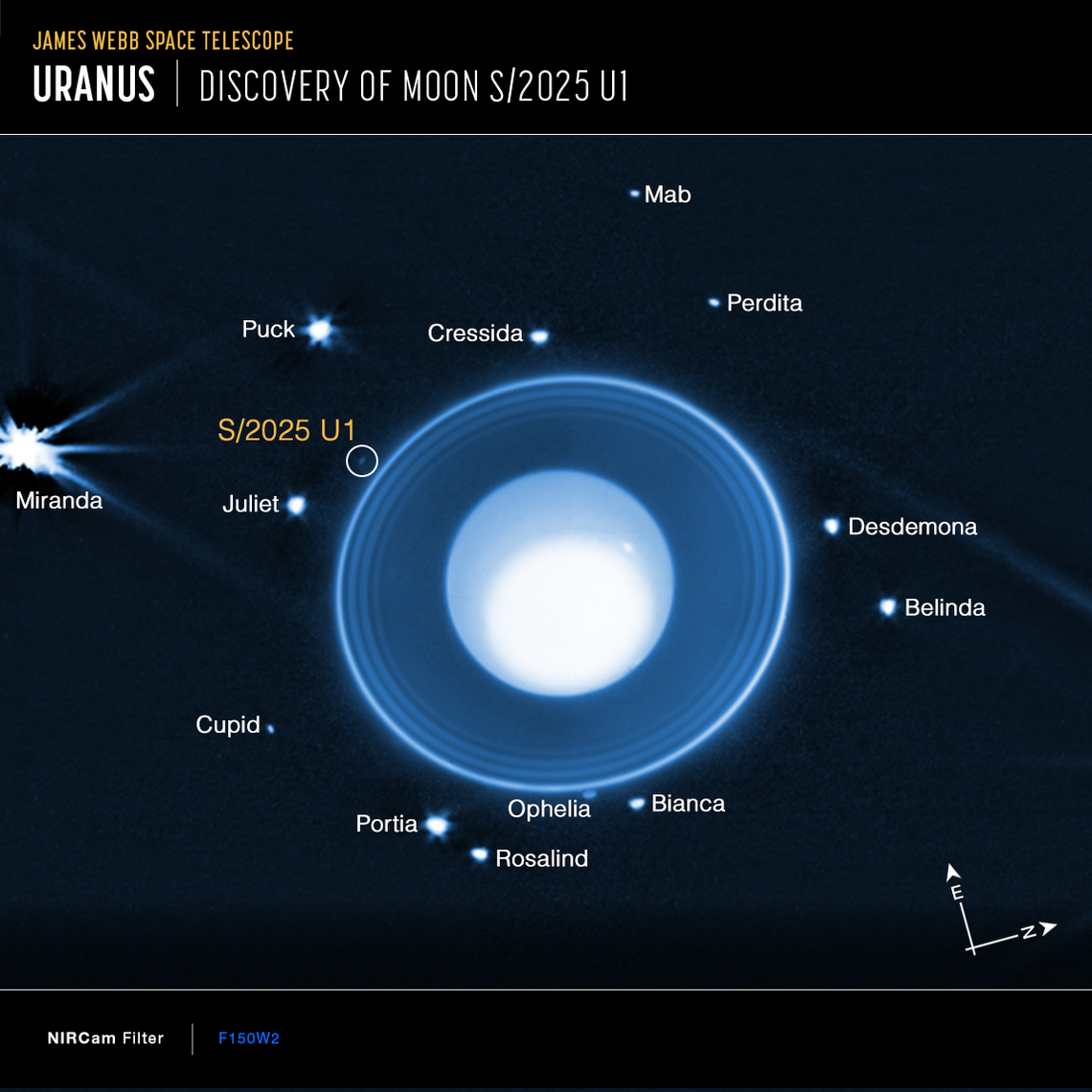
On 2 February 2025, the James Webb Space Telescope watched Uranus for roughly six hours and recorded a faint moving point between the orbits of Ophelia and Bianca. The object is probably only about 10 kilometres across. Under the provisional designation S/2025 U1, it raised the current total to 29 known Uranian moons.
The interval was 39 years and nine days.
That precision is useful because the new moon did not suddenly appear four decades after Voyager. It orbited through the 1986 encounter and through every later telescope campaign. Astronomers needed an observing sequence that could collect enough light, separate the source from ring and planetary glare, and demonstrate that the point moved like a moon rather than a background object.
SpaceDaily’s earlier report introduced the faint Webb discovery. The history behind it reveals something subtler: “missed” does not mean Voyager’s camera was simply inferior to a telescope billions of kilometres away. Finding a tiny moon depends on sensitivity, exposure time, glare, orbital motion and how long an observatory can keep returning to the same crowded field.
The ten moons Voyager found in 1986
The NASA Uranus moon catalogue names the ten discoveries as Juliet, Puck, Cordelia, Ophelia, Bianca, Desdemona, Portia, Rosalind, Cressida and Belinda. Their estimated diameters range from about 26 to 154 kilometres. Puck is the largest of the group; several of the others are only a few tens of kilometres wide.
Voyager 2 came within 81,500 kilometres of Uranus’s cloud tops and returned the first close observations of the planet, rings and moons. It also had to divide a short, fast flyby among atmospheric imaging, magnetic measurements, ring searches and unevenly lit major satellites. A spacecraft moving through the system cannot turn one encounter into forty years of monitoring.
The camera search was nevertheless extraordinary. Before Voyager, astronomers knew the five large moons Miranda, Ariel, Umbriel, Titania and Oberon. The new objects revealed a separate, crowded population inside Miranda’s orbit, closely entwined with the rings.
Perdita complicates the simple tally
There is a wrinkle in saying Voyager found ten. The spacecraft’s 1986 photographs contained another moon, but nobody recognised it during the encounter. In 1999, Erich Karkoschka compared archived Voyager frames and identified the object now called Perdita.
NASA’s history of Perdita records that it was discovered thirteen years after its picture was taken. The initial identification was later judged uncertain, then Hubble recovered an object at the predicted position in 2003 and confirmed the moon. Its provisional designation, S/1986 U10, preserves the year of the images.
The conventional mission tally remains ten because those moons were discovered by the Voyager science team. The current JPL discovery table credits Perdita separately to Karkoschka. In other words, Voyager photographed eleven previously unseen moons, but its team found ten during the flyby.
What Webb recorded
The NASA Webb discovery report says the moon appeared in ten 40-minute exposures taken with NIRCam. The observations used the broad F150W2 filter, which transmits infrared wavelengths from about 1.0 to 2.4 microns. Tracking across the sequence separated the moving object from fixed background sources.
This was not an accidental speck in a decorative photograph. The images came from General Observer programme 6379, led by Maryame El Moutamid of the Southwest Research Institute, to examine Uranus’s ring-moon system. The annotated result combines different image treatments because the planet, rings and moons differ enormously in apparent brightness.
Repeated frames supply the evidence that a single exposure cannot. A fixed star or galaxy stays registered with the background, while a Uranian satellite changes position around the planet. An instrumental blemish does not trace a physically consistent orbit. The six-hour baseline gave the team both accumulated signal and measurable motion.
The original NASA announcement described the analysis as science in progress that had not yet passed peer review. Since then, the official JPL table of IAU-recognised planetary satellites has incorporated S/2025 U1 and lists 29 satellites of Uranus. The designation remains provisional and no permanent name appears in the current catalogue.
Ten kilometres is an estimate, not a resolved world
Webb did not photograph a 10-kilometre disc with visible terrain. At the observation date, Uranus was about 19.8 astronomical units from Earth, approximately 2.9 billion kilometres. A body only 10 kilometres wide at that distance is far too small to resolve as a surface. It contributes light to a point in the detector.
The diameter comes from brightness. The researchers assumed that S/2025 U1 reflects a similar fraction of sunlight to Uranus’s other small satellites. If its surface is darker, it would need to be somewhat larger to produce the measured signal; if brighter, smaller. Ten kilometres is therefore the best present scale, not a tape-measure result.
This distinction also explains why “Webb saw it” should not be read as “Webb mapped it.” The telescope detected enough photons and repeated the observation long enough to establish motion. Its success lies in finding and tracking a source well below the size at which any telescope can show the moon’s shape from Earth.
Why the nearby spacecraft missed it
Voyager was incomparably closer to Uranus than Webb, but closeness did not guarantee discovery. The spacecraft had limited observing time, a rapidly changing view, 1970s detector technology and finite storage and transmission capacity. Exposures long enough to bring out a very faint object could smear a moving moon or become dominated by scattered light from the planet and rings.
Webb could instead hold a planned field, collect ten exposures totalling 400 minutes and use a modern infrared detector. Astronomers could register the frames, model the bright components and look for a point that shifted consistently with a Uranian orbit. That is a different experiment from a high-speed reconnaissance flyby.
Perdita supplies the useful caution. Voyager’s camera was capable of recording a moon that its original search did not identify. S/2025 U1 may yet appear in archival data too faint or confused to have been recognised, but the present discovery rests on the Webb sequence.
There is no contradiction in a distant telescope finding what a nearby probe missed. Voyager maximised the science possible during one passage; Webb optimised one scheduled programme for faint targets and could transmit its complete digital exposures without the constraints of a 1977 spacecraft operating at Uranus.
A tiny orbit in a crowded zone
S/2025 U1 travels about 56,000 kilometres from Uranus’s centre, only about 30,000 kilometres above the visible cloud tops. It circles in the equatorial plane between Ophelia, which lies just outside the main ring system, and Bianca. The reported orbit is nearly circular, evidence consistent with formation near its current location rather than capture from a distant solar orbit.
It is the fourteenth known small moon inward of Miranda. No other planet has as many small inner satellites. Around Uranus, the distinction between rings and moons is partly a distinction of scale: particles, embedded bodies and larger satellites occupy related orbits and exchange gravitational effects and impact debris.
Ophelia and Cordelia already serve as shepherds whose gravity helps hold the epsilon ring’s edges. Other inner moons travel in configurations that dynamical models find unstable over long intervals. Adding one object does not overturn those models, but every moon adds a mass, an orbit and possible source of ring material that the models must accommodate.
How the count reached 29
The previous addition was not another object beside the rings. S/2023 U1 is a distant irregular satellite announced in 2024, one of the discoveries covered in SpaceDaily’s report on new moons of Uranus and Neptune. It probably represents a captured body or fragment and raised the Uranian total from 27 to 28.
S/2025 U1 then made 29. The two provisional labels describe discovery years and host planet, not permanent names or surface types. Uranian moons are traditionally named for characters from Shakespeare and Alexander Pope, but a proposed name requires approval by the International Astronomical Union. As of August 2026, the Webb moon remains S/2025 U1.
The total is a census of known objects, not a declaration that the census is complete. Because the new moon is smaller and fainter than every previously known inner member, it moves the practical detection boundary and strengthens the case that more bodies remain hidden near the rings.
The JPL table also shows why numbering can lag counting. Some provisionally designated satellites await permanent Roman numerals or names even after their orbits are accepted, so an object’s position in a formal list need not match the chronological phrase “29th known moon.” The headline count describes the population known today.
The discovery cannot replace a return mission
Webb can revisit Uranus, refine the orbit and search for additional points. It cannot measure a tiny moon’s mass directly, fly between the rings, map the unseen hemispheres of major satellites or watch the inner system continuously from changing angles.
As SpaceDaily has examined in its account of the four-decade gap since Voyager 2, Uranus still rests on one spacecraft encounter. A future orbiter could repeatedly measure mutual perturbations, constrain moon masses, map surfaces and search the glare from inside the system.
Until then, the record advances through complementary views. Voyager supplied proximity and preserved more than its first analysts found. Hubble recovered Perdita. Webb supplied patience, infrared sensitivity and a six-hour sequence that isolated a still fainter point.
Voyager revealed the crowd. Webb showed that the crowd was not yet fully counted.