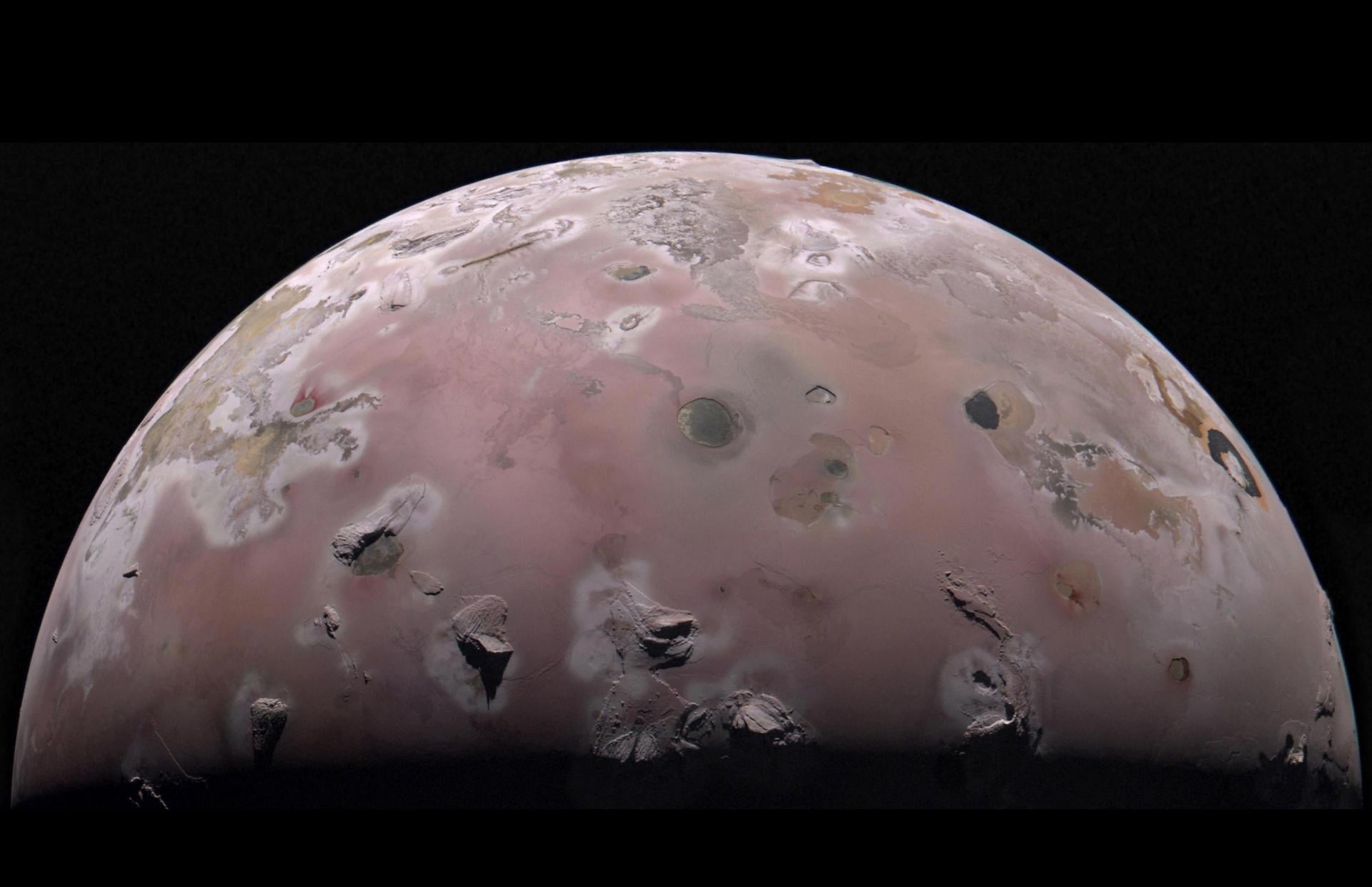
Io looks like a solid moon, but it never holds a completely fixed shape. During each 42.5-hour trip around Jupiter, the giant planet’s changing tidal force can raise and lower Io’s ground by as much as about 100 metres.
That is roughly the height of a 30-storey building. It is a tide in rock, not an ocean, and about 500 times the vertical motion of Earth’s solid-ground tide. An imaginary observer standing on Io would be carried through a slow rise and fall of the landscape while Jupiter remained almost fixed in the sky.
The 100-metre figure is a model-based maximum, not a direct laser-altimeter record of one point travelling that exact distance. It comes from spacecraft observations, orbital dynamics and models of Io’s tidal response. The underlying conclusion is nevertheless secure: Io is deformed on a scale that no solid world close to Earth experiences.
This motion also explains why a moon only slightly larger than Earth’s can power roughly 400 volcanoes. Rock is not perfectly elastic. Every time Io is squeezed and relaxed, some mechanical energy becomes heat, feeding the most volcanically active world known in the Solar System.
A tide is a difference in gravity
Jupiter pulls every part of Io towards it, but it does not pull equally. The hemisphere facing the planet is closer and feels a stronger attraction than Io’s centre, while the far side feels a weaker one. This gravitational gradient stretches the moon along the line towards Jupiter and compresses it in other directions.
Earth’s oceans make tides familiar, but liquid water is not required. Earth itself flexes under the gravity of the Moon and Sun. Its solid surface generally rises and falls by less than about 20 centimetres. On Io, NASA compares the possible 100-metre displacement to riding an elevator from the bottom to the top of a 30-storey building.
The figure describes the changing solid-body tide across an orbit. It does not mean every patch of ground moves vertically by 100 metres relative to a nearby landmark. The whole moon changes shape, so the local motion depends on position, interior response and how a reference surface is defined.
A small orbital imperfection makes the bulge move
Io rotates synchronously, completing one turn each time it circles Jupiter and therefore showing the planet nearly the same hemisphere. If its orbit were perfectly circular and its rotation perfectly settled, the main tidal bulge could remain in a comparatively steady configuration. A permanent distortion alone would not supply today’s repeated heating.
Io’s orbit is slightly eccentric. Its distance from Jupiter changes by roughly 3,500 kilometres between the near and far parts of each circuit, altering the strength of the tide. The direction of the deformation also rocks slightly because Io’s orbital speed varies while its rotation remains nearly uniform.
The moon completes this cycle in about 42.5 hours at an average distance of approximately 422,000 kilometres from Jupiter. NASA’s detailed Io overview describes how the changing pull continually flexes the surface. Each individual change is slow, but there is no long rest between cycles.
Europa and Ganymede keep the squeezing alive
Tidal friction normally works against the condition that creates it. Dissipation tends to circularise a moon’s orbit, reducing the distance changes and allowing its deformation to settle. If Io orbited alone, its great tidal engine would gradually lose power.
Europa and Ganymede prevent that simple ending. The three Galilean moons occupy a 4:2:1 Laplace resonance. For every orbit Ganymede completes, Europa completes two and Io completes four. Their recurring arrangements deliver gravitational nudges at regular phases, maintaining Io’s small eccentricity even while tidal dissipation tries to erase it.
This is not perpetual motion. Energy and angular momentum are exchanged among Jupiter’s rotation and the moons’ orbits, and the orbits evolve slowly. The resonance keeps the changing tide operating over long spans of time by continuously restoring the orbital imperfection on which it depends.
Rock that responds late converts motion into heat
Io’s interior does not deform instantaneously and spring back without loss. Warm rock bends, creeps and, in places, partially melts. Its response lags behind the changing gravitational load. That phase lag lets Jupiter’s tide do mechanical work on the moon, with part of the work dissipated internally as heat.
Bending a metal coat hanger until it warms is a useful analogy, but the actual process is not simply rock surfaces rubbing together. Researchers model a viscoelastic interior whose behaviour lies between an ideal spring and a flowing fluid. Temperature, rigidity, grain structure and the fraction of melt all affect how much energy is absorbed and where it is deposited.
A 2024 Nature analysis combining Juno and Galileo measurements with long-term astrometry put Io’s tidal power close to 100 terawatts. That is comparable to tens of thousands of large power stations operating continuously inside a world with only about one-third Earth’s diameter.
The total alone cannot predict the surface. Heating deep in the mantle would be transported differently from heating in a shallow, softer layer. Io’s observed hot spots also do not fall into the simple global pattern produced by the most basic tidal models, so the depth and lateral distribution of dissipation remain active questions.
The heat continually resurfaces the moon
Io has roughly 400 volcanoes, although they are not all erupting at once. Its activity includes lava lakes, curtains of fire, long silicate flows and explosive sulphur-rich plumes. New deposits cover older terrain so quickly that large impact craters, common on most airless moons, are almost absent.
The volcanic explanation arrived at almost the same time as the first evidence. In 1979, researchers predicted intense tidal heating shortly before Voyager 1 encountered Jupiter. Navigation engineer Linda Morabito then noticed a strange curved feature beyond Io’s limb while processing an image used to refine the spacecraft’s position.
As Space Daily has recounted in its history of Voyager’s discovery of Io’s volcanoes, the feature was a plume, the first active eruption observed beyond Earth. Later missions found plumes climbing hundreds of kilometres. Io’s low gravity and extremely thin atmosphere let material follow immense ballistic arcs before falling back, while some escapes into a torus of charged particles around Jupiter.
Extreme heating does not require a global magma ocean
Io’s output once made a shallow, worldwide layer of magma seem like an attractive explanation. Such a layer would deform in a distinctive way under Jupiter’s pull. Juno’s close passes on 30 December 2023 and 3 February 2024 gave researchers a much better measure of that response.
The measured deformation was too small for a shallow global magma ocean. The 2024 analysis instead favoured a mantle that remains mostly solid, with partial melt distributed through it and magma concentrated in separate local or regional reservoirs. A deeper global melt layer has not been ruled out as firmly, but one immediately beneath the crust is inconsistent with the data.
Space Daily’s report on Juno’s evidence for localised magma chambers explains the implication: hundreds of volcanic centres need not share one continuous shallow source. The great tide can generate and move melt through a mostly solid body.
Juno has begun taking Io’s subsurface temperature
Visible and infrared instruments reveal hot lava and cooling deposits at the surface. Juno’s microwave radiometer adds a different view by sensing thermal emission from below the uppermost material. Results released by NASA in July 2026 provided the first broad subsurface temperature measurements of Io.
The observations were consistent with an average heat flow of roughly one to three watts per square metre, perhaps as much as 30 times Earth’s global average. They also suggested that relatively smooth, low-density material covers much of the moon and that unusually warm terrain a few metres down may be conductive crust or buried lava still cooling beneath the surface.
A related 2026 Journal of Geophysical Research: Planets study examined emission from depths of roughly nine to 11 metres. One interpretation has cooling lava occupying about a tenth of Io’s surface. That remains a model-dependent estimate, but it begins to connect the heat generated inside Io with the changing terrain seen from space.
Io makes orbital energy visible
Io is the extreme member of a wider family. Tidal heating helps maintain water beneath Europa’s ice and drives activity at Saturn’s moon Enceladus. Space Daily’s earlier comparison of tidally heated moons showed how the same basic mechanism can produce lava on one world and preserve a hidden ocean on another.
What changes is the forcing, composition and interior. Io is close to an enormous planet, held in an eccentric orbit by neighbouring moons and made primarily of rock rather than water ice. Its position turns a normally subtle effect into a planetary-scale engine.
The 100-metre tide is the most tangible measure of that engine. Jupiter supplies the changing gravitational stress, Europa and Ganymede prevent the orbit from settling, and Io’s delayed response converts part of the system’s ordered motion into disordered heat. Magma then carries the energy outward, where eruptions continually erase and redraw the moon’s surface.
Io’s ground can rise by the height of a high-rise and subside again before two Earth days have passed. The movement is slow enough to seem almost stately. Its consequence is anything but: a solid moon kept in unending geological motion by the clockwork of its orbit.