
Sunlight is only one way to warm a world. It dominates the climates of planets, but a moon orbiting a giant planet can draw energy from a source that works perfectly well in darkness: the repeated deformation of its own interior.
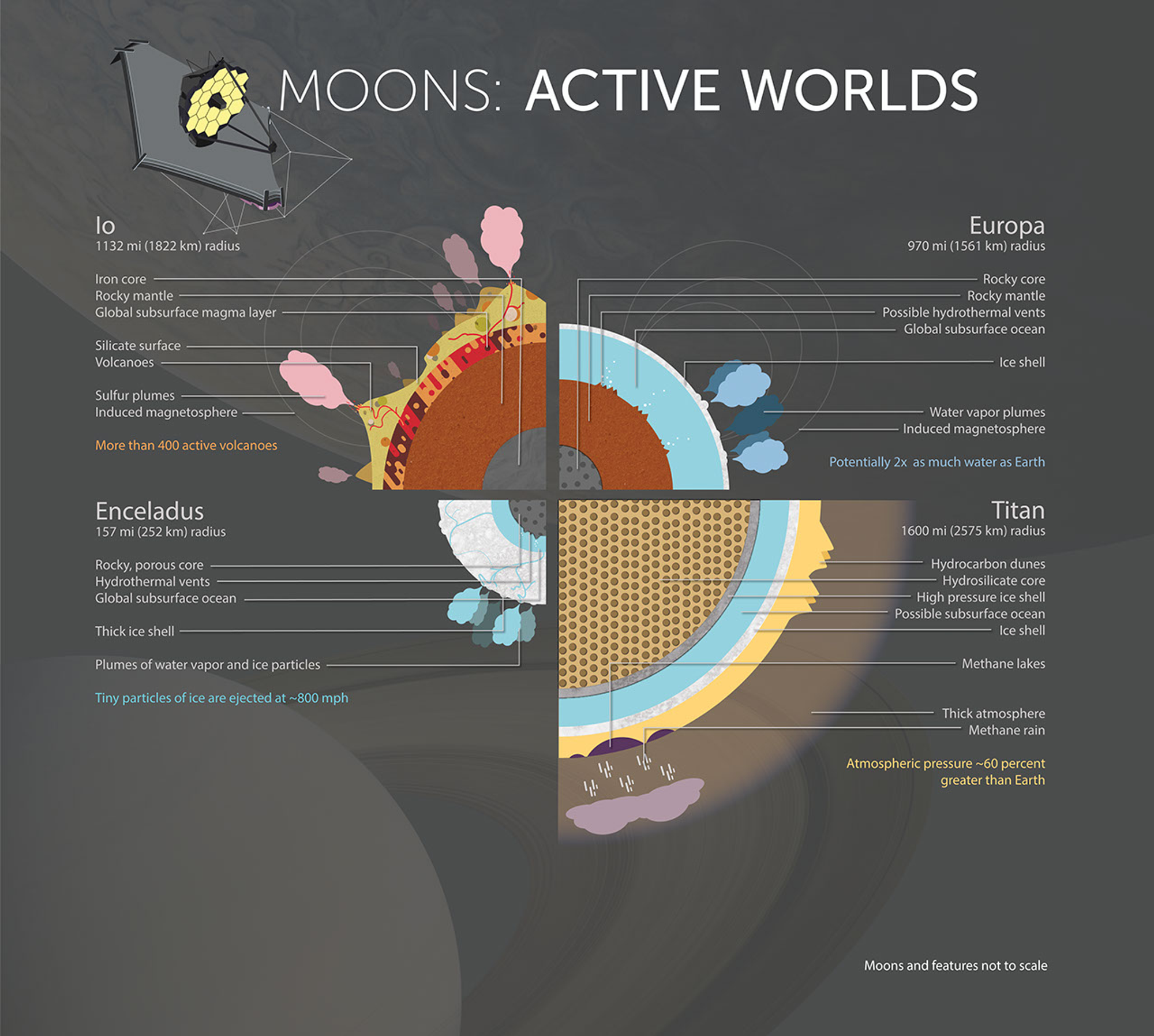
Io, Europa and Enceladus show the result in three radically different forms. Io converts the energy into molten rock and eruptions. Europa appears to spend part of it maintaining a saltwater ocean below ice. Enceladus concentrates activity near its south pole, where warm fractures release water vapour and ice into space.
The shared mechanism is tidal heating. The crucial point is not simply that Jupiter and Saturn pull hard. It is that the deformation changes through an orbit, flexing each moon over and over.
A tide is a difference in gravity
The side of a moon nearest its planet feels a slightly stronger gravitational pull than the far side. That difference stretches the moon. If the orbit were perfectly circular and the moon’s shape stopped changing, the tidal bulge could settle into a mostly steady configuration.
Io, Europa and Enceladus instead follow slightly eccentric orbits. Their distance from the planet varies, changing the strength of the tide. Rock and ice are squeezed, relaxed and squeezed again. Because real materials resist deformation, some mechanical energy is lost as heat, rather like a piece of metal warming when it is repeatedly bent.
The scale is easy to miss because these moons look solid. NASA estimates that Io’s surface can rise and fall by as much as 100 metres under Jupiter’s changing tide. Solid ground on a body slightly larger than Earth’s Moon is moving by the height of a tall building.
Resonance keeps the squeezing alive
Tidal friction normally damps eccentricity. Left alone, a moon tends toward a more circular orbit, which reduces the changing stress and eventually weakens the heating. Neighbouring moons interrupt that quiet ending with precisely timed gravitational nudges.
Io, Europa and Ganymede are locked into a 4:2:1 resonance around Jupiter. For every orbit Ganymede completes, Europa completes two and Io completes four. Their recurring alignments preserve small departures from circular motion. At Saturn, Enceladus circles twice each time Dione goes around once. NASA’s Enceladus overview explains that Dione keeps Enceladus’s orbit slightly elliptical, allowing Saturn’s tidal force to keep changing.
No energy appears from nowhere. Heating draws on the rotational and orbital energy of the system. Moons and planets exchange angular momentum, and their orbits slowly migrate. A resonance can sustain activity for a very long time, but it is not a perpetual-motion machine.
Io is the high-heat end of the experiment
Io is the innermost Galilean moon and receives the strongest tidal forcing. It has hundreds of volcanoes, lakes of lava and eruptions capable of throwing material hundreds of kilometres above the surface. New volcanic deposits continually cover old terrain, leaving few large impact craters.
Voyager 1 exposed this activity in 1979. As Space Daily has previously recounted, navigation engineer Linda Morabito spotted a plume while examining an image taken to check the spacecraft’s position. It was the first active eruption observed beyond Earth.
Io is also a useful correction to the idea that internal warmth is automatically favourable for life. Extreme tidal heating produces a violently volcanic, intensely irradiated world with almost no water. The mechanism that preserves an ocean elsewhere pushes Io toward the opposite extreme.
Europa is a colder middle case
Europa orbits farther from Jupiter and is heated less fiercely. Its outer layer is dominated by water rather than exposed silicate rock: probably 15 to 25 kilometres of ice above a global salty ocean perhaps 60 to 150 kilometres deep, according to NASA’s Europa summary.
The case for that ocean combines Europa’s fractured, geologically young surface with Galileo measurements consistent with a global electrically conductive layer. Tidal heat can help keep the water liquid and may support volcanic or hydrothermal activity at the rocky seafloor. Exactly where the energy is dissipated among ice, water and rock remains a modelling question.
Our recent look at ocean moons beyond the traditional habitable zone considered what this does to the search for life. The boundary matters: water and energy make Europa potentially habitable, not inhabited. Europa Clipper is travelling to Jupiter to investigate the moon’s ice, composition, geology and interior. It is not a direct life-detection mission.
Enceladus turns heat into a sample stream
Enceladus is only about 500 kilometres wide, yet Cassini found strong evidence for a global saltwater ocean and jets erupting from four long fractures near its south pole. Water vapour and ice leave those “tiger stripes” at roughly 400 metres per second. Some material falls back; some becomes part of Saturn’s E ring.
The pole should receive less solar energy than the equator, but Cassini measured it as warmer. Parts of the fractures reached around minus 93 degrees Celsius, much warmer than the terrain around them. Sunlight could not account for where the heat was appearing.
Early models struggled to sustain the observed activity by flexing the ice shell alone. A 2017 study described by the European Space Agency found that tidal friction in a porous rocky core could generate up to about 30 gigawatts. Water moving through deforming rock would collect heat, rise toward the seafloor and help focus activity beneath the unusually thin south-polar ice.
This arrangement makes Enceladus unusually accessible. As we noted when comparing Europa’s water with Enceladus’s vents, a spacecraft can sample the hidden ocean without drilling through the shell. Cassini found salts, organic compounds, silica grains and molecular hydrogen, but it was not built to establish whether the ocean contains life.
The grip is continuous, not necessarily eternal
The title’s gravitational grip captures the repeated nature of tidal forcing. A moon cannot undergo one flex and then remain still. As long as its eccentric orbit and resonance persist, the changing shape keeps doing internal work.
Over geological time, however, the machine changes. Orbits migrate, resonances can begin or end, interiors cool, ice shells change thickness and the main site of dissipation can move. Researchers still debate whether Enceladus has operated continuously for billions of years or passed through warmer episodes. Even the pattern of heat emerging from Io does not line up perfectly with simple tidal models.
The defensible conclusion is narrower than eternal heating and more consequential than a curiosity: distance from the Sun does not decide whether a world can remain active inside. A giant planet, neighbouring moons and a slightly imperfect orbit can convert motion into heat over immense spans of time.
Io, Europa and Enceladus are demonstrations of the same gravitational machinery under different conditions. Across three moons, it produces lava, preserves a dark ocean and drives water into space.