The Montreal Protocol produced a result that can be measured in the atmosphere. Nearly all controlled ozone-depleting substances have been phased out, and the ozone layer is expected to return towards its 1980 condition over the coming decades.
Low-Earth orbit is now creating a different source of reactive material. Short-lived satellites vaporise metal as they reenter. Aluminium reacts with oxygen during that destruction, forming particles of aluminium oxide, usually called alumina.
The concern is scientifically plausible, but its scale remains unsettled. Researchers have measured spacecraft metals in stratospheric aerosol, modelled alumina production during reentry and established the relevant surface chemistry. They have not measured a satellite-driven reversal in global ozone recovery.
The ozone recovery is real but incomplete
The UN-backed 2022 Scientific Assessment of Ozone Depletion says nearly 99 per cent of banned ozone-depleting substances have been phased out. Assuming countries continue to comply, total ozone is projected to return to 1980 values around 2040 across most of the globe, 2045 in the Arctic and 2066 over Antarctica.
The treaty did not remove every CFC molecule from the air. It stopped most new production and consumption of the controlled chemicals, while their long-lived atmospheric burden began a slow decline. Chlorine left behind by those compounds is one reason recovery still takes decades.
That distinction matters because aluminium oxide does not need to carry new chlorine into the stratosphere to affect chlorine chemistry already there.
A satellite does not simply disappear
A 2024 Geophysical Research Letters paper by José Ferreira and colleagues modelled a 250-kilogram satellite containing 30 per cent aluminium. Its atom-scale simulation estimated that about 32 per cent of the aluminium would oxidise during reentry, producing just under 30 kilograms of alumina clusters between one and 100 nanometres across.
Applying that model to the recorded satellite population, the authors estimated that reentries in 2022 generated about 17 tonnes of aluminium oxide. In a scenario where planned mega-constellations were fully deployed and regularly replaced, the figure rose above 360 tonnes per year.
Those are model estimates, not atmospheric weighings. The paper simulated oxidation and transport, then identified an ozone-depletion pathway. It did not calculate how much global ozone would actually disappear.
How alumina can awaken chlorine
Aluminium oxide does not supply chlorine. It provides a solid surface on which relatively stable chlorine reservoirs can be converted into more reactive forms. Once activated, chlorine participates in catalytic cycles that destroy ozone and regenerate the chlorine, allowing it to react again.
This is related to the heterogeneous chemistry that made polar stratospheric cloud particles so consequential in the Antarctic ozone hole. The particles are not interchangeable, and their reaction rates depend on composition, coating, temperature and surface area. The shared point is that a particle surface can change which chemical pathways are available.
The 2024 model suggested that tiny alumina particles released near 80 kilometres could take up to 30 years to descend towards 40 kilometres, where chlorine activation becomes relevant. The delay complicates both measurement and policy: a rapid rise in reentries may not produce its full stratospheric effect immediately.
Spacecraft metals are already in stratospheric particles
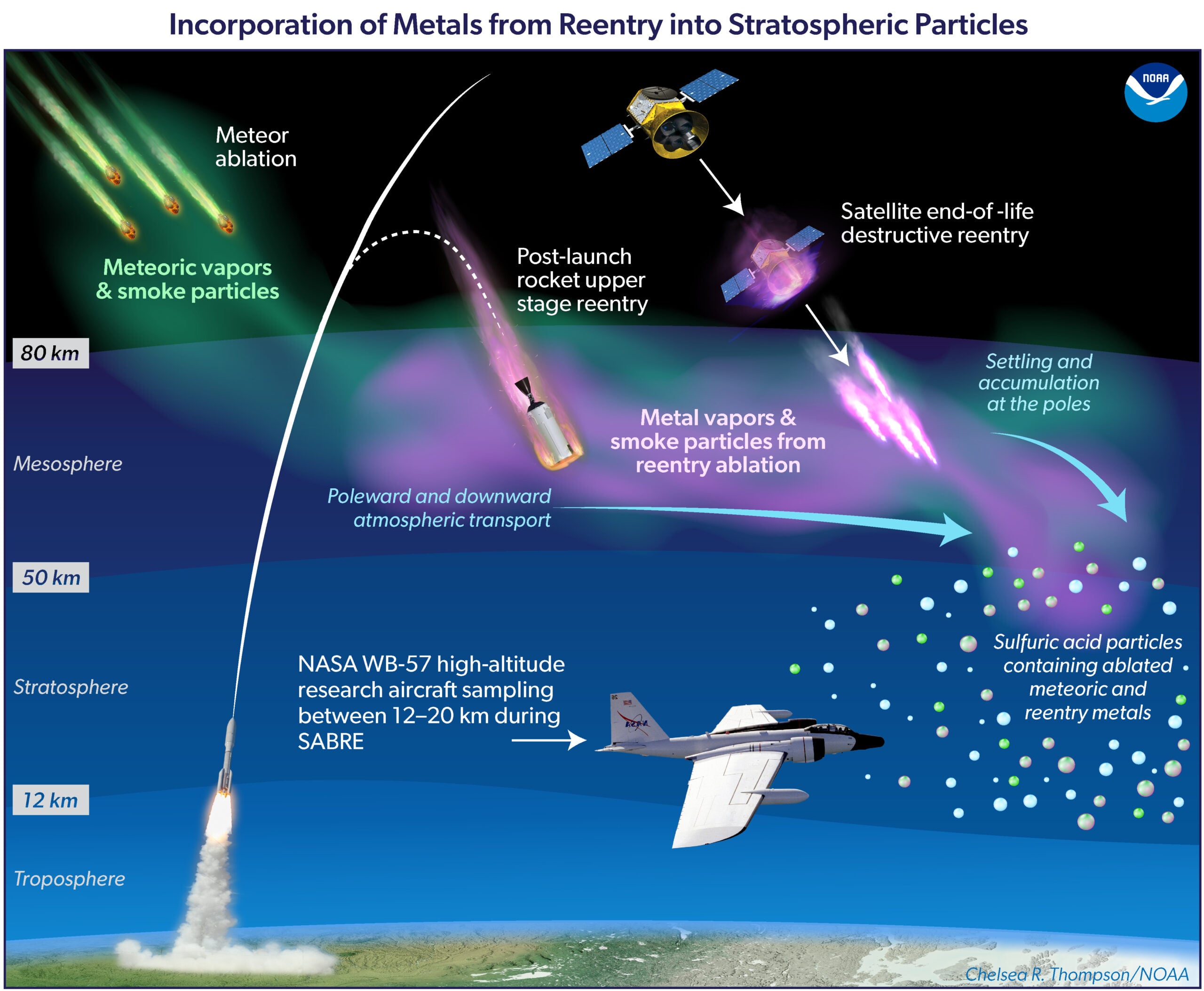
NOAA supplied the observational piece in 2023. A high-altitude aircraft carrying the agency’s PALMS mass spectrometer sampled individual aerosol particles and found that about 10 per cent of stratospheric sulphuric-acid particles larger than 120 nanometres contained aluminium and other elements associated with spacecraft reentry.
The ratios of aluminium, copper, niobium and hafnium matched aerospace alloys closely enough to separate the material from ordinary meteoric dust. It was the first unambiguous observation of spacecraft reentry pollution incorporated into stratospheric aerosol.
It was not a measurement of alumina-driven ozone destruction.
NOAA described the influence of that metallic content on aerosol properties as unknown and estimated that the affected fraction could eventually rise to half of stratospheric particles if low-Earth-orbit traffic expands as projected.
“Thousands” describes the pipeline, not one falling swarm
The latest ESA space-environment statistics, updated on 31 July 2026, list about 16,000 functioning satellites in orbit. A 2025 atmospheric study counted 9,692 spacecraft below 600 kilometres as of March that year and concluded that most would reenter within five to ten years because of atmospheric drag.
ESA separately reported that intact satellites and rocket bodies were already reentering more than three times a day on average in 2024. So thousands are not burning together. Thousands of relatively short-lived machines are moving through a replacement cycle whose waste stream ends in the atmosphere.
This is the awkward trade-off behind responsible disposal. As I noted in an earlier article about orbital debris, dead spacecraft left aloft can collide and manufacture thousands of new fragments. Bringing them down protects the orbital environment, but burning them up is not chemically invisible.
The best current estimate is small, with large uncertainties
A 2026 Earth’s Future study led by Connor Barker modelled launch and reentry emissions from 2020 to 2029. It projected global chemical loss of stratospheric ozone of about 0.02 per cent by 2029 from all space missions, compared with roughly 2 per cent associated with regulated sources in 2022. Chlorine from solid rocket motors dominated the modelled loss. Reentry alumina made a negligible contribution under that study’s assumptions.
That result does not cancel the catalytic mechanism. It shows how strongly the answer depends on particle size, the fraction of a spacecraft that vaporises, chemical coatings, vertical transport, residence time and the future launch market. The 2024 paper identified a credible pathway and a potentially large future source. The 2026 paper calculated a small near-term effect using a coupled atmospheric model.
The ozone layer is still recovering, and satellites now introduce a pollutant the Montreal Protocol was never designed to manage. The remaining question is quantitative: how much reentry alumina reaches ozone-rich air, what form it takes there, and how much chlorine chemistry its surface actually drives.