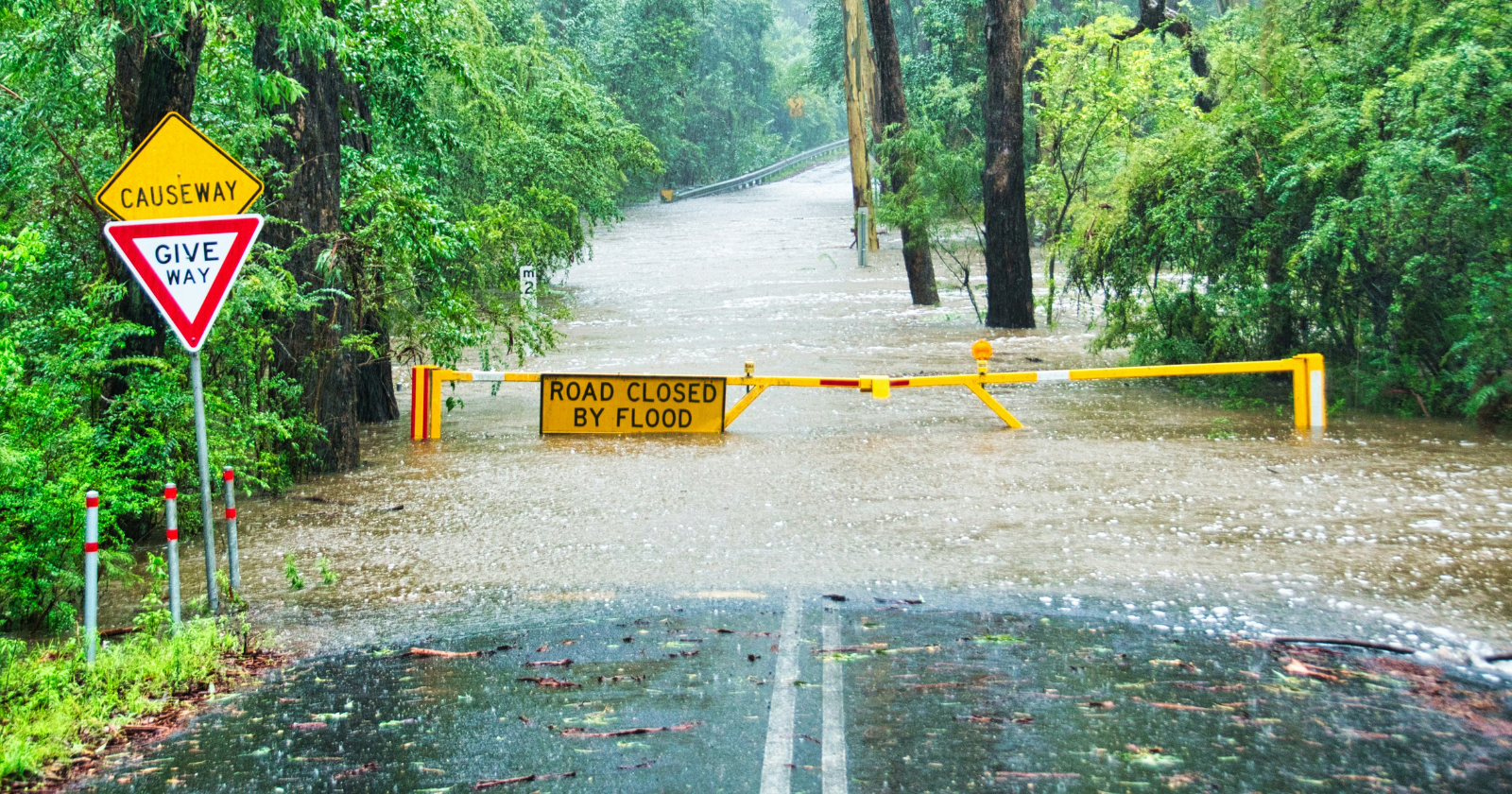
A hurricane gives you warning. A cold front gives you warning. What NASA described for the middle of the next decade gives you almost none of that, and that absence of warning is the detail that stopped me when I first read the study: a clear sky, flat calm water, and a street that floods anyway.
That is the specific, unsettling scenario a 2021 NASA-led study put an actual date on, and the date is close enough now, less than ten years out, that I think it is worth understanding exactly what is coming and why the moon, of all things, is the reason.
The mechanism behind it is not new. The moon has been raising two tidal bulges in Earth’s oceans for as long as there has been a moon: one bulge reaching toward it, one left behind on the far side, with the planet rotating through both every day, which is why most coastlines get two high tides on a normal schedule. What changes on a much longer clock is how tall those bulges get, and that longer clock is about to roll into the part of its cycle that makes an ordinary tide reach higher than it has in years.
The 18-year rhythm hiding inside your ordinary tide
The moon’s orbit is tilted relative to Earth’s equator, and that tilt itself slowly rotates, completing one full lap every 18.6 years, a rhythm astronomers have tracked for centuries. For roughly half of each cycle, the tilt works against the ordinary tidal bulge and mutes it, giving milder high tides than average. For the other half, it works with the bulge and stretches it taller. We are currently past the muting half. The amplifying half begins in the middle of the next decade, and it will not arrive on a coastline sitting at the same sea level it sat at during the last amplifying phase back in the 2010s.
That timing is the entire problem. An amplifying lunar cycle on its own has shown up every 18.6 years for the planet’s whole history without much incident, because the ordinary tide it stretches has always settled back down to roughly the same baseline afterward. This time the baseline itself has moved, quietly, underneath the cycle, thanks to decades of sea level rise from a warming ocean and melting ice. Layer a stronger tide on top of a higher starting point and the extra inches that used to stay in the harbor start reaching the parking lot.
What NASA is actually predicting
Ben Hamlington, who leads NASA’s Sea Level Change Team at the Jet Propulsion Laboratory, put it plainly when the study came out: “We’re getting closer and closer to the flooding thresholds or tipping point in these coastal locations. The same variability in the past that didn’t cause flooding is now going to cause flooding.” The study projects that once the amplifying phase lines up with current sea levels, a majority of the U.S. coastline will see three to four times as many high-tide flood days each year, and rather than spreading evenly through the calendar, those floods cluster into just a few months at a time, turning what used to be two or three nuisance floods a month into a dozen or more. Three to four times is not a rounding error.
The Vessel channel has put together the fuller physics of how the moon does this, the tidal bulges, the Apollo-era mirrors that let scientists measure the moon drifting away by laser, even the Babylonian eclipse tablets used to prove Earth’s spin is slowing, in a video below. It walks through the whole mechanism this specific flooding forecast is just one consequence of.
Why “no storm” is the part that should worry planners
William Sweet, an oceanographer with NOAA, has spent years describing this exact category of flood: minor by itself, dangerous in accumulation. “Right now, they’re mostly minor as individual events, but the cumulative frequency is starting to become damaging and taxing on infrastructure around America,” he said. “Now’s the time to start planning on how to live with water and maintain the viability of these important coastal communities.” A dozen floods a month for a decade is not a single dramatic event a city can brace for once and move past. It is a slow tax on roads, drainage systems, and basements that never quite dry out, paid in small installments that are each too minor on their own to make the news.
A slow flood is not a story until it already is one
People prepare for storms comparatively well. A named hurricane gets a forecast track, a curfew, sandbags stacked days ahead, an evacuation order if it is bad enough. Nuisance flooding gets none of that theater, and NOAA’s own definition of the phenomenon makes the mismatch obvious: minor tidal flooding that overtops old sea walls or pools water on low-lying roads, in the agency’s own words “not necessarily widespread or damaging, but just… relatively easy to navigate around.” Easy to navigate around is precisely the trap. A single flooded parking lot is a minor inconvenience. The same parking lot flooding a dozen times a month for ten years running becomes an infrastructure problem nobody budgeted for, because it never looked urgent enough on any one day to move up the list.
NOAA’s own modeling for some East Coast tide stations puts the coming increase at somewhere between a 33 percent and 125 percent jump in nuisance flood days, depending on the location, once this wobble cycle and sea level rise stack together. That is a wide range, and it is wide for a real reason. Coastal geography, local land subsidence, and the shape of a given harbor all change how much extra water actually shows up on a given street, which is also why the fix looks different from one coastline to the next instead of resolving into one national answer.
None of this is a reason to panic about a specific street tomorrow, and the flooding will not look like the news footage most people picture when they hear the word. It looks like a parking lot with an inch of water in it on a calm afternoon with not a cloud overhead, which is exactly why I think it is easy to miss until it is routine. The risks that quietly become the biggest ones are rarely the dramatic ones. If you own or manage property along a U.S. coastline, NOAA’s own tide and flooding outlook for your specific location is a better guide than any general warning, mine included. The moon has been keeping this particular appointment for over four billion years. This is simply the decade it starts showing up on a lot more doorsteps.