

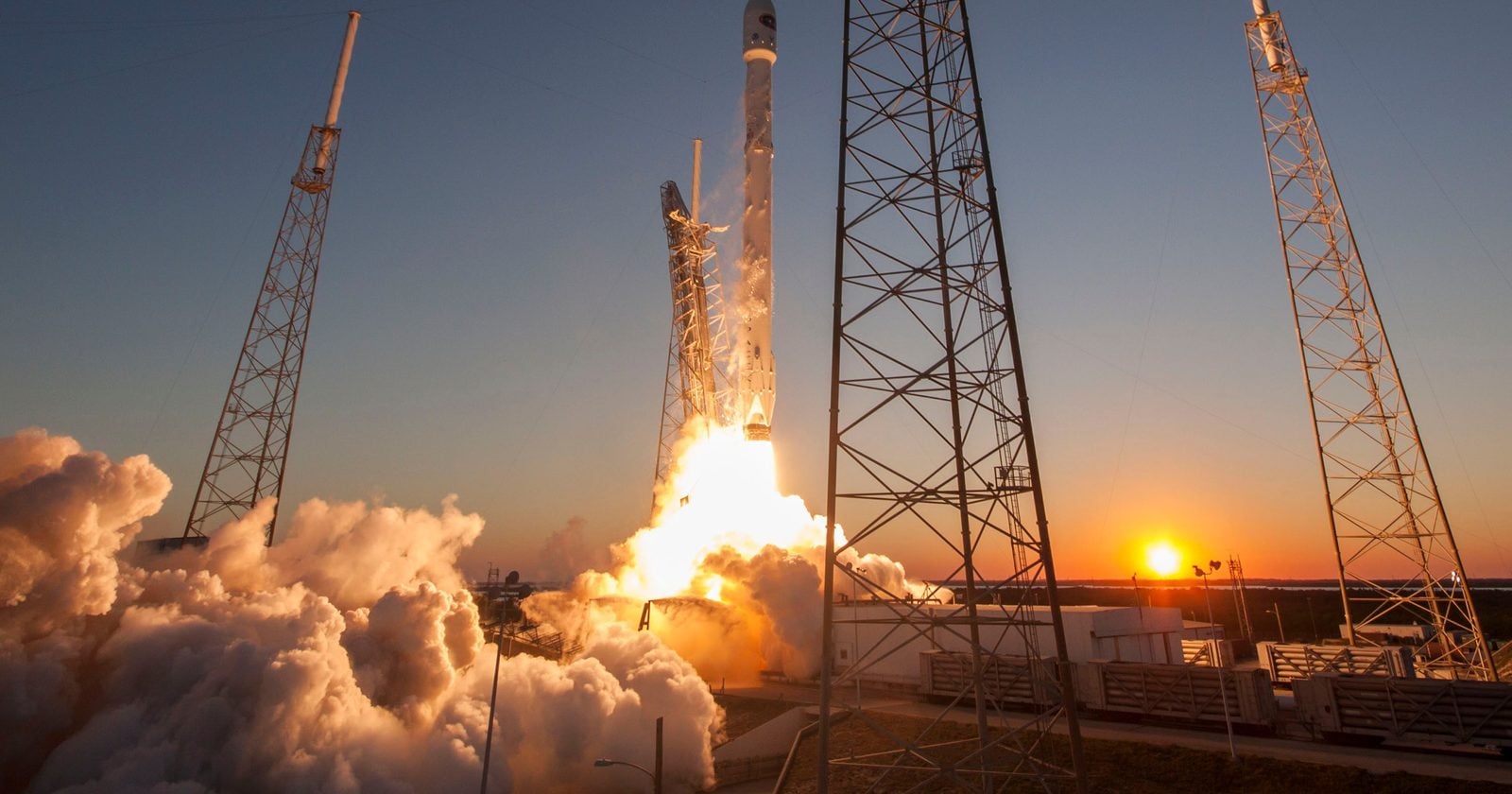
A rocket launch used to be an event. You cleared your schedule, found the livestream, told people about it afterward. That reflex is worth keeping in mind, because what SpaceX did in the small hours of 19 August did not feel like an event at all. It felt like a shift change.
The mission itself was ordinary by the company’s own standards. A Falcon 9 carrying 24 Starlink satellites lifted off from Vandenberg Space Force Base in California, crossing into the early hours of 19 August UTC.
What made it worth writing down was the count. It was SpaceX’s 100th launch of the year, reached by mid-August. The company first topped 100 launches in 2024, on its way to 138 that year, but did not hit the mark until well into the autumn. Same milestone, reached about two months sooner.
The number itself
One hundred launches by 18 August works out to a bit over three a week. That is the part we keep turning over. Not the record, but how ordinary it has become. When something happens more than three times a week, it stops registering as news and starts registering as infrastructure, like train departures or flights out of an airport.
Anne Mason, SpaceX’s director of national security space launch, put the strangeness of that plainly last year. “I always find it amazing,” she said, “that this cadence has become somewhat normal.” That is a telling thing for someone inside the company to admit. The people flying these rockets are also a little startled by how routine the extraordinary has become.
How fast the curve bent
The speed of the climb is the real story. SpaceX flew 25 launches in 2020, then 31, 61, 96, 134, and 165 through 2025. Each year the number outran the last.
Mason described the same jump from the inside: “if we look back just five years ago, in 2020 when we launched roughly 25 times, which is still a healthy rate at twice a month, and now launching on average every two to three days.”
Twice a month to every two to three days, in five years. That kind of curve does not happen by launching harder. It happens by building faster. Mason pointed to the factory as the thing that actually sets the pace: “We have a second stage coming off the production line every two and a half days.” Falcon 9’s boosters land and fly again, but the top part of the rocket is thrown away on every flight. To launch every couple of days, you have to build a new one at roughly the same rate. The pace in the sky is really a pace on the assembly line.
Set 2025 next to the rest of the world and the imbalance is hard to look away from. As reported by Space.com, SpaceX’s output that year was nearly twice as many launches as all of China and about 85 percent of the total US figure. One company had become a meaningful share of everything humanity was putting into orbit.
What is actually flying
Almost all of it is Starlink. The vast majority of these hundred launches carried the company’s own internet satellites, which now number around 10,000 active spacecraft, making SpaceX the largest satellite operator in the world by a wide margin. A June 2026 count from the French space-tracking firm Look Up put Starlink at nearly two-thirds of every working satellite orbiting Earth.
This is the part that reframes the whole achievement. The launch pace is not being driven by a booming market of outside customers clamoring for rides. It is driven mostly by SpaceX flying SpaceX’s own hardware to build SpaceX’s own network. The rocket company and the internet company are the same company, and each feeds the other. That loop is what lets the numbers pile up the way they do.
The cost of a sky that busy
A sky that busy is not free of consequence, and we should be plain that we are not orbital-mechanics specialists while the people raising these concerns are.
Drawing on SpaceX’s own filings to the Federal Communications Commission, Space.com reported that Starlink satellites made over 355,000 collision avoidance maneuvers across the past year. Each satellite now dodges debris or other spacecraft on an almost weekly basis. That total is more than three times the count from 2024.
Those maneuvers are happening in an already-crowded neighborhood. Scripps News, citing tracking data in 2024, noted there were more than 27,000 tracked pieces of space junk and nearly 7 million kilograms of debris in orbit. The worry attached to those figures has a name: Kessler syndrome. The idea is that one collision throws off enough fragments to cause the next, which causes the next, until a whole band of orbit becomes hard to use.
The scenario is far from settled. CNN describes Kessler syndrome as a hypothetical phenomenon with a fuzzy definition, and experts disagree about whether the process has even begun. In 2024, Vishnu Reddy, a planetary sciences professor at the University of Arizona, told CNN that “the number of objects in space that we have launched in the last four years has increased exponentially.” Other researchers are more cautious about where the tipping point sits.
SpaceX says it is taking the crowding seriously. The company announced in early 2026 that it would move thousands of Starlink satellites down from around 550 km to roughly 480 km. Michael Nicolls, the company’s vice president of Starlink engineering, argued that “the number of debris objects and planned satellite constellations is significantly lower below 500 km, reducing the aggregate likelihood of collision.”
Where the cadence is pointing
One hundred launches by August is not the destination anyone at SpaceX is aiming for. It is a stop on the way to something much larger.
Elon Musk has talked about eventually pushing annual totals to 1,000 or so, with Starship flying multiple times a day and Falcon 9 retired entirely. If Falcon’s climb from 25 to 165 in five years felt steep, that goal is on another order entirely.
The tension the century mark exposes is between routine and consequence. The whole point of SpaceX’s engineering is to make orbit boring, to turn a launch into a scheduled departure that nobody clears an afternoon for. It has largely succeeded. But boring and consequence-free are not the same thing. The fuller that band of low orbit gets, the more the industry will have to reckon with the fact that a cadence which no longer feels remarkable is still writing itself, permanently, into the space just above our heads.