

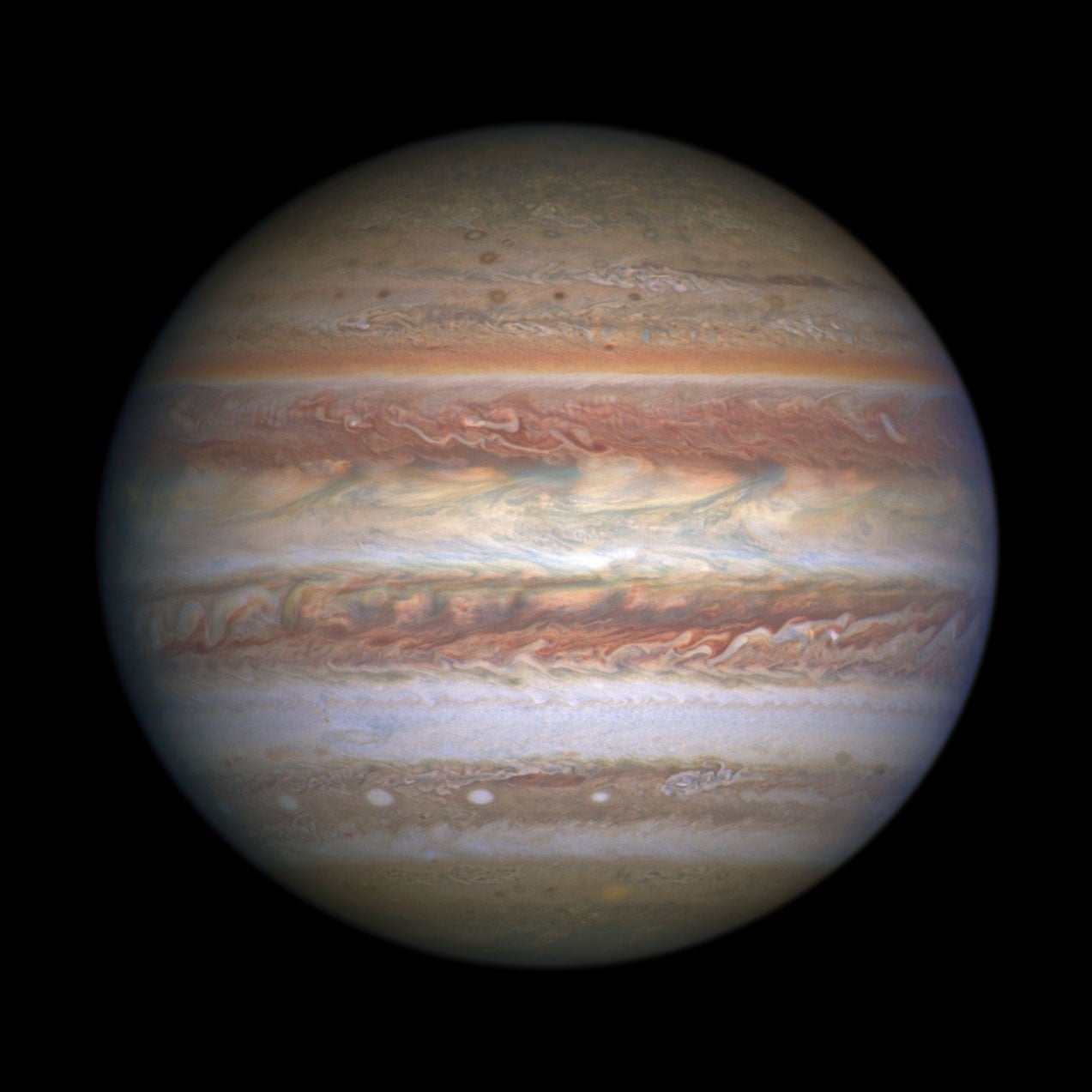
Carl Sagan and Edwin Salpeter began with a planet on which falling is not a temporary condition. Jupiter has no crust beneath its weather, no sea level followed eventually by ground, and no safe bottom where an organism could settle. Anything living in its atmosphere would have to remain airborne from birth to death.
In December 1976, the two Cornell scientists published “Particles, Environments, and Possible Ecologies in the Jovian Atmosphere” in the peer-reviewed Astrophysical Journal Supplement Series. Its most memorable inhabitants were tiny “sinkers,” vast balloon-like “floaters” and self-propelled “hunters.” The paper even considered a fourth group, scavengers living close to depths where heat would chemically destroy the remains of organisms descending from above.
The names sound like science fiction, but the work was a set of calculations. Sagan and Salpeter estimated particle motion, convection, buoyancy, growth, food supply and metabolic cost. They asked whether an imagined biology could reproduce before Jupiter’s circulation carried it into fatal heat, and whether a biological balloon could become large enough to stop sinking.
They did not claim to have found life. The NASA record of the original paper accurately describes an investigation of “possible” ecological niches. In the paper itself, the authors warned that a plausible and internally consistent ecology would not demonstrate that life on Jupiter was likely. This is one paper, not evidence of a discovered biosphere. No probe has detected a Jovian organism, biological pigment or accepted biosignature.
The real enemy was not pressure but downward time
Jupiter’s familiar stripes are clouds suspended in an atmosphere dominated by hydrogen and helium. Descend and the gas becomes continuously denser and hotter. There is no clean boundary where atmosphere ends and a liquid ocean begins. Deeper still, hydrogen becomes an electrically conducting fluid, while the planet’s central material may be diluted through a broad region rather than arranged as a tidy solid ball.
That structure matters to the 1976 ecology. As Space Daily explored in an earlier account of why Jupiter has nowhere to land, a descending object does not eventually hit a surface. It is heated, compressed, broken down and absorbed.
Sagan and Salpeter called the biological version of that ending convective pyrolysis. Organic matter drifting or being carried deep enough would encounter temperatures that decompose it. An organism therefore faced a clock: grow and reproduce before it fell out of the useful atmospheric layer.
The problem works in the other direction too. At high altitude, gas becomes thinner and colder, ultraviolet radiation is stronger and useful materials may be scarce. Somewhere between those extremes can be a pressure-temperature band that looks less immediately hostile. But an atmospheric band is not a room. It convects, mixes, rises and sinks.
The paper’s first half built this physical stage. It considered cloud particles, coloured compounds called chromophores, vertical diffusion and possible organic chemistry. Its second half placed hypothetical organisms into that moving environment and compared their growth times with their descent times.
Sinkers would survive as a population by losing individuals
The model for sinkers came from Earth’s oceans. Microscopic phytoplankton occupy the sunlit upper water where photosynthesis is possible. Some sink out of that layer and die, while reproduction and turbulent mixing keep the larger population going.
A Jovian sinker would follow the same statistical strategy. It would be a small photosynthetic organism, slightly denser than the surrounding gas, absorbing sunlight and dividing while it drifted downward. Individual sinkers would eventually reach destructive heat. The population might persist if they reproduced quickly enough and atmospheric mixing returned enough daughter organisms to the upper layer.
This is why “sinking microorganisms” does not mean microbes trying and failing to fly. Sinking was part of the proposed life cycle. Smaller organisms fall more slowly and can reproduce faster relative to their mass, so the unforgiving downward clock could actually favour microscopic life.
The authors also examined heterotrophs that consumed organic molecules made without biology by ultraviolet chemistry. Jupiter contains methane, ammonia, hydrogen and other compounds from which more complex molecules can form under some conditions. Yet an inventory of organic chemistry is not an ecosystem. The paper had to assume production rates, capture efficiencies and biological behaviour that no observation established.
Jupiter’s colours provided another tempting idea. Sagan and Salpeter considered whether biological material might contribute to the poorly understood compounds colouring its clouds, while carefully separating that question from the rest of their ecological calculations. Modern observations still do not require biology to explain the colours. A chromophore is a substance that absorbs particular wavelengths, not a synonym for pigment made by life.
Floaters were not animals with wings but living balloons
A larger organism has a different problem. It can contain more specialised structures, but it also falls faster unless it controls its density. Sagan and Salpeter modelled floaters as thin spherical shells filled with gas and kept close to the same pressure as the atmosphere outside.
The buoyancy mechanism was ingenious. Jupiter’s atmosphere is mostly molecular hydrogen but includes helium, which raises its average molecular weight. A floater that pumped helium out of its interior would leave purer, lighter hydrogen inside. The small density difference could supply lift without requiring an impossible rigid pressure vessel.
Heating the internal gas was another route, but the paper found it less useful because heat would diffuse through the surrounding hydrogen quickly. Pumping helium demanded metabolism and a membrane, yet it offered a calculable way to remain at a favourable pressure level.
Size followed from structure. The skin adds weight, while the enclosed volume supplies buoyancy. Volume grows faster than surface area as a sphere gets larger, so a balloon with a thick, complicated skin must become enormous before the lift balances the tissue. For an effective structural thickness of about one centimetre, the paper said floaters would have kilometre dimensions.
That line later became one of the most recognisable images in Sagan’s Cosmos: giant airborne beings moving through a gas-giant sky. The scientific paper was less picturesque. It did not specify faces, intelligence, social behaviour or anything resembling a whale. “Kilometres across” emerged from a scaling calculation about skin and buoyancy, and the authors immediately noted that metabolism limited how large a floater could become.
Hunters introduced movement, but not necessarily teeth
Passive floaters and sinkers depend on nutrients or smaller organisms reaching them. A hunter improves that encounter rate by steering. Sagan and Salpeter calculated what happened if an organism could spend energy to move sideways through the atmosphere, search a larger volume and approach another organism before both descended too far.
The popular retelling turns this into straightforward predation. The paper was more abstract. It modelled organisms approaching and coalescing, and explicitly noted that hunting and mating might not be sharply distinguishable under those assumptions. It did not design a mouth, sensory organ or digestive system, although it suggested that optical sensors able to locate coloured organisms and acceleration sensors able to find rising thermals would improve the odds.
Its maximum-size table varied dramatically with food and manoeuvrability. Hunters relying on sparse organic matter made without life remained much smaller. Those feeding in a rich population of photoautotrophs could, under the most favourable assumed steering, reach kilometre scales. One extreme entry allowed a 20-kilometre size parameter. That number is best read as the edge of a model, not a forecast of a 20-kilometre predator.
The ecological sequence was the more interesting point. Sinkers might first evolve limited movement to find and merge with food. More capable hunters could grow larger. Once large enough, an organism could gain buoyancy and become a true floater, perhaps releasing offspring already large enough to avoid repeating the sinking stage.
The fourth category, pyrolytic scavengers, occupied the lower boundary. They would use products created as other organisms decomposed in deeper heat. Sagan and Salpeter treated these as a specialised form of floater. Even in their imagined biosphere, there was no bottom-dwelling community because there was still no bottom.
Galileo and Juno found a more complicated atmosphere, not an ecosystem
The paper appeared after the Pioneer flybys but before Voyager reached Jupiter. The Galileo atmospheric probe did not make its descent until 7 December 1995. It entered at roughly 170,000 kilometres per hour, opened a parachute and transmitted measurements for 58 minutes before heat silenced it at about 22 bars of pressure.
Galileo sampled only about 120 kilometres below the conventional one-bar reference level. It also entered an unusually dry meteorological region, limiting how confidently its water measurement could be applied to the planet. NASA’s later comparison of Galileo and Juno makes clear how local that descent was. The probe was designed to analyse temperature, winds, pressure, clouds, lightning and composition, not to catch floaters or test for life.
NASA’s Juno orbiter has since looked far deeper with microwave measurements and revealed that ammonia and water are distributed unevenly. Violent storms can loft water ice into cold upper layers where ammonia partially melts it. Collisions can electrify these droplets and help produce shallow lightning, while larger ammonia-water hailstones may fall into the depths. The Juno team described this proposed ammonia-water transport cycle in 2020.
Space Daily reported those “mushball” and shallow-lightning results when they appeared. They give the 1976 descent problem a sharper modern edge. Material is not merely drifting through neat layers; storms can move water and ammonia vertically across great distances, while precipitation can carry them down.
None of this is evidence of an ecology. It does show why a simple habitable altitude is not enough. Any aerial life would need continuity through a weather system that rearranges its water, nutrients, temperature and altitude.
A modern water result leaves one narrow door open
One later result is genuinely relevant. A 2021 Nature Astronomy study of water activity in planetary clouds concluded that parts of Jupiter’s clouds combine temperatures and biologically available water in a range permissive for some known terrestrial microbes.
Water activity is not simply humidity or total water abundance. It measures how available water molecules are for biological processes. On Earth, even extremophiles stop growing below a measured limit. The 2021 analysis found Venus’s sulfuric-acid clouds far below that threshold, but placed a region of Jupiter above it.
That result does not vindicate sinkers, floaters or hunters. It checks two boxes, water availability and temperature, across part of an atmospheric profile. It does not establish that suitable droplets persist, that carbon and nutrients arrive in usable forms, that energy can be harvested, that harmful chemistry is absent, or that life could originate and maintain a population there.
The origin problem is the largest gap in the 1976 paper, and its authors said so. Showing that a fully functioning organism could grow under selected conditions is different from showing how chemistry crossed into replication and evolution. Earth offered long-lived oceans, mineral surfaces, shorelines and repeated wet-dry environments. Jupiter offers enormous volume and abundant interfaces among gas, droplets and particles, but every possible laboratory is in motion and some of its contents are continually carried into destructive depths.
NASA’s current Jupiter overview consequently describes the planet itself as probably unsuitable for life as we know it. The more practical astrobiological targets in the system are icy moons. In another recent article, Space Daily examined why Europa and Enceladus can keep oceans liquid through tidal heating. Those environments may provide long-lived water, chemical gradients and contact with rock, even though reaching them is difficult.
Why the paper still matters after nearly fifty years
The Sagan-Salpeter ecology survives because it did something more durable than invent memorable creatures. It refused to assume that a habitat needs ground. Then it replaced that freedom with numbers.
How fast does an organism fall? How quickly can it divide? How thick must its membrane be? How much lift comes from removing helium? How much energy does steering consume? How frequently must food appear in the volume it can search? At what depth does heat destroy it? Each question turned a picture into a constraint that could, at least in principle, be compared with evidence.
The calculations were necessarily tied to 1970s knowledge and broad assumptions about Earth-like biochemistry. Jupiter’s real cloud structure, ammonia circulation, water abundance and storms have proved more heterogeneous than early one-dimensional pictures implied. The paper also could not solve abiogenesis, establish a stable liquid habitat or identify a remotely detectable biological signal.
Yet the central thought remains useful for exoplanets and cool substellar objects. A world can contain an atmospheric layer with tolerable temperature and pressure even when everything above and below is hostile. Whether that layer can become a self-contained biosphere depends on residence time, cycling, solvent, nutrients and energy, not on the presence of a landscape.
There are no known sinkers in Jupiter’s clouds, no kilometre floaters crossing the Great Red Spot and no hunters pursuing them. The achievement of the 1976 paper was not to make those creatures probable. It was to make an extraordinary idea answer to physics, and to show exactly where imagination ends and evidence would have to begin.