A 1.6-pound piece of metal fell out of orbit on March 8, 2024, crossed the roof of a home in Naples, Florida, continued through the second floor and stopped in the subflooring. The homeowner’s son was inside and in a nearby room. Nobody was physically injured.
The object was small enough to hold in one hand, but it came from a discarded structure weighing about 5,800 pounds. NASA had expected the entire International Space Station battery pallet to burn up during atmospheric entry. When the agency examined the recovered fragment, it identified a heat-scarred support post made from Inconel, a nickel alloy designed for punishing temperatures.
The physical survival was surprising. The legal route that followed was stranger. Space law gives people and property a place in its definition of damage, yet its international claims machinery is built around states. It does not give a homeowner a direct treaty claim against NASA, SpaceX or any other operator.
A battery pallet spent three years falling home
NASA ground controllers used the station’s robotic arm to release the cargo pallet in March 2021. It carried aging nickel-hydride batteries removed during an upgrade to lithium-ion units. Atmospheric drag gradually lowered the unguided hardware until it re-entered nearly three years later.
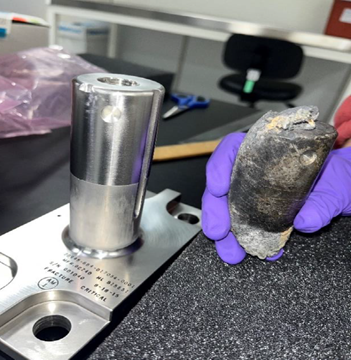
In its official analysis of the recovered object, NASA said the released hardware had a total mass of roughly 5,800 pounds. The surviving piece was a stanchion from NASA flight support equipment used to mount batteries on the pallet. It weighed 1.6 pounds, stood four inches high and measured 1.6 inches in diameter.
The fragment went much farther into the Otero family’s house than the phrase “punched through the roof” alone suggests. An account by the family’s attorney says it passed through the second floor and reached the subflooring below. Photographs show its surface melted, blackened and rough beside an undamaged example of the same component.
NASA said its engineering models had predicted complete destruction. Re-entry modelling combines mass, shape, orientation, material properties and a changing flow of extreme heat. A dense component made from a high-temperature alloy can behave differently from the larger assembly surrounding it. The agency said the station programme would investigate why the stanchion survived and update its models where necessary.
The Outer Space Treaty makes private activity a state concern
The foundation is the 1967 Outer Space Treaty. Article VI says states bear international responsibility for national activities in space, whether a government agency or a non-governmental entity conducts them. Private space activity must be authorised and continuously supervised by the appropriate state.
Article VII then establishes international liability for a state that launches or procures the launch of an object, or from whose territory or facility it is launched. That wording can produce more than one “launching state” for a single mission. Ownership alone does not decide the answer.
This is the important qualification to the headline. The Florida incident itself was not a simple private-company accident. NASA identified the fragment as NASA flight support equipment released from a multinational station, and the family pursued NASA. The private-company issue is the architecture exposed by the case: even when a commercial operator is involved, the treaty system places international responsibility and liability on states.
The Liability Convention is strict on the ground
The 1972 Convention on International Liability for Damage Caused by Space Objects adds detail. It defines a launching state as one that launches or procures a launch, or one whose territory or facility is used. A “space object” includes component parts, so a small stanchion does not escape the framework merely because it separated from a larger pallet.
For damage on Earth’s surface or to aircraft in flight, Article II applies absolute liability. A claimant state does not need to prove negligence by the launching state. Damage to another space object away from Earth’s surface follows a different, fault-based rule.
Absolute liability sounds like a direct guarantee to the person under the falling object. It is not. Under the convention, a state presents a claim to a launching state through diplomatic channels. If the injured person is a Florida homeowner and the relevant object belongs to the United States, there is no foreign claimant government needed to activate that state-to-state route. The convention also does not create a private right of action that an individual can file directly against an agency or company.
The Otero family made a domestic claim and settled
The family used a United States administrative process. SpaceDaily reported in June 2024 that the Oteros were seeking more than $80,000 from NASA for uninsured property loss, business interruption, emotional distress and other costs. Their homeowner’s insurer separately sought recovery for repair payments.
NASA has authority under its domestic regulations to consider property and personal-injury claims. The relevant rule covering claims against the United States arising from NASA conduct includes the Federal Tort Claims Act and separate statutory settlement authority, each with its own limits and conditions.
The public story did not end with the 2024 demand. In a 2025 legal-journal article, Mica Nguyen Worthy, the attorney who handled the matter, reported that NASA offered to settle on November 22, 2024. According to that non-confidential account, NASA ultimately paid $44,151.22 in total: $7,500 to Cindy Otero, $10,000 to Alejandro Otero, $12,500 to Daniel Otero and $14,151.22 to the homeowner’s insurer.
The account says NASA resolved the claims without admitting fault or liability. Settlement therefore produced compensation but no court decision establishing a negligence standard for the next domestic debris strike.
Private companies are not simply immune
Saying that treaties focus on launching states does not mean commercial operators can drop hardware without consequence. It means international liability and private legal liability occupy different layers.
A victim may have remedies under national tort law. Contracts can allocate risk among launch providers, customers and contractors. Licensing regimes can require insurance, and governments may seek reimbursement or contribution from operators. Which route applies depends on the operator, the launch licence, the place of impact, the states involved and the agreements behind the mission.
In the United States, the FAA requires licensed launch and re-entry operators to demonstrate financial responsibility. The agency calculates a maximum probable loss for third-party death, injury and property damage, and operators generally meet the amount through insurance, escrow or reserved funds. The maximum probable loss is not the maximum possible loss, and the statutory system also contains risk-sharing provisions for claims above required coverage.
Those rules are a domestic bridge between the treaty obligation resting on the United States and the commercial company carrying out the activity. Other countries build their own bridges. The result is not one universal claims form but a patchwork beneath a state-centred international framework.
The gap is procedural as much as legal
The Florida case did not prove that space law leaves every victim uncompensated. The Oteros and their insurer were paid. Nor did it test a direct claim against a private company, because the confirmed fragment was NASA hardware and the settlement was with NASA.
What it exposed is a procedural gap. The Liability Convention can make a launching state absolutely liable for surface damage, yet the injured person cannot personally invoke its international machinery. The person’s government decides whether to present a treaty claim, while domestic law decides whether an agency, operator, insurer or contractor can be pursued directly.
That design made more sense when spaceflight was almost exclusively governmental. It is harder to explain in an era when public agencies, multinational partnerships and private launch companies routinely share a mission. A fragment may have a manufacturer, owner, operator, launching state, state of registry and insurer, all different actors linked by contracts that a homeowner never sees.
The stanchion was only four inches tall. It nonetheless connected an engineering error in orbit to a roof in Florida, a federal administrative claim and treaties negotiated more than half a century earlier. The awkwardness is not that the law assigns no responsibility. It is that responsibility reaches the victim through governments and domestic systems rather than through a direct international claim against whoever built or operated the falling object.