
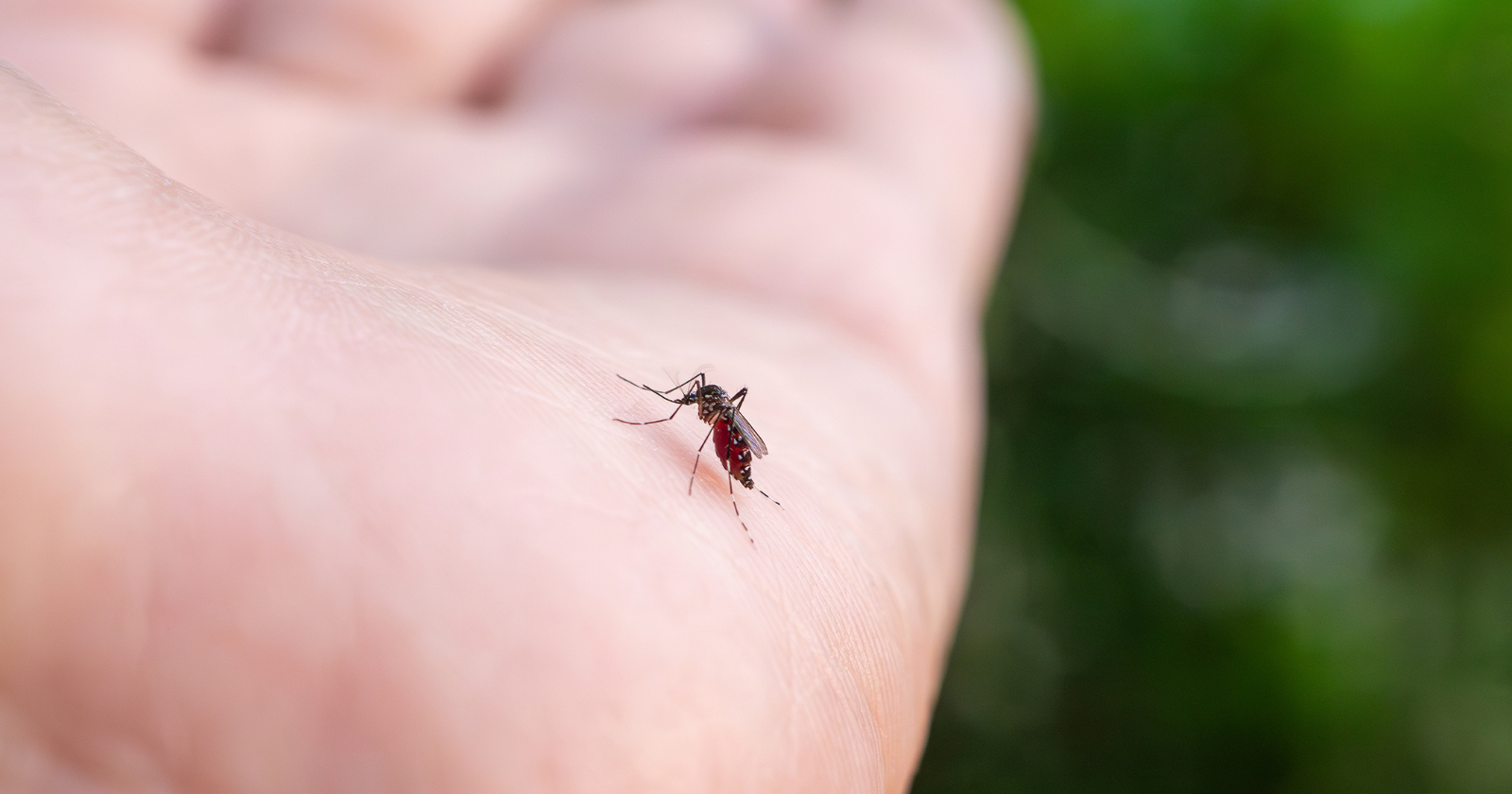
There’s a folk theory that refuses to die: that mosquitoes go for people with “sweet blood.”
Maybe you’ve been told you have it, usually by someone watching you swat at your ankles while they sit untouched. It’s a tidy story. It’s also wrong, and the way it’s wrong turns out to be more interesting than the myth.
In 2022, a team at The Rockefeller University published a study in Cell, Differential Mosquito Attraction to Humans Is Associated with Skin-Derived Carboxylic Acid Levels. They found that people who were especially attractive to mosquitoes had higher levels of certain carboxylic acids in their skin emanations. Those substances are associated with sebum, the oily film on the skin, and with the bacteria that help produce human body odour.
The ‘sweet blood’ story, and why it never held up
The sweet-blood idea assumes mosquitoes are tasting you and preferring the sugary ones. But a mosquito doesn’t know your blood is there until it has already landed. The choice of who to approach happens earlier, using cues including smell, carbon dioxide and heat.
Skin is a busy chemical surface. An explainer in The Conversation notes that more than 300 chemical compounds have been identified coming off human skin. Mosquitoes home in using carbon dioxide from your breath, your body heat and this cloud of body-odour compounds. So the question was never really “whose blood is sweeter” but “whose skin smells most attractive.”
The nylon-sleeve tournament
The Rockefeller work gets clever in its design. First author Maria Elena De Obaldia and neurobiologist Leslie Vosshall had volunteers wear nylon stockings on their forearms to soak up their skin scent, then tested the fabric.
Eight participants wore the stockings six hours a day on multiple days. Over several years, samples were matched against each other two at a time in a device that let Aedes aegypti mosquitoes fly toward whichever scent they preferred. De Obaldia said the difference could be obvious almost immediately: “It would be obvious within a few seconds of starting the assay.”
The standout was Subject 33, who was about 100 times more attractive to the mosquitoes than the least attractive volunteer and four times more attractive than the next person in line. De Obaldia’s summary was blunt: “This is something real. This is not splitting hairs. This is a huge effect.”
The oily film, and the chemistry of body odour
Once the rankings were clear, the team looked at the chemistry of the high-scoring samples. They identified 50 molecular compounds that were elevated in the sebum of the highly attractive participants and found that the mosquito magnets produced substantially more carboxylic acids than the less-attractive volunteers.
The reporting in Chemical & Engineering News highlighted pentadecanoic, heptadecanoic and nonadecanoic acid among the compounds associated with the highly attractive subjects. These substances are present in sebum and are used by skin bacteria in producing our characteristic body odour.
Vosshall put the result carefully: “There’s a very, very strong association between having large quantities of these fatty acids on your skin and being a mosquito magnet.”
Why it seems baked in
The pattern was also strikingly stable. Some participants were tested across several years, and people who began as mosquito magnets tended to remain mosquito magnets. The team then enrolled another 56 people for validation, with Subject 33 again remaining the most attractive.
That doesn’t mean diet or behaviour can never change mosquito attraction; this study wasn’t designed to rule that out. Vosshall has suggested that manipulating the skin microbiome might eventually alter someone’s attractiveness, but she explicitly described that possibility as speculative because the experiment has not yet been done.
What’s still open
A few caveats are worth keeping in view. The experiments focused on Aedes aegypti, an important vector of Zika, dengue, yellow fever and chikungunya. Whether the same pattern applies across other mosquitoes remains an open question. Vosshall specifically pointed to malaria-spreading Anopheles mosquitoes as a group worth testing next: “I think it would be really, really cool to figure out if this is a universal effect.”
What stays with me is the reversal itself. The sweet-blood myth puts the difference inside you, in the blood. The Rockefeller work instead points to chemistry emanating from the surface of the skin, particularly carboxylic acids associated with human body odour, and the pattern seems capable of remaining stable for years.
The harder questions — how universal it is across mosquito species and whether anyone can deliberately shift their own skin chemistry enough to matter — are still unanswered.
