

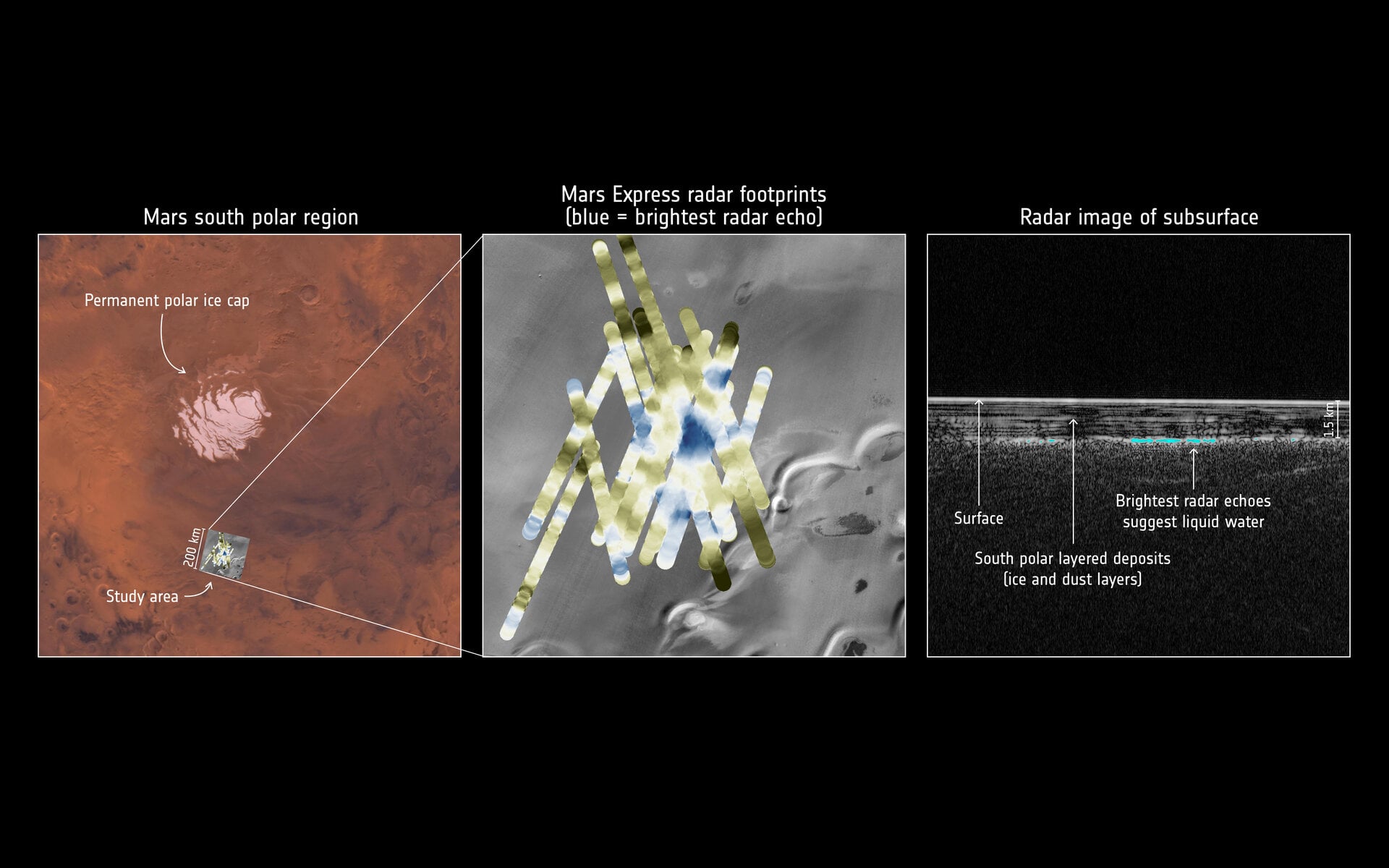
In 2018, ESA’s Mars Express detected a basal radar reflection brighter than the surface echo above it. The signal came from beneath about 1.5 kilometres of layered ice and dust near the planet’s south pole. On Earth, that can mark liquid water beneath ice.
The proposed Martian lake covered a patch roughly 20 kilometres wide. The evidence was always indirect. A radar echo records a change in electrical properties, not a photograph or chemical identification of the material causing it.
Now a second radar has reached the same buried boundary. After NASA’s Mars Reconnaissance Orbiter performed a carefully timed 120-degree roll, its SHARAD instrument heard only a faint echo from the putative lake site. The disagreement does not tell us exactly what is under the ice. It does make a broad, smooth body of liquid harder to explain.
Why the MARSIS echo looked like water
The original 2018 paper in Science, led by Roberto Orosei, drew on 29 MARSIS observations collected between May 2012 and December 2015. The strongest returns clustered near 193 degrees east and 81 degrees south, beneath a part of the South Polar Layered Deposits called Ultimi Scopuli.
MARSIS transmitted radio pulses at 3, 4 and 5 megahertz. Those long wavelengths can penetrate thick ice, though they deliver a comparatively broad view of the ground. In the central 20-kilometre zone, signals returning from the base of the ice sometimes carried more power than reflections from the surface.
That matters because radar energy reflects strongly where it crosses between materials with very different dielectric permittivities. Liquid water has a much higher permittivity than ice or many rocks. Comparing the Martian return with radar observations of subglacial water on Earth, the team argued that a pool of salty liquid was the best fit. ESA’s 2018 account of the result described evidence for water, rather than a direct detection of a lake.
Why SHARAD could not simply check
NASA’s SHARAD sounder operates near 20 megahertz. It resolves finer layers, but loses more energy while crossing polar ice. In the spacecraft’s normal orientation, part of Mars Reconnaissance Orbiter also sits in the radar antenna’s field of view.
SHARAD could not see the base at Ultimi Scopuli clearly, despite years spent mapping both poles. SpaceDaily covered how more than 2,000 SHARAD orbit passes became three-dimensional polar maps. The suspected lake remained too deep for a clean comparison.
The solution was a Very Large Roll. MRO rotated about 120 degrees, moving itself out of the antenna’s path and raising SHARAD’s signal strength by roughly tenfold or more. The manoeuvre must happen in Mars’s shadow to protect other instruments and limit the loss of solar-array power.
At the pole, that is possible only around Martian winter solstice, and the ground track must cross a target just 20 kilometres wide. According to the Planetary Science Institute, a suitable opportunity comes only about once every two Earth years.
The second radar heard a faint return
SHARAD reached the base of the ice during the special pass, but the return from the putative lake was weak. Gareth Morgan and colleagues published the comparison in Geophysical Research Letters in 2025.
The instruments were never expected to produce identical images. They use different frequencies, footprints and processing; SHARAD is also more sensitive to small-scale roughness and attenuation. The question was whether those differences could turn a water-bright MARSIS reflector into a faint SHARAD one.
Morgan’s team concluded that previously proposed frequency-dependent conductivity effects were not large enough. In their models, a smooth interface with the very high permittivity expected of liquid water should still give SHARAD a bright basal return. Preserving the lake explanation requires another assumption, such as unusually strong high-frequency absorption in the ice directly above this one patch.
The researchers favour a simpler reading of the SHARAD data: a base with relatively low permittivity, with variations in roughness changing how much energy returns to the spacecraft. That is an interpretation of the combined radar evidence, not a direct identification of rock or ice.
Several alternatives can imitate a lake
Radar brightness is not a label for one material. A smooth rock boundary can reflect efficiently. Clay-bearing or conductive material can alter low-frequency returns. Thin layers may also interfere constructively, allowing echoes at one wavelength to add together while another radar receives something weaker. A 2024 modelling study showed that small changes in ice-layer thickness and dust content could generate MARSIS-like bright reflections without liquid water.
The thermal setting is difficult too. Models place the bottom of the cap well below water’s ordinary freezing point. Perchlorate salts help, but a sizeable liquid reservoir may still require unusually high geothermal heat or extreme brine.
In 2021, JPL researchers reported dozens of other bright south-polar reflections, including some beneath ice too shallow and cold for melting. Either liquid water is unexpectedly common, or some bright echoes have a different cause.
What the disagreement can still teach us
A single special SHARAD pass cannot settle the geology beneath 1.5 kilometres of ice. Repeated Very Large Roll observations could show whether the faint return persists along nearby tracks. Better maps of attenuation in the ice, buried layer geometry and the roughness of the basal boundary would let researchers test both radar datasets within one model.
A future mission carrying several radar bands could make the comparison far cleaner. A geophysical station on the surface, still a remote prospect at this hostile pole, could add seismic and thermal measurements that orbiting radar cannot supply.
Until then, the safest description is also the least dramatic. MARSIS found a low-frequency reflector with properties consistent with liquid water. SHARAD found a much fainter high-frequency echo where a lake should still have looked bright. Something distinctive lies beneath the south polar ice; what it is remains unresolved, and the second observation has made the most enticing answer harder to defend.