

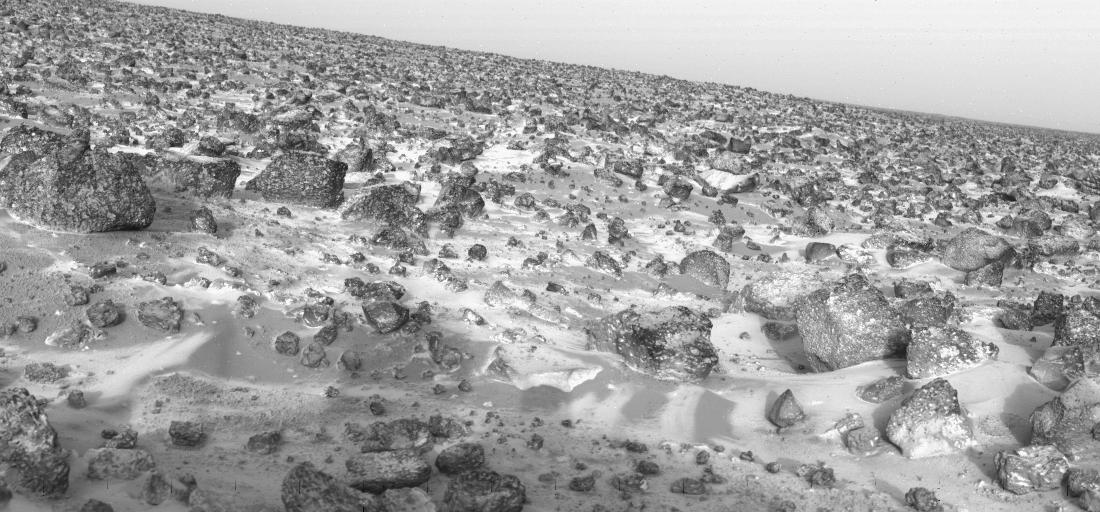
On 18 May 1979, NASA’s Viking 2 lander looked across Utopia Planitia and returned a Martian landscape dusted pale with frost. Ice picked out the tops of rocks and settled into hollows between them. The coating had appeared almost exactly one Martian year after an earlier winter frost.
The camera could see the ice. The lander’s weather instruments could measure air temperature and pressure. What Viking’s scientists could not know was that perchlorate salts were probably mixed through the soil, or that these salts might give a vanishingly small fraction of the frost a route into the liquid state.
Nearly five decades later, Vincent Chevrier of the University of Arkansas combined Viking 2’s old measurements and frost images with a modern Mars climate model. His 2025 study in Communications Earth & Environment found a recurring window of about 30 Martian days when calcium perchlorate in contact with retreating frost could form tiny amounts of brine.
This is not a hidden pond beside the lander. The predicted liquid would be exceptionally salty, very cold and limited by frost far thinner than a millimetre. If it exists, think microscopic films around soil grains or minuscule pockets in surface pores, appearing briefly and then freezing or evaporating again.
Viking watched a winter no modern rover has revisited
Viking 2 touched down at 47.6 degrees north in Utopia Planitia on 3 September 1976. Its northerly, low-lying landing site experienced a winter unlike those recorded by the more equatorial rovers. The lander’s cameras watched a bright coating spread across the rocks and soil and then recede with the season.
The frost was not merely a flash of white at dawn. A review of Mars surface meteorology reports that it remained visible for about 250 sols from late autumn into early spring during the first observed year. NASA’s 1979 high-resolution photograph showed the cycle repeating a Martian year later, with an extremely thin coating of water ice on rocks and soil.
The meteorology boom measured air temperature about 1.6 metres above the ground and recorded atmospheric pressure. It did not include a surface hygrometer, and Viking carried no direct ground-temperature sensor. That matters because the fate of a film only micrometres thick depends on conditions at the soil surface, not in the air above a person’s head.
The information survived even after Viking 2 fell silent in 1980. An earlier SpaceDaily article on how NASA preserved and digitised the Viking archive described rolls of microfilm being reopened decades after the mission. The brine study is exactly the kind of second scientific life that long-term archives are meant to enable.
Ordinary water still cannot pull off the trick
Liquid on present-day Mars must escape three traps at once. It must be warm enough not to freeze, under enough pressure not to boil and humid enough not to evaporate immediately. Pure water has almost nowhere on the surface where all three conditions overlap for long.
During Viking 2’s frost season, measured air temperatures ranged from roughly 155 to 220 kelvin, or about minus 118 to minus 53 degrees Celsius. Even modelled maximum ground temperatures stayed far below the melting point of pure ice. As the season warmed, the frost sublimated directly from solid to vapour.
Pressure at the site varied from about 7.5 to 10 millibars. Utopia’s low elevation makes that relatively generous by Martian standards, yet it remains below one percent of Earth’s sea-level pressure. The boiling point of water there sits only just above zero Celsius, a temperature the winter surface never approaches.
This is why photographs of frost do not by themselves imply a wet Mars. Ice can accumulate and vanish for years without ever becoming liquid. Chevrier’s proposal needs another ingredient to change the phase boundaries.
Perchlorate opens a colder liquid window
Perchlorates are salts containing chlorine and oxygen. Viking was not equipped to identify them, but NASA’s Phoenix lander confirmed perchlorate in northern Martian soil in 2008. Curiosity later found oxychlorine compounds much closer to the equator, supporting the idea that they are widely distributed.
Calcium perchlorate is useful to this story because its eutectic temperature, the lowest point at which that salt-water mixture can remain liquid, is about 198 kelvin or minus 75 degrees Celsius. Dissolved ions reduce water activity, lowering both the freezing temperature and the solution’s vapour pressure.
A salty film can therefore remain liquid where ordinary water would freeze. It may also resist evaporation better than pure water. Yet the margin is narrow: the study calculated an upper water activity near 0.52 for stable calcium-perchlorate brine in equilibrium with the frost.
No instrument at Viking 2 measured perchlorate. Chevrier’s model assumes that salts detected at other Martian sites were probably present in Utopia’s regolith too. That is a reasonable planetary inference, not a direct chemical result from the landing site, and the distinction is central to reading the paper honestly.
The model stitched together measurements Viking lacked
Chevrier revisited two Martian winters in the Viking record. He compared the changing frost coverage in lander photographs with Viking’s measured air temperatures and pressures. To fill the missing near-surface variables, he used modelled ground temperature and water-vapour abundance from the Mars Climate Database.
The calculation then asked whether a candidate brine would survive freezing, boiling and evaporation at each point in the seasonal cycle. Most of winter was too cold even for a concentrated calcium-perchlorate solution. Once spring advanced, the frost source disappeared and conditions became too dry for liquid to last.
Between those regimes lay a narrow overlap. Near the end of winter, frost was still present, the surface had warmed towards the perchlorate eutectic and sublimation raised humidity immediately above the soil. According to the University of Arkansas account of the modelling, favourable conditions recurred around early morning and late afternoon for about one Martian month.
That month is roughly 30 sols, or close to two Earth months because a Martian day lasts about 24 hours and 40 minutes. The result repeated in the two winters examined, suggesting a seasonal process rather than a one-off weather accident.
Thirty sols does not mean thirty days of puddles
The 30-sol figure describes a season containing short daily windows. It does not mean liquid remained exposed continuously for a month. Within a single sol, temperatures could move from too cold, through a brief compatible interval, and then into conditions where frost and moisture were lost.
Quantity imposes an even sharper limit. The frost layer ranged from tens to hundreds of micrometres thick, far less than a millimetre. Calcium perchlorate may constitute around one percent of the regolith. Brine volume is restricted by whichever ingredient, ice or salt, runs out first at a particular grain contact.
The paper therefore describes the resulting amount as minimal and does not calculate a lake, puddle or harvestable reservoir. “Tiny pools” is useful only at the pore scale. Nothing in Viking’s photographs resolves liquid, and no sensor detected a wet phase. This is a thermodynamic reconstruction showing when brine could be stable, not a retrospective sighting of droplets.
That caution is consistent with Chevrier’s wider work. SpaceDaily previously covered his co-authored review arguing that liquid brines on Mars are elusive and severely constrained. The Viking result does not reverse that conclusion. It identifies one especially narrow loophole where frost, salt, pressure and temperature may briefly align.
A liquid phase is not automatically a habitat
Liquid water matters to astrobiology, but the word “liquid” can conceal how hostile a solution is. A water activity near 0.52 means most water molecules are tied up by dissolved ions and unavailable for biology. That sits below the recognised growth limits of known terrestrial organisms, before adding extreme cold, surface radiation and reactive perchlorate chemistry.
The study found no organism, organic molecule or biosignature. It did not claim that the predicted brine could support human explorers. Even the researcher who modelled it has described present-day Mars as a cold, dry and uninhabitable desert by terrestrial standards.
The brine could still matter geologically. Thin liquid films recurring over many winters might redistribute salts, weather grain surfaces or leave mineral and chemical patterns that outlast each brief wet interval. Frost-rich mid-to-high latitudes may therefore preserve evidence of processes invisible during a warm-season landing.
The clean test requires returning at the awkward time. A lander equipped with ground thermometers, a near-surface hygrometer and conductivity or chemical sensors could watch frost retreat at the end of winter and sample the same grains through morning and afternoon. The model provides both a place and a timetable.
Viking did not overlook an ocean beneath its feet. It preserved a weather record whose full meaning depended on a salt discovered 31 years later and climate tools its original team did not possess. The hardware stopped talking in 1980; the data have not finished speaking.