

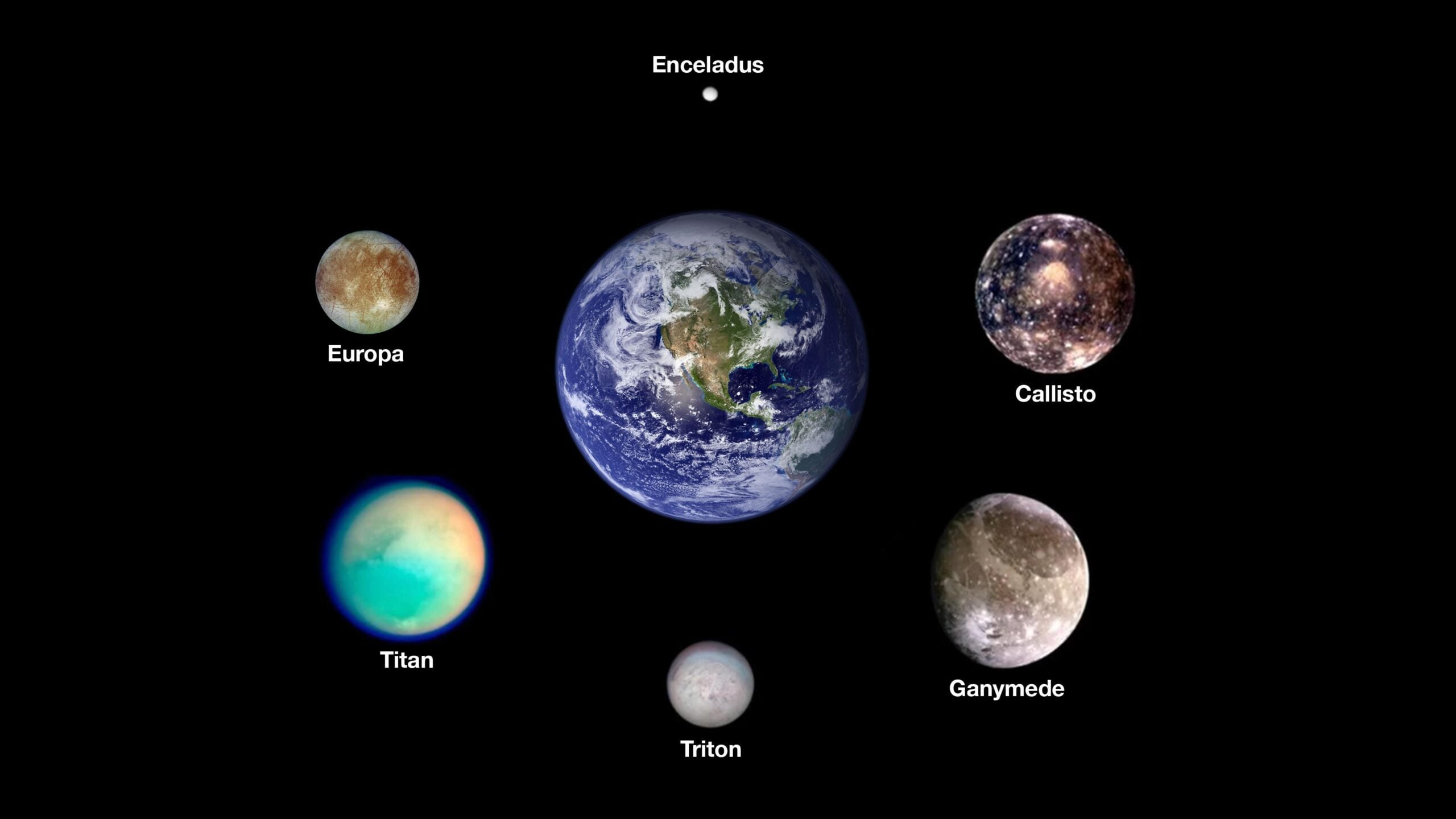
If we mapped the Solar System only by the warmth of sunlight, Jupiter and Saturn would look like poor neighbourhoods for life. They orbit far beyond the region where an exposed sea could remain liquid. Europa’s surface is colder than any place on Earth, and Enceladus is colder still.
Yet both moons appear to contain global oceans under their ice. Enceladus even sprays grains and vapour from its ocean into space. The energy keeping those waters liquid does not arrive mainly as sunshine. It is generated as the gravity of a giant planet repeatedly deforms the moon.
That is the important meaning of saying tidal heating “doesn’t care” about distance from the Sun. The heat is not directly powered by sunlight, so moving beyond the traditional habitable zone does not switch it off. Solar distance still affects the surface, ice thickness and radiation environment. The internal heating, however, is governed much more directly by a moon’s orbit around its planet.
The habitable zone was never the whole story
The familiar habitable zone describes where a planet with a suitable atmosphere might maintain liquid water on its surface. It remains a useful filter when astronomers study Earth-like planets. It was not built to assess oceans sealed beneath ice.
NASA’s survey of ocean worlds in our Solar System now includes several moons whose interiors may contain liquid water. This expanded map does not make the old one wrong. It identifies a different class of habitat, one in which an ice shell acts as both prison and insulation. The ice blocks sunlight and makes the ocean difficult to reach, but it also slows the loss of heat to space.
An earlier SpaceDaily overview introduced this broader view of habitability. The more revealing question is how a small, cold moon keeps generating heat for billions of years instead of simply freezing solid.
A giant planet turns orbital energy into heat
Gravity does more than hold a moon in orbit. The near side feels a stronger pull from the planet than the far side, stretching the moon along the line between them. If the moon’s orbit were perfectly circular and the arrangement never changed, its shape would settle into a mostly steady bulge.
Europa and Enceladus travel on slightly eccentric orbits. Their distance from the planet changes as they go around, so the tidal force rises and falls. Rock and ice are flexed, relaxed and flexed again. Because real materials resist deformation, some mechanical energy is dissipated as heat. NASA compares the basic effect to repeatedly bending a paperclip until it warms, in its explanation of Europa’s tides.
No energy appears from nowhere. Tidal heating draws from rotational and orbital energy. Left alone, friction tends to circularise an orbit, which would reduce the changing tide. Neighbouring moons keep interfering with that quiet ending. Orbital resonances give regular gravitational nudges that preserve a small eccentricity and keep the flexing alive.
The details matter. Heating depends on the moon’s distance from its planet, its eccentricity, the strength of the resonance and the way its ice, ocean and rock respond. Too little dissipation allows an ocean to freeze. Too much can produce the volcanic violence seen on Io. Habitability needs neither a deep freeze nor an inferno, but a durable energy budget in between.
Europa’s neighbours keep the kneading going
Europa completes one orbit of Jupiter in about three and a half days. It is locked with Io and Ganymede in a 4:2:1 resonance: while Ganymede goes around once, Europa goes around twice and Io four times. Those repeated alignments stop Europa’s orbit from becoming perfectly circular.
As NASA’s Europa facts page explains, Jupiter consequently stretches and relaxes the moon throughout each orbit. An ocean decoupling the outer ice from the interior would allow much larger surface tides than a frozen-through body. Europa Clipper will use gravity measurements and other instruments to test how the moon responds.
Galileo provided the strongest evidence for a salty ocean when it detected an induced magnetic response consistent with a global conductive layer. Europa’s fractured, relatively young surface adds geological evidence that the ice has been mobile. Models commonly give the ocean more water than all Earth’s seas combined, probably above a rocky seafloor.
That combination is attractive because life needs more than water. NASA’s habitability framework for Europa emphasises chemistry, energy and time as well. Water-rock reactions at the seafloor could create useful chemical gradients. Radiation at the surface can split molecules and make oxidants. If material moves between surface and ocean, those oxidants could become fuel for chemistry below. The crucial “if” is transport through the ice.
Enceladus puts its ocean within reach
Enceladus presents the same underlying physics in a more accessible form. The moon is only about 500 kilometres wide, yet Cassini saw jets erupting from four long south-polar fractures known as tiger stripes. Gravity measurements and the slight wobble of its ice shell support a global ocean beneath the surface.
Saturn supplies the dominant tide, while a 2:1 resonance with Dione helps maintain Enceladus’s eccentric orbit. In the time Dione circles Saturn once, Enceladus completes two orbits. The changing stress not only warms the interior but also flexes the tiger-stripe fractures, helping regulate the plume.
Early models struggled to generate enough long-lived heat by bending the ice alone. Later work found that a porous rocky core could be much more effective. Water forced through shifting pores and fractures would dissipate energy and promote warm water-rock reactions. An ESA account of this modelling showed how such a core could sustain concentrated seafloor hotspots for very long periods, although the exact age and stability of the present ocean remain uncertain.
The plume turns an otherwise hidden sea into a natural sample-return system. Cassini detected water, salts, organic compounds, tiny silica grains and molecular hydrogen. The silica and hydrogen are consistent with hot water interacting with rock. NASA’s summary of the ingredients found at Enceladus is compelling, but also explicit about the limit: Cassini found no evidence that the moon is inhabited and was not equipped to detect life itself.
Water is necessary, not sufficient
“Ocean world” is a physical description, not a biological result. A large body of liquid water could still be sterile. For life as we know it, researchers also look for biologically useful elements, sources of usable energy, chemical imbalances and enough stability for those ingredients to interact.
Europa and Enceladus are promising for different reasons. Europa is larger, may hold an enormous ocean and experiences powerful tides, but its water is buried beneath ice and its surface is exposed to intense radiation from Jupiter. Enceladus is smaller and may have a less stable long-term history, but it offers direct access to fresh ocean material through its plume. Both probably allow water to interact with rock, a connection that can generate chemical energy.
Tidal heating is also only part of each moon’s budget. Radioactive decay, heat retained from formation, chemical reactions and the detailed structure of the interior contribute. Nor is distance from the Sun literally irrelevant. Sunlight influences surface chemistry and how much ice a moon must carry. The narrower and defensible claim is that liquid water below an ice shell does not require the Sun to keep the surface warm.
Most importantly, habitable does not mean inhabited. No spacecraft has found evidence of extraterrestrial organisms on either moon. The observations identify places where a serious search is justified, not places where the answer is already known.
The next test is habitability, not a life announcement
Europa Clipper launched in October 2024 and is scheduled to reach Jupiter in April 2030. It will make 49 close flybys, using radar, cameras, spectrometers, magnetic measurements and gravity science to investigate the ice shell, ocean, composition and geology. Its goal is to determine whether Europa has environments that could support life. It is not a direct life-detection mission.
Enceladus has no comparable mission currently on the way, but it remains one of astrobiology’s most practical future targets because a spacecraft can cross the plume without landing or drilling. A purpose-built mission could look for complex organic patterns, cell-like structures or other signatures with instruments designed after Cassini revealed what was there.
The larger lesson is a change in how we search. Asking which worlds orbit at the right distance from a star finds possible surface oceans. Asking where water, rock, chemistry and energy have stayed in contact finds another set of candidates entirely.
In the outer Solar System, a moon can spend its whole history under a frozen sky and still carry a dark, active ocean below. Gravity, sustained by the clockwork of neighbouring orbits, can keep doing work where sunlight has almost none to spare.