I love a clean chart as much as anyone, and the history of launch cost seems to offer a beauty: about $55,000 to place a kilogram in low Earth orbit with the Space Shuttle, a few thousand dollars with modern commercial rockets, then perhaps less than $100 if Starship becomes rapidly and fully reusable.
The direction is real. The neatness is not.
Those three numbers come from different kinds of calculation. One is a fully burdened programme cost divided by maximum payload. Another combines an advertised launch price with a rocket’s theoretical capacity. The last is a projection resting on a vehicle and operating tempo that do not yet exist.
I do not say that to drain the excitement from the story. Reusability has already changed the economics of leaving Earth. I say it because the honest version is more useful: launch is becoming dramatically cheaper, while “cost per kilogram” remains a slippery unit that can conceal almost as much as it reveals.
The Shuttle’s $55,000 was not a ticket price
The familiar number comes from a NASA Ames analysis of falling launch costs. It assigned the Shuttle a cost of about $1.5 billion per launch and a maximum low-Earth-orbit payload of 27,500 kilograms. Divide the first figure by the second and you get $54,500 per kilogram, usually rounded to $55,000.
That is a legitimate benchmark, but it is not what every customer was invoiced for every kilogram. Shuttle missions carried people, life-support equipment, an orbiter that returned to Earth and hardware tailored to the job. The useful payload also changed with the destination. In the same paper, NASA calculated a cost of $93,400 per kilogram for cargo delivered to the International Space Station because the Shuttle could carry only 16,050 kilograms there.
This is the first rule of launch-cost comparisons: orbit is not one destination, and maximum capacity is not the same as typical delivered mass. The $55,000 figure tells us the scale of Shuttle economics. It does not reconstruct a universal Shuttle fare.
Falcon 9 changed what gets thrown away
NASA applied similar arithmetic to Falcon 9. It took SpaceX’s then-advertised price of $62 million and divided it by a maximum LEO payload of 22,800 kilograms, producing $2,720 per kilogram. On paper, that was about one twentieth of the Shuttle benchmark.
SpaceX still lists 22,800 kilograms as Falcon 9’s maximum payload to LEO. There is a revealing wrinkle, though: the company’s 2026 prospectus describes that capacity as the fully expendable figure. A mission that lands the booster reserves propellant for the return, reducing the performance available to the payload. The famous $2,720 calculation is therefore a useful theoretical benchmark, not a measurement of a particular reused Falcon 9 mission.
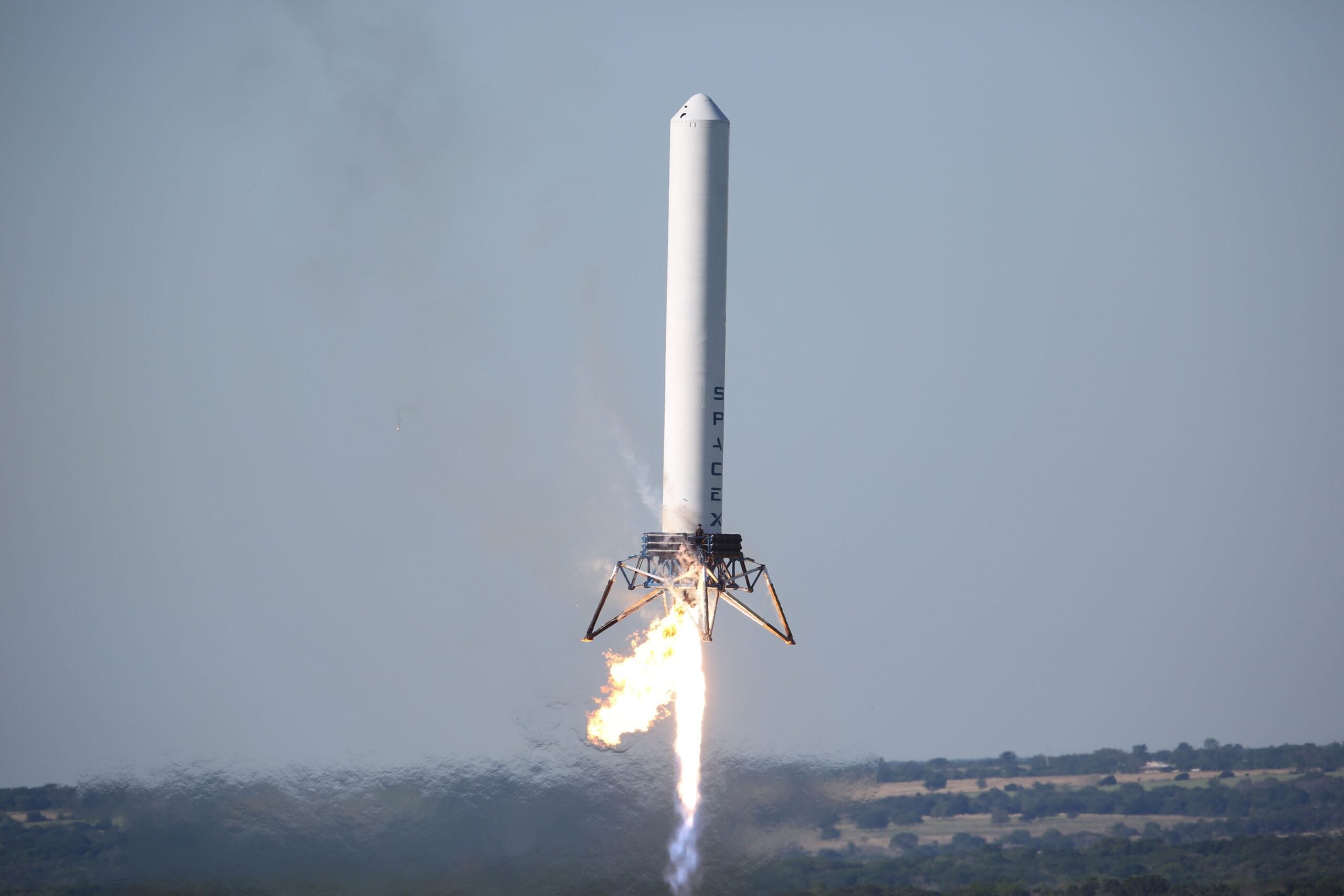
The achievement underneath it is nevertheless substantial. Falcon 9 proved that an orbital-class first stage could fly back, land and be used repeatedly. SpaceX said in its 2026 prospectus that a booster had flown 34 times by the end of March. Engines, tanks, avionics and structure that once would have been discarded were having their production cost spread across dozens of missions.
That is the economic heart of reuse. Rocket propellant is comparatively cheap. Rocket hardware, the industrial system that builds it and the people who prepare it are not.
A kilogram does not have one market price
A small satellite operator cannot buy one kilogram at the full-rocket bulk rate. The payload needs an adapter, testing and integration. It needs the correct orbit and a place on a real launch schedule. Empty capacity on the wrong trajectory is not useful capacity.
SpaceX’s current small-satellite rideshare offer starts at $350,000 for 50 kilograms to sun-synchronous orbit, with additional mass priced at $7,000 per kilogram. The starter package itself works out to $7,000 per kilogram, well above the familiar $2,720 Falcon benchmark and still far below Shuttle-era scale.
A useful reality check arrived in 2026 from researchers Alessio Terzi and Francesco Nicoli. Their PNAS Nexus study standardised data from more than 4,400 launches between 1960 and 2025. It estimated that the average cost of sending a kilogram to orbit fell from $87,023 in 1960 to $3,868 in 2025. Their central model projected about $1,600 by 2030 and $300 by 2040.
That broad dataset is a better portrait of the market than one rocket’s ideal ratio. It also reminds us that price and internal cost are different. A launch company may save money by reusing a booster without passing every dollar to customers. Demand, available slots, contracts and competition still shape the price.
Below $100 is a scenario, not a present quote
SpaceX says Starship is designed to carry more than 100 tonnes to orbit in a fully reusable configuration. The arithmetic is easy. A $10 million flight carrying 100 tonnes gives $100 per kilogram. A $2 million flight gives $20.
The latter figure traces to a 2019 projection, reported by TechCrunch, in which Elon Musk put eventual Starship operating cost at roughly $2 million per launch, including about $900,000 for propellant. That was an aspiration made years before the present vehicle, not an audited cost or a public customer price.
SpaceX’s own 2026 prospectus makes a more restrained claim. The company says it aims to reduce the cost of reaching orbit by 99 per cent or more relative to a historical benchmark of $18,500 per kilogram. A 99 per cent reduction is $185 per kilogram. “Or more” leaves room for double digits, but does not promise them.
Every optimistic Starship estimate rests on the same stack of conditions. Both stages must return and refly with limited inspection and refurbishment. Launches must occur often enough to spread pad, factory, workforce and development costs across a large number of flights. Customers must provide enough payload to use that enormous capacity. A half-empty rocket doubles the cost per delivered kilogram before anything else changes.
Reuse changes economics, not orbital physics
When I wrote about why reaching orbit is mostly about moving sideways at roughly 28,000 kilometres per hour, what stayed with me was the stubbornness of the physics. Reusability does not reduce the speed a spacecraft needs. It changes how much expensive machinery we discard while reaching it.
This is where the airline analogy helps, then breaks. An airliner would be absurdly costly if its engines and airframe were scrapped after every journey. A rocket designed to fly again should gain the same basic economic advantage. But a rocket also carries its oxidiser, operates near extreme structural margins and returns through punishing heat. The inspection burden, heat-shield life and turnaround time matter as much as whether the vehicle lands.
I made a similar point when examining Starship’s still-unproven ship-to-ship refuelling system. The programme has demonstrated difficult pieces of its architecture. It has not yet demonstrated rapid full-stack reuse. We should be able to admire real progress without quietly treating the remaining milestones as completed.
Cheap launch changes design before it makes space ordinary
If launch eventually falls below $100 per kilogram, the first transformation may be in engineering culture. Spacecraft teams spend years shaving mass because every kilogram carries such a large transport penalty. A much cheaper ride allows thicker shielding, larger propellant margins, more standard components and spare hardware. Stations, depots and large telescopes become easier to assemble when lifting beams, tanks and tools is no longer the dominant expense.
That still does not make a working satellite ordinary freight. Design, testing, integration, insurance and operations remain. Human travel adds life support, abort capability and stringent safety requirements. The launch price of a person’s body mass tells us almost nothing about the cost of carrying that person safely.
Higher cadence also carries obligations. In an earlier piece on orbital debris creating more orbital debris, I argued that cheaper access and responsible stewardship have to grow together. Launching more hardware can enable extraordinary science and infrastructure. It can also increase congestion unless tracking, disposal and traffic coordination keep pace.
So I would keep the dramatic falling curve, but label it honestly. Shuttle’s $55,000 and today’s few-thousand-dollar range are useful markers of a genuine transformation. Starship below $100 is a plausible projection only if full reuse, rapid turnaround, high cadence and heavy utilisation all arrive together.
That is not ordinary transportation yet. It is the engineering proposition that might one day make orbit feel less extraordinary.