

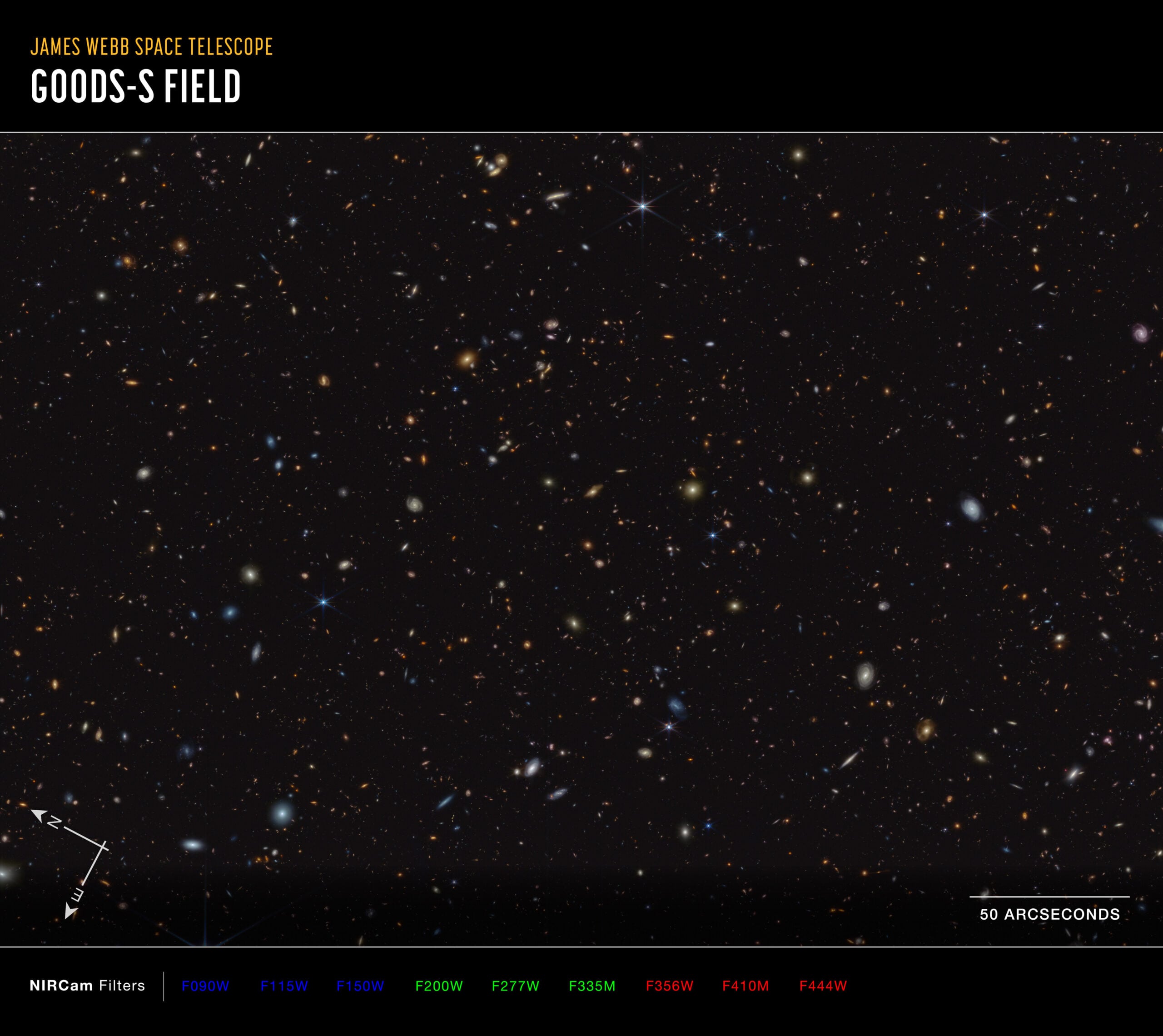
Four years of James Webb Space Telescope observations have turned the first few hundred million years of cosmic history from a realm of extrapolation into a growing galaxy census. That census does not resemble the quiet, sparsely populated dawn implied by many forecasts made before Webb began science operations in 2022. Bright galaxies appear earlier and more often, and several had already converted gas into stars at an impressive rate.
This is a synthesis across deep-field surveys, spectroscopy and competing galaxy-formation models. Webb has exposed weaknesses in assumptions about star formation, dust, feedback and stellar populations at extreme redshift. It has not, by itself, falsified ΛCDM, the cosmological framework in which structure grows around cold dark matter in a universe whose late expansion is associated with a cosmological constant.
The distinction is essential. ΛCDM predicts the statistical growth of dark-matter haloes. A galaxy model must then explain how ordinary matter falls into those haloes, cools, forms stars, makes dust and responds to radiation and explosions. Webb is directly measuring the luminous outcome. Translating that light back into a challenge to cosmology requires several uncertain astrophysical steps.
Webb turned forecasts into a census
Before Webb, astronomers could see only a few unusually bright galaxies near the edge of Hubble’s reach. Beyond redshift 10, forecasts depended heavily on extending trends measured at later times. A 2020 UniverseMachine study generated pre-Webb mock catalogues out to redshift 15 and predicted that the telescope would find galaxies deep into this era. It also showed how rapidly uncertainty widened above redshift 12.
Webb’s Near-Infrared Camera changed the scale of the search. As the universe expands, light emitted in the ultraviolet by very distant young stars is stretched into infrared wavelengths. A candidate can be selected when its light drops sharply blueward of the Lyman break, where intervening neutral hydrogen absorbs it. Webb’s Near-Infrared Spectrograph can then spread the source’s light into a spectrum and test whether the break really lies at the proposed redshift.
The result has been both a longer distance ladder and a population measurement. Individual records attract attention, but the deeper challenge comes from finding many luminous objects across several survey fields. A theory can accommodate one rare object more easily than an unexpectedly high number density.
“Too bright” means more than one thing
A galaxy’s ultraviolet luminosity is not a direct reading of its total mass. It is especially sensitive to young, massive stars, which shine intensely and die quickly. Dust can absorb some of that ultraviolet light. Hot gas around new stars can add emission lines, while an accreting black hole can contribute light that a simple stellar fit mistakenly assigns to stars.
Astronomers therefore compare observations through a ultraviolet luminosity function: the number of galaxies in each brightness interval at a given redshift. Many pre-Webb calculations expected the bright end of that function to thin rapidly as observations approached the Big Bang. Webb has repeatedly measured a slower decline above redshift 10.
This does not mean every early galaxy is excessively massive. It means that familiar recipes often make too few bright systems unless gas turns into stars more efficiently, star formation occurs in stronger bursts, dust dims the galaxies less, the mix of stellar masses changes, or some combination of these effects is at work.
Spectroscopy corrected the first rush without erasing it
Webb’s earliest images produced a rapid stream of extreme candidates, some initially assigned redshifts as high as 16. Photometric redshifts are estimates from a handful of brightness measurements. A dusty galaxy much nearer to Earth, or strong emission lines falling into one filter, can imitate the colour pattern of a remote source.
A 2023 Nature paper illustrated the correction process. Spectroscopy confirmed two luminous galaxies in the first 500 million years but showed that another prominent candidate was a lower-redshift interloper. Derived stellar masses have also fallen for some sources once black-hole light, nebular emission and improved stellar histories were included.
Those revisions removed the language of “impossible galaxies” from the defensible account. They did not return the census to pre-Webb expectations. In 2024, NIRSpec confirmed JADES-GS-z14-0 and JADES-GS-z14-1 at redshifts 14.32 and 13.90. The Nature analysis placed them about 300 million years after the Big Bang and found that their light was dominated by stellar continua. Accreting black holes could not explain away the entire bright-galaxy excess.
Record holders sharpen a population problem
The deep JADES Origins Field provided more than two remarkable points. Brant Robertson and colleagues used the field to estimate the luminosity function and star-formation-rate density at cosmic dawn. Their Astrophysical Journal study found evidence that the decline in luminous galaxies at the earliest times was slower than a simple extrapolation from pre-Webb observations suggested.
MoM-z14 has since extended the spectroscopic frontier to redshift 14.44, when the universe was about 280 million years old. The 2026 Open Journal of Astrophysics paper reported that the number density implied by its survey was more than 100 times the level in a set of pre-Webb consensus models. It also inferred that the galaxy’s recent star-formation rate had risen sharply over roughly five million years.
That factor is striking, but it is not a universal measurement of all early galaxies. MoM-z14 belongs to a rare population, and estimates based on small numbers carry wide statistical intervals and cosmic variance, the field-to-field variation created by clustered structure. The relevant internal Space Daily account of MoM-z14 describes the object and those limits in detail.
Galaxy physics has room to change
Several explanations can brighten the early census without manufacturing extra dark matter. Gas may have reached early haloes quickly and converted into stars with higher efficiency than models calibrated at later epochs assume. Star formation may have been bursty, briefly lifting otherwise ordinary galaxies above a survey’s detection limit. With less dust, more ultraviolet light escapes. Stars born with a different distribution of masses could produce more ultraviolet radiation for the same total stellar mass.
Each solution leaves different evidence. Bursts should create rapid variation in inferred star-formation histories and more scatter in luminosity at fixed halo mass. Low dust should produce blue ultraviolet slopes, although gas emission complicates the colours. A top-heavy stellar initial mass function changes ionizing-photon production and chemical enrichment. Black holes can dominate compact red sources, but resolved blue galaxies show that accretion is not the answer for every object.
Modellers have already demonstrated that the tension moves when these ingredients move. Shengdong Lu and colleagues compared the observed ultraviolet luminosity functions with GALFORM, a semi-analytic framework whose relevant predictions predated Webb. Their Monthly Notices study reproduced counts through redshift 10 with its baseline model and extended agreement farther by changing dust evolution and the duration of starbursts. That is evidence that at least part of the discrepancy belongs to luminous astrophysics rather than the supply of dark-matter haloes.
Why this is not yet a failed ΛCDM test
A clean cosmological contradiction would require more than galaxies being brighter than expected. Researchers would need secure redshifts, reliable stellar masses and a measured abundance so high that the required host haloes do not exist in sufficient numbers under ΛCDM, even after adopting conservative limits on how efficiently baryons become stars.
Webb has not yet established that chain. Stellar masses depend on assumed star-formation histories, dust, nebular gas, the stellar initial mass function and possible black-hole light. Survey areas remain small compared with the scales needed to average over rare structures. The most distant samples mix photometric candidates with spectroscopically confirmed sources, and the luminosity function above redshift 12 is still being built from modest numbers.
None of that makes the surprise unreal. The pre-Webb expectation of a rapidly emptying bright end has not survived intact. Galaxies were forming stars vigorously within 300 million years of the Big Bang, metal enrichment began quickly, and diverse systems were already present. Models that once treated this regime as a smooth continuation of later galaxy behaviour now have to explain a more efficient, variable and luminous beginning.
The measured pressure currently falls most directly on the astrophysics layered over ΛCDM. That is a substantial result, not a retreat. Galaxy formation contains difficult interactions among gravity, gas, radiation, chemistry and feedback, and Webb has opened the first era in which those interactions can be tested rather than extrapolated. If future wide surveys and spectra eventually exhaust the astrophysical freedom and still demand more early structure than ΛCDM can supply, the cosmological question will become sharper. Four years in, Webb has made that test possible without yet deciding it.