Earth looks like the obvious water world. Oceans cover about 71 per cent of its surface, colour the planet blue from space, drive its climate and support every ecosystem we know. Yet if the contest is simply the volume of liquid water, Earth may not even beat a moon one quarter of its diameter.
NASA’s current Europa comparison assigns Earth’s oceans a volume of roughly 1.4 billion cubic kilometres and Europa’s probable subsurface ocean about 3 billion cubic kilometres. Europa achieves that apparent upset not by covering more surface, but by hiding a global sea that may average around 100 kilometres deep beneath ice.
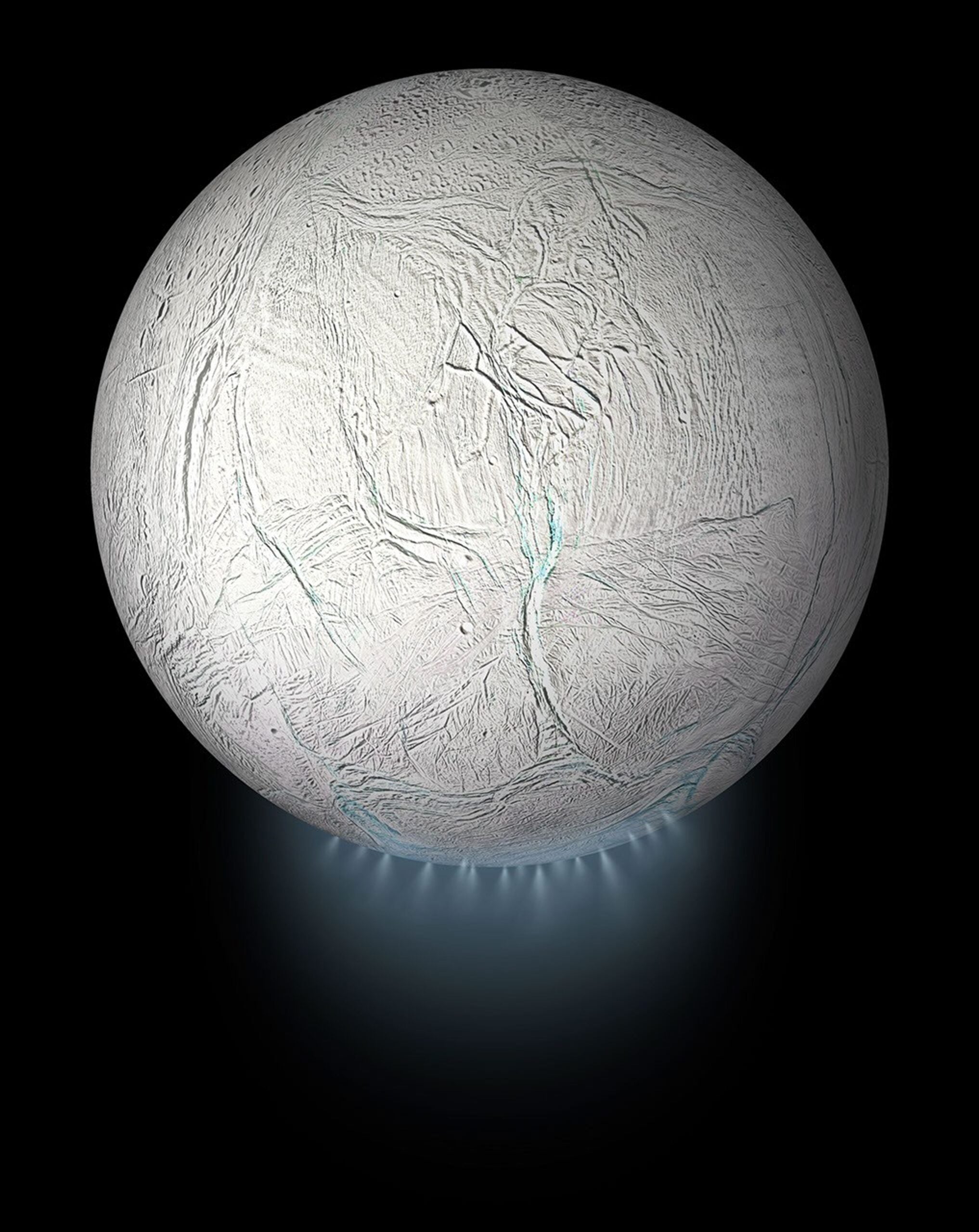
Saturn’s moon Enceladus offers a second correction to our surface-centred intuition. It is only about 500 kilometres wide, yet jets from fractures near its south pole carry water vapour and ice grains from its buried ocean into space, where Cassini was able to fly through and sample them.
This is a synthesis of several mission results and interior models, not one direct measurement. Europa’s ocean has not been visited, the quoted volume has uncertainty, and Enceladus’s plume varies in strength. Neither moon has produced evidence of life. Even with those boundaries, both worlds make Earth’s claim to be the Solar System’s definitive “water world” much less straightforward.
Europa wins the volume comparison by going deep
Earth’s oceans spread across a vast surface, but their average depth is only about four kilometres. Europa’s proposed ocean is geographically smaller and far deeper. NASA’s illustrative estimate uses an average depth of about 100 kilometres, sufficient to produce roughly 3 billion cubic kilometres of liquid saltwater below the moon’s frozen exterior.
The arithmetic is not mysterious. Volume depends on thickness as well as area. Europa’s diameter is only about 3,120 kilometres compared with Earth’s 12,742 kilometres, but a water layer tens of kilometres deep can compensate for that much smaller circumference. On those estimates, Europa contains a little more than twice the combined volume of all Earth’s oceans.
“More than twice” should not be mistaken for a laboratory reading. No instrument has drilled through Europa’s shell and sounded the full ocean. Scientists infer its internal layers from surface geology, gravitational behaviour, magnetic measurements and models of how the moon responds to Jupiter’s tides. The 3 billion cubic kilometre figure is a useful scale comparison, not a precisely surveyed inventory.
The evidence for Europa’s ocean comes in layers
Europa’s surface is young by Solar System standards and crossed by ridges, bands and disrupted regions called chaos terrain. The patterns look consistent with an outer ice shell that has shifted, cracked and been resurfaced. Very few large impact craters survive, another sign that the exterior has changed over geological time.
A particularly important clue came from Galileo. The spacecraft measured a magnetic response that changes as Europa moves through Jupiter’s magnetic field. A global electrically conductive layer, with salty liquid water the leading explanation, can produce that induced signal. Tidal flexing supplies a mechanism for keeping the interior warm: Europa’s slightly eccentric orbit repeatedly squeezes and relaxes the moon as Jupiter’s gravity changes in strength.
Current estimates remain broad. NASA describes a possible ocean roughly 60 to 150 kilometres deep and an ice shell commonly modelled at around 15 to 25 kilometres, although the values depend on the assumptions used. Europa Clipper is designed to test this ocean interpretation through dozens of close fly-bys, using radar, magnetic, gravity, thermal and compositional measurements.
The mission will assess whether Europa has environments that could support life. NASA explicitly describes it as a habitability mission, not a mission that can declare life detected.
Enceladus exposes what Europa keeps hidden
Enceladus is a different kind of ocean world. Cassini observed jets issuing from four long fractures near the south pole, informally called tiger stripes. The jets loft icy particles and water vapour hundreds of kilometres above the surface. Some material falls back as snow; some escapes and helps sustain Saturn’s diffuse E ring.
NASA describes the eruptions as continuous, but that does not mean the output is constant. A long series of Cassini observations showed that the plume brightens and fades predictably as Enceladus travels around Saturn. Tidal stresses flex the tiger stripes, opening them wider when the moon is farther from Saturn and squeezing them closer to shut at other parts of the orbit.
Gravity measurements and a small rotational wobble indicate that the south-polar activity connects to a global subsurface ocean rather than a local pocket alone. The crucial practical result is access. A future spacecraft need not land, drill or melt through kilometres of ice to collect material from that ocean. It can cross the plume, an advantage I examined more closely in this earlier SpaceDaily explainer on plume sampling.
Cassini sampled ocean chemistry, not organisms
Cassini was not built to look for life at Enceladus because the plume had not been discovered when the spacecraft was designed. Even so, its instruments turned fly-throughs and impacts with plume grains into an unexpectedly rich chemical survey.
The spacecraft detected water, salts, silica particles, molecular hydrogen and organic compounds. Silica and hydrogen support the idea that warm water interacts with rock on or within the seafloor. In 2023, researchers analysing Cassini data reported phosphates in salt-rich ice grains, adding phosphorus to the collection of elements important for life as we know it.
A 2025 reanalysis focused on grains collected only about 21 kilometres above the surface during a fast 2008 fly-by. Because those particles were just minutes old, they had experienced less time for radiation and space weathering to alter them. The team found additional organic compounds in fresh plume grains.
Organics are carbon-bearing chemistry, not proof of organisms. Phosphorus, water and chemical energy make Enceladus a compelling habitable-environment candidate. They do not show that life began there or survives there now.
More water does not automatically mean more habitable
An ocean’s size is only one variable. Life as we know it also needs usable energy, suitable chemistry, long-term stability and a way to keep essential materials cycling. Whether water contacts rock matters because water-rock reactions can supply chemical gradients. If high-pressure ice separates an ocean from a rocky seafloor, the chemistry may be very different from an ocean with direct contact.
Earth remains extraordinary under almost every ecological definition of a water world. Its oceans sit on the surface, receive sunlight, exchange gases with an atmosphere and circulate over an active rocky crust. They are also the only oceans known to be inhabited. Europa’s larger estimated liquid volume does not make it a second Earth, and Enceladus’s plume does not guarantee that its ocean is biologically productive.
The comparison nevertheless changes where scientists look. For much of the history of planetary science, the search for liquid water concentrated on the narrow distance from the Sun where surface temperatures could allow it. Icy moons demonstrate that tides and internal heat can maintain oceans far beyond that traditional zone.
“Water world” has no single winner
If the metric is visible surface coverage, Earth dominates. If it is estimated liquid-water volume, Europa probably holds more. If it is convenient access to a hidden extraterrestrial sea, Enceladus is exceptional because the ocean sends samples into space on its own.
That is why “ultimate water world” is more slogan than scientific category. The phrase collapses distinct questions about amount, location, chemistry, energy and accessibility into one image of a blue surface.
The better conclusion is not that Earth has lost a planetary contest. It is that the Solar System stores water in radically different ways. Some of its most consequential oceans are sealed under darkness, and one of them is spraying evidence of its existence into space.