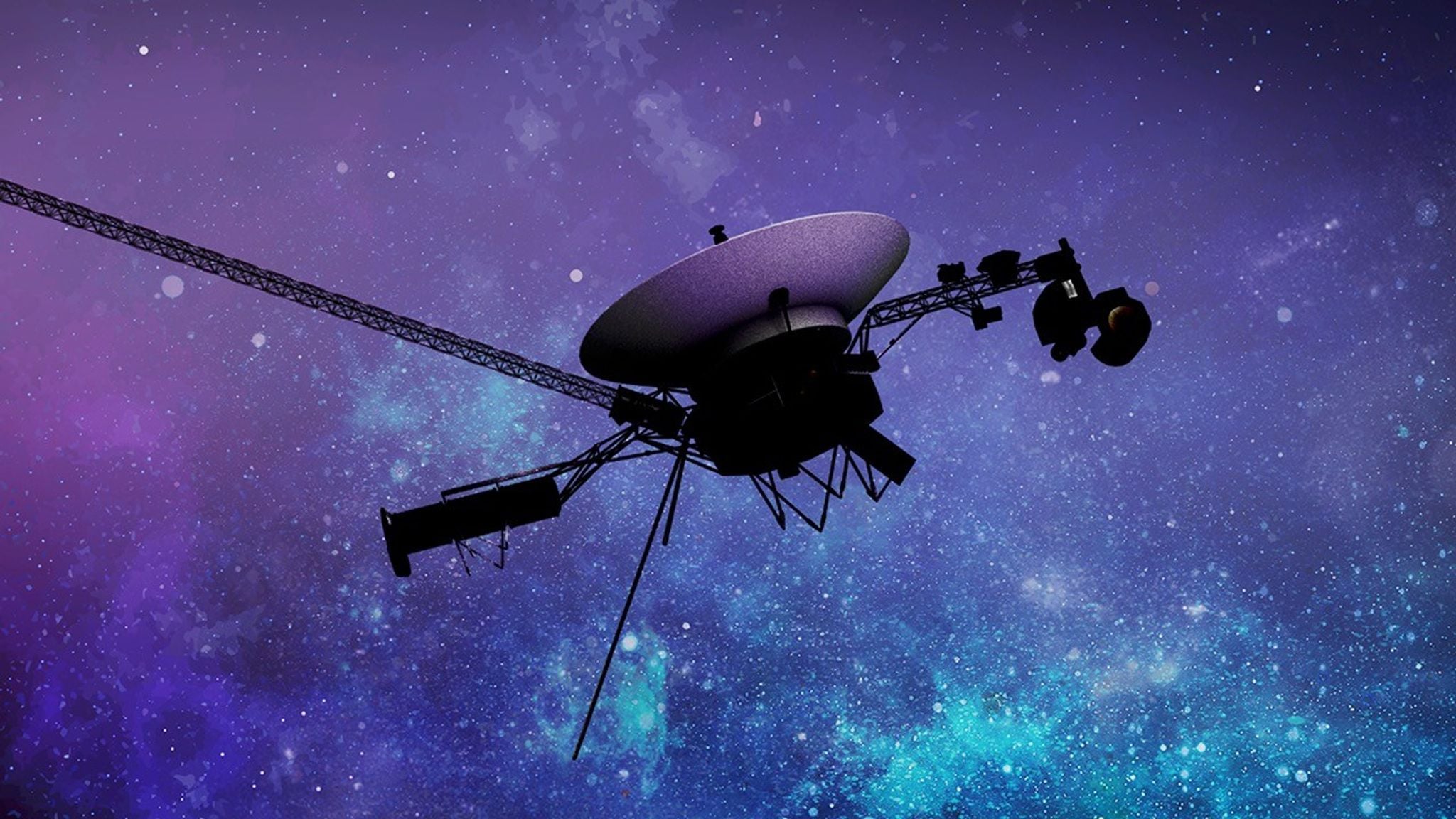
Voyager 1 is still operating, and the predictable decline of its nuclear power supply is the mission’s central limiting resource. That much is true.
The rest of the headline needs qualification. Voyager 1 has been flying for nearly 49 years, but it entered interstellar space in 2012. Several original instruments and components have failed or been switched off. Its power source is not a rechargeable battery, but three radioisotope thermoelectric generators.
The achievement does not become smaller when those distinctions are restored. The spacecraft alive in 2026 is a reduced, repeatedly repaired version of the machine launched in 1977, and keeping that version useful has become an engineering discipline of its own.
Two science instruments remain active
NASA’s current instrument-status page lists two active science instruments on Voyager 1: the magnetometer and the Plasma Wave Subsystem.
The magnetometer measures magnetic fields. The plasma-wave instrument detects oscillations in the thin charged material surrounding the spacecraft. Both are returning measurements from beyond the heliopause, the boundary Voyager 1 crossed on 25 August 2012.
Communications, command, data handling, thermal control and attitude control must also continue working. The high-gain antenna has to stay pointed towards Earth while a radio link carries data across more than 25 billion kilometres.
That is a functioning mission, but it is no longer the full planetary observatory sent past Jupiter and Saturn.
Not every original system still works
Some retired systems are healthy but no longer powered. Others degraded or failed.
The cameras were switched off after the planetary encounters. The plasma instrument was turned off in 2007 because its performance had degraded. The photopolarimeter had failed much earlier. The cosmic-ray subsystem and low-energy charged-particle instrument were retired in 2025 and 2026 to save power.
In November 2023, Voyager 1 stopped sending readable engineering and science data. Engineers traced the problem to a failed memory chip in the Flight Data Subsystem. They divided the affected software among other memory locations and restored useful telemetry in 2024.
Thrusters have also aged. Propellant tubes have become clogged with residue, forcing the team to swap among different branches. In 2025, engineers even revived roll thrusters considered unusable since 2004 after restoring power to their heaters.
Calling all this failure would miss the scale of the recovery work. Saying nothing failed would miss the evidence.
The four-watt decline is real
Voyager 1 carries three RTGs. They turn heat from the radioactive decay of plutonium-238 into electricity through thermoelectric couples, with no turbine or moving generator.
NASA says the available output declines by roughly four watts each year. The plutonium slowly produces less heat, and the thermoelectric material also becomes less efficient with age.
The three generators supplied about 470 watts at launch. That margin allowed Voyager to operate ten science instruments, heaters, computers, radio equipment and spacecraft systems during its encounters with Jupiter and Saturn.
Power management now works through subtraction. Heaters, instruments and other loads are switched off so the remaining systems can stay above the voltage needed for reliable operation. Four watts sounds trivial until four watts is approximately the annual budget for buying another year.
The familiar phrase “plutonium battery” is understandable shorthand. Technically, an RTG is a generator that continuously converts decay heat, not a battery storing a finite electrical charge.
A shutdown can be a success, not a failure
On 17 April 2026, engineers switched off Voyager 1’s Low-Energy Charged Particles experiment. It had operated almost continuously since launch.
The instrument was not sacrificed because it suddenly broke. It was turned off to protect power for the magnetometer, plasma-wave instrument and the engineering systems that let them return data.
The decision makes the meaning of failure less obvious. Losing an instrument ends one line of science, but doing it deliberately can extend the rest of the mission. NASA said the two remaining instruments were still working well and returning data from a region no other operating spacecraft had reached.
This is how the planned end of Voyager looks in practice. It is not one moment when an otherwise complete spacecraft suddenly exhausts a battery. Capability is being traded for time, one load at a time.
Power is the planned limit, not the only possible ending
Declining RTG output is the constraint engineers can predict. It does not guarantee that power will be the immediate cause of the final signal. A memory failure, a blocked thruster, a radio problem or a fault-protection event could end communications sooner.
The spacecraft also does not have one clean expiration date. Science operations could end before engineering telemetry. The transmitter could fall silent while Voyager 1 continues coasting through interstellar space for thousands of years.
Our earlier account of the small plutonium supply that powers Voyager explains why the generators lasted so long. The present story is about what that longevity looks like near the end: less power, fewer instruments and increasingly careful choices.
Voyager 1 is not an untouched 1977 machine, and it has not spent nearly 50 years in interstellar space. It is an old spacecraft surviving through redundancy, software repairs and planned sacrifices. The four-watt decline is real, but so is everything engineers have already worked around.