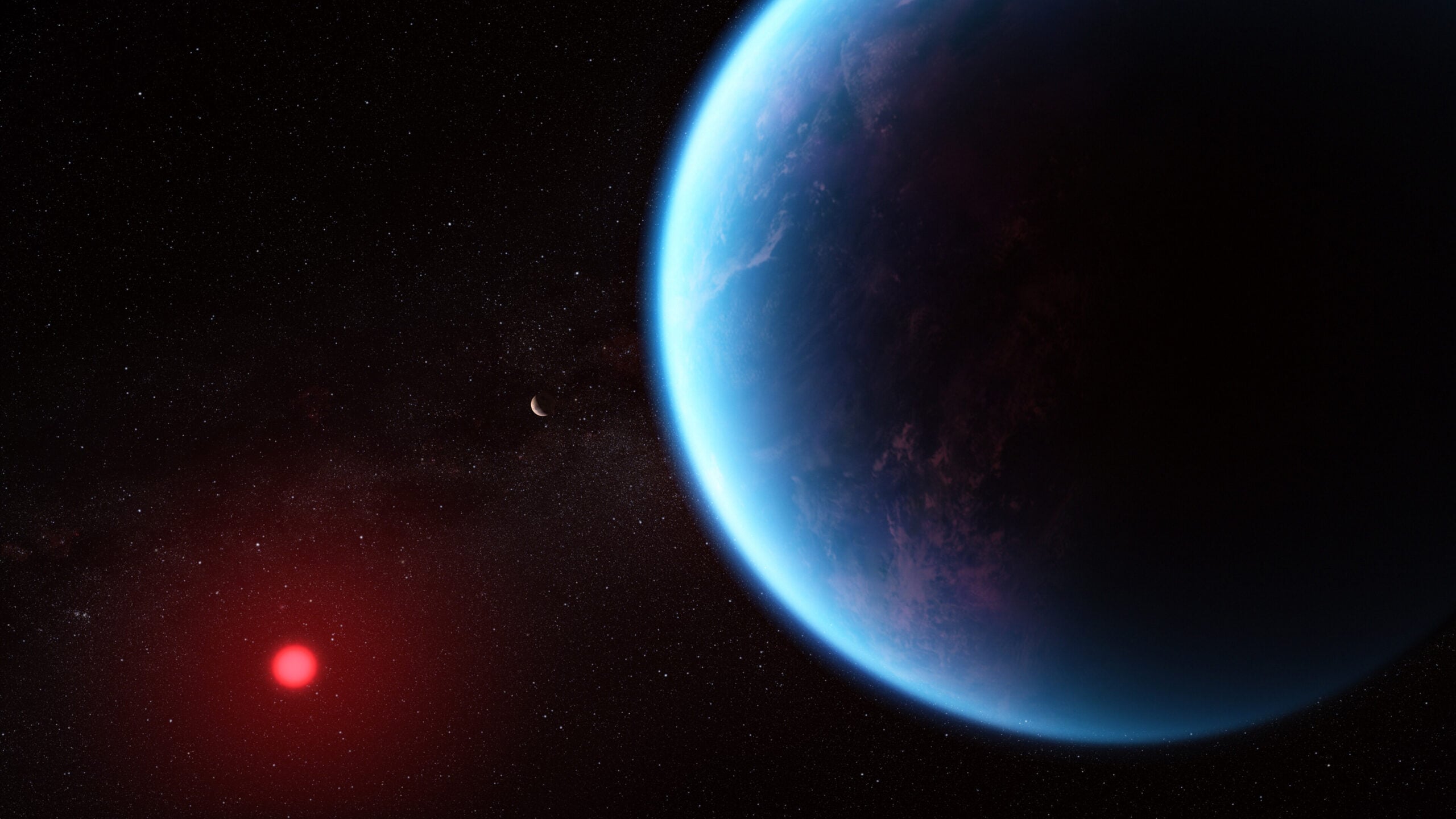
Dimethyl sulfide, or DMS, attracts attention in the search for life because its story on Earth begins overwhelmingly with organisms in the ocean. Marine microbes and algae make the precursor compounds, food-web processes release DMS into seawater, and some of the volatile gas crosses into the atmosphere.
The James Webb Space Telescope has recorded faint spectral features around K2-18 b that one research group argues are compatible with DMS. The planet lies about 120 light-years away. Other teams analysing the same observations have not found statistically significant evidence for the molecule.
This is an active scientific dispute, not settled consensus.
Why DMS looks biological on Earth
A 2023 review in Nature Reviews Earth & Environment describes a global marine DMS cycle driven by phytoplankton, bacteria and other organisms. The authors estimated that marine DMS supplies between 15 and 40 teragrams of sulfur to the atmosphere each year.
Most of the gas never gets that far. More than 90 per cent is consumed or degraded in the water column. The remainder escapes across the sea-air boundary and is oxidised in the atmosphere, contributing to sulfate aerosols.
That Earth history makes DMS a candidate biosignature. It does not make the molecule a universal proof of biology. A remote planet may have different raw materials, pressures, radiation and reaction pathways.
What Webb actually recorded
Webb did not capture a sample of K2-18 b’s air. During a transit, a small fraction of the host star’s light passed through the planet’s atmosphere. Different molecules absorb particular wavelength bands, leaving patterns that researchers try to recover from a signal much smaller than the starlight itself.
The first Webb analysis announced in 2023 used the NIRISS and NIRSpec instruments. It reported methane and carbon dioxide, plus a lower-confidence possible DMS feature. ESA’s release said the DMS inference was less robust and required validation.
In April 2025, Nikku Madhusudhan and colleagues published a mid-infrared analysis in The Astrophysical Journal Letters. Using Webb’s MIRI instrument, they found that DMS and/or dimethyl disulfide, or DMDS, could explain the spectrum at about three-sigma significance. The two molecules overlap spectrally, so the data did not distinguish between them.
Why the proposed detection remains disputed
Three sigma is a model-dependent statistical preference, not a direct sighting. The result can change when researchers alter how detector effects are treated, how wavelength points are grouped and which alternative molecules are allowed into the comparison.
A joint analysis led by Rafael Luque found insufficient evidence for DMS or DMDS when the near-infrared and mid-infrared observations were considered together. Kevin Stevenson and colleagues reported that red noise affected the MIRI data; with their preferred wavelength binning, 87.5 per cent of retrievals did not favour the sulfur gases.
Luis Welbanks and colleagues reached a related conclusion in a Nature Astronomy analysis. When they widened the molecular search, many candidates fitted parts of the low-signal spectrum. The lesson is methodological: a molecule beating one chosen comparison does not mean it will beat a much larger field of alternatives.
I covered the broader sequence of claims and reanalyses in SpaceDaily’s earlier K2-18 b overview. The dispute begins before the question of life. Researchers first have to establish what molecule, if any, produced the feature.
Non-biological chemistry has not been ruled out
The Earth analogy also has limits. DMS has been reported in non-living cometary material and in an interstellar molecular cloud. Neither environment tells us how much DMS a K2-18 b atmosphere could make, but both show that biology is not required for the molecule to exist somewhere in nature.
A March 2026 preprint by Sean Jordan and colleagues tested proposed abiotic organosulfur pathways in hydrogen-rich sub-Neptune atmospheres. One pathway produced potentially observable DMS and DMDS. Its efficiency, however, depended strongly on the energy barrier of a rate-limiting reaction that has not been measured experimentally.
The same models produced hydrocarbons such as ethane in abundance. Those hydrocarbons can overlap with the spectral features attributed to organosulfur gases. Laboratory reaction rates and absorption data therefore matter alongside more telescope time.
A new analysis keeps DMS in contention
The counterargument did not disappear. In 2026, Lorenzo Pica-Ciamarra, Madhusudhan and colleagues published a peer-reviewed search across 661 trace molecules. DMS was the only candidate that consistently reached their minimum Bayes-factor threshold across the mid-infrared and near-infrared datasets considered independently.
The result was still modest. The authors used lnB of at least 2.0 as a screening threshold, slightly below the conventional 2.5 threshold they cited for moderate preference, and the near-infrared result depended on detector-offset assumptions. They concluded that DMS remained a plausible candidate and called for more observations. They did not report a confirmed biosignature.
The next evidence has several jobs to do
A stronger case would need to survive independent reductions, different wavelength binning, broader molecular libraries and realistic noise models. Researchers would then need to show that the inferred abundance can persist in K2-18 b’s atmosphere and that the planet’s deeper environment is compatible with a habitable ocean rather than a hot, gas-rich mini-Neptune.
Only after those steps would origin become the central question. At present, Webb has supplied an intriguing possible feature. The molecule, the ocean and the biological interpretation all remain unconfirmed.