

Every known cell speaks a version of the same biochemical language. Bacteria and archaea use the same genetic code and deeply related machinery to turn genetic instructions into proteins. That inheritance is among the strongest evidence that all cellular life descends from a common ancestral population.
But shared instructions do not necessarily mean that the first system carrying them was already a self-sufficient cell. A new study argues that the common ancestor still depended on chemical help from its surroundings. Its bacterial and archaeal descendants may then have completed the machinery of metabolism separately.
That is the precise sense in which life may have begun twice. It is not evidence for two unrelated acts of abiogenesis.
The study reconstructs a transition, not two separate creations
The paper, published in Science Advances on 7 August 2026, examines the enzymes behind the core reactions that make amino acids, nucleotides and cofactors. These are the small molecules from which cells build proteins, genetic material and much of their catalytic machinery.
The researchers began with a network of roughly 420 metabolic reactions. They analysed 401 archaeal and 552 bacterial genomes, grouping enzymes not only by their amino-acid sequences but by three-dimensional structure. Structure can preserve evidence of kinship after sequences have changed beyond easy recognition.
Their reconstruction places only about half of the enzymes in the last universal common ancestor, or LUCA. The remaining reactions, they propose, were catalysed by metals in the environment. Later, after the bacterial and archaeal branches had separated, each lineage filled in missing parts of metabolism with its own enzymes.
This is one study, not settled consensus. It is an inference from surviving genomes and laboratory chemistry, not a direct view of events more than four billion years ago.
One genetic code, two sets of metabolic inventions
The striking evidence comes from reactions for which bacteria and archaea use enzymes that do the same job but have unrelated structures. The team identifies five such cases. If those enzymes had been present in LUCA and passed down normally, the two versions should retain signs of a common origin.
Instead, the researchers interpret the mismatch as convergent evolution: two lineages arriving independently at different protein solutions to the same chemical problem. Natalia Mrnjavac, the paper’s lead author, described them as “structurally distinct enzymes” that could have opened separate paths to free-living bacteria and archaea.
William Martin, a biologist at Heinrich Heine University Düsseldorf and the senior author, made the conclusion explicit in the study announcement: “We are looking at one origin of the genetic code, but two origins of life.”
The shared code still points backwards to common ancestry. The proposed duplication comes later, at the transition from an environmentally supported ancestral system to cells capable of running all essential metabolism for themselves.
Before enzymes, rocks may have carried part of the load
Modern metabolism contains a familiar chicken-and-egg problem. Cells need enzymes to accelerate reactions, but enzymes are proteins that metabolism itself must make. The new model replaces that impossible first step with geochemistry.
Native iron, cobalt, nickel and palladium can catalyse reactions in water. The paper links these metals to serpentinising hydrothermal systems, where water reacts with rock and produces hydrogen. Carbon dioxide, ammonia, hydrogen sulphide and phosphate would supply starting material for the network.
The idea has been assembled in stages. A 2021 reconstruction of the biosynthetic core counted about 400 reactions capable of turning simple inorganic inputs into amino acids, bases and cofactors. Earlier work found self-sustaining subnetworks inside the metabolism of ancient anaerobic microbes.
The new study adds both comparative genomics and experiments. It reports that phosphite, a form of phosphorus found in serpentinised rocks, can help phosphorylate simple organic molecules in water in the presence of native metal catalysts. That offers a possible source of energy-rich phosphate bonds before cells had the enzymes and ATP machinery that handle them today.
In this picture, enzymes and cofactors gradually replaced catalytic minerals. Early metabolism did not appear as a finished 420-reaction package. It grew away from a chemically active environment until a cell could carry the package with it.
Why “free-living” does so much work in the claim
The phrase “two origins of life” depends on a chosen boundary. Martin’s team puts the decisive line at the free-living cell: a bounded system that can maintain and reproduce itself without requiring a particular rock surface to complete essential reactions.
Under that definition, LUCA could possess a genetic code, translate proteins and undergo evolution while remaining not quite alive in the modern cellular sense. Bacteria and archaea would cross the boundary separately once each acquired a complete enzymatic metabolism.
Other definitions draw the line elsewhere. Viruses carry inherited information and evolve, yet lack autonomous metabolism. Obligate parasites depend heavily on hosts but are still regarded as living organisms. A gradual chemical transition does not have to provide one universally agreed instant at which non-life became life.
So the headline should not be read as evidence that life started from scratch twice. The paper proposes one origin for the coding system followed by two independent completions of cellular metabolism.
LUCA remains a contested reconstruction
The new result sits inside a live disagreement about what LUCA was. A large 2024 study in Nature Ecology & Evolution reconstructed a much fuller organism: a prokaryote-grade anaerobic acetogen with a genome of about 2.75 million bases, roughly 2,657 proteins, an ATP synthase and signs of an early immune system.
That study explicitly noted the divide between reconstructions in which LUCA carried most core metabolism and those in which it remained dependent on geochemistry. Different methods produce different ancestors. One analysis models gene-family gains, losses and transfers across a species tree. The new work follows enzyme structures and the ordering of metabolic reactions.
Both approaches face the same deep-time difficulties. Genes move horizontally between microbes. Genes disappear. Unrelated proteins sometimes converge on similar functions, while ancient relatives can diverge until their relationship is difficult to detect. Archaeal genomes are also less extensively sampled than bacterial ones.
The five candidate cases of independent enzyme invention are therefore important, but they are not fossils. More archaeal genomes, better protein structures and experimental tests of the proposed metal-catalysed reactions could strengthen or weaken the model.
A geochemical nursery, not proof that life is common
Hydrothermal systems remain attractive origin settings because they bring water, rock, hydrogen and metals together continuously. Modern vent ecosystems run on chemical energy rather than sunlight, while mineral surfaces provide catalysts and microscopic compartments. Space Daily has previously covered experiments in which vent-like conditions produced long-chain fatty acids, possible ingredients of primitive membranes.
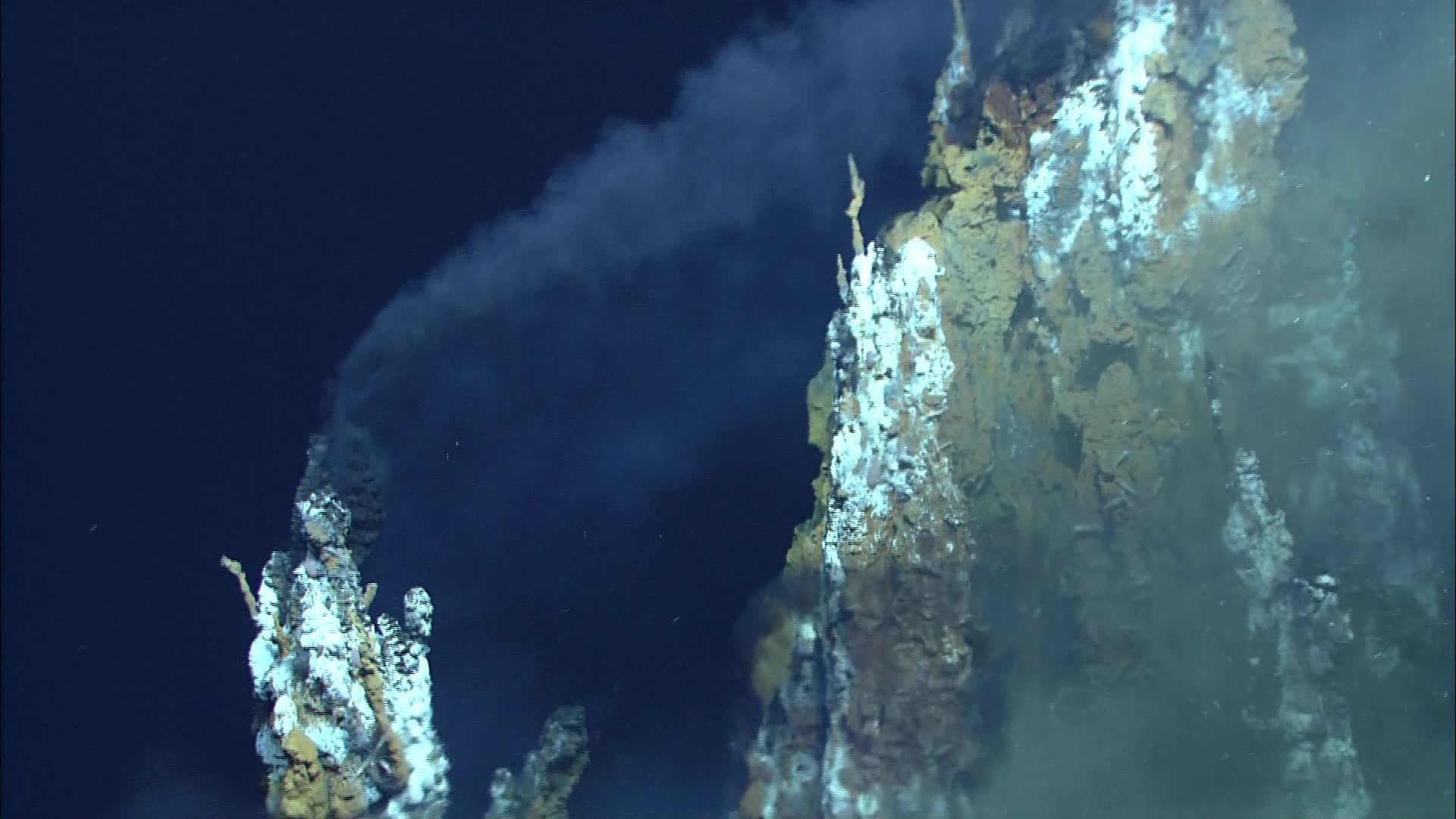
The featured photograph shows an active black smoker at Niua South Volcano, recorded by NOAA Ocean Exploration. It is representative of hydrothermal activity. It is not an image of the specific alkaline, serpentinising system proposed by the paper, much less of the setting where life actually originated.
Nor does the study show that life must be common elsewhere. Two independent metabolic solutions on one planet would be intriguing evidence that cellular autonomy can be reached more than one way once a genetic system and a favourable chemical environment already exist. It says nothing direct about how often that earlier coding system arises, how narrow the required conditions are or whether either step occurred on another world.
If the model holds, the family tree of life still has a shared genetic root. What changes is the image of its trunk. Rather than one finished cell dividing neatly into bacteria and archaea, there may have been an ancestral genetic community still leaning on the chemistry of its birthplace. Its two surviving branches then learnt, independently, how to leave.