
The idea that most stars in the night sky are already dead begins with a true statement: light takes time to travel. Every star is therefore seen as it was, not as it is at some shared present instant.
The mistake comes next. The stars visible without a telescope are not generally millions of light-years away, and their lives are not generally short. For almost all of them, the light-travel delay is tiny beside the time the star spends shining.
In this context, “alive” is astronomical shorthand, not biology. It means the star has probably not yet reached the end of its stellar evolution. On that definition, the familiar night sky is almost entirely alive.
The naked-eye sky is a local sample
The points that make up the familiar constellations are individual stars in the Milky Way. Radio astronomer Alastair Gunn writes in BBC Sky at Night that all stars visible to the naked eye lie within about 4,000 light-years of Earth. A separate analysis by radio astronomer Laura Nicole Driessen places the most exceptional naked-eye cases as far away as roughly 10,000 light-years under ideal conditions.
The difference reflects where one draws the visibility line and how one handles unusually luminous stars. Neither figure is remotely close to millions of light-years. The Yale Bright Star Catalogue contains 9,110 entries and is broadly complete to visual magnitude 7, slightly fainter than the conventional unaided-eye limit. Only part of the sky is above any one horizon, and real visibility is reduced by daylight, weather and artificial light.
Stellar lifetimes dwarf the delay
Distance alone cannot tell us whether a star has died. The relevant comparison is between the age of the light and the expected lifetime of the object producing it.
NASA’s overview of stellar evolution puts the range from a few million years for some massive stars to trillions of years for low-mass stars. The Sun spends roughly 10 billion years in its stable, hydrogen-fusing main-sequence phase. Massive blue stars burn through their fuel much faster, but even a lifetime of a few million years is hundreds of times longer than a 4,000-year light journey.
The popular claim reverses that scale. It takes a delay measured mainly in years, centuries or a few millennia and treats it as if it were comparable with a lifespan measured in millions or billions of years.
Where one death every 10,000 years comes from
Gunn’s figure is an order-of-magnitude estimate for the naked-eye population, not an observed timetable. He uses knowledge of the Milky Way’s stellar death rate and an intermediate distance of about 1,000 light-years to estimate that one visible star dies roughly every 10,000 years.
The calculation is necessarily approximate. Naked-eye selection favours intrinsically bright, massive stars at greater distances while allowing dimmer, longer-lived stars into the sample only when they are close. The answer also depends on the visibility threshold, the distribution of stars around the Sun and what counts as “death”.
Still, the conclusion is robust enough for the myth being tested. The period in which a visible star could have died without its final signal reaching us is normally shorter than its enormous lifetime, and stellar endings are rare within this small observed population. Gunn’s conclusion is that it is unlikely, although not impossible, that any naked-eye star has already died.
Betelgeuse shows possibility is not probability
Betelgeuse is the example people usually have in mind. The red supergiant is about 700 light-years away and will eventually undergo core collapse. It is therefore logically possible that the explosion happened after the light now reaching Earth departed.
There is no evidence that it did. NASA’s Betelgeuse overview, updated in March 2026, says the star is not expected to explode for about another 100,000 years. The estimate is model-dependent rather than a calendar appointment, but it makes an explosion during the unseen seven-century interval improbable.
SpaceDaily has also reported how Hubble observations traced a companion’s wake through Betelgeuse’s atmosphere. That work helps explain a long cycle in the star’s behaviour without turning its variability into a countdown. Light-travel time creates an information gap. It does not fill that gap with a supernova.
A dead star does not simply vanish
“Death” is itself an imprecise word. A lower-mass star can shed its outer layers and leave a white dwarf that cools for billions of years. A massive star can explode as a supernova and leave a neutron star or black hole. The transition may produce a bright new object, an expanding remnant or a compact source rather than a blank patch of sky.
For observers, a star remains whatever the arriving photons show. We cannot receive news of a later change before its light, neutrinos or gravitational waves cross the same distance.
Telescopes change the answer
The myth becomes true when the sample changes. Hubble detected the enormously magnified star Earendel as it appeared 12.9 billion years ago. NASA’s account of the discovery describes a star at least 50 times the Sun’s mass, seen only because a foreground galaxy cluster acted as a gravitational lens. A star of that kind could not survive for anything close to 12.9 billion years.
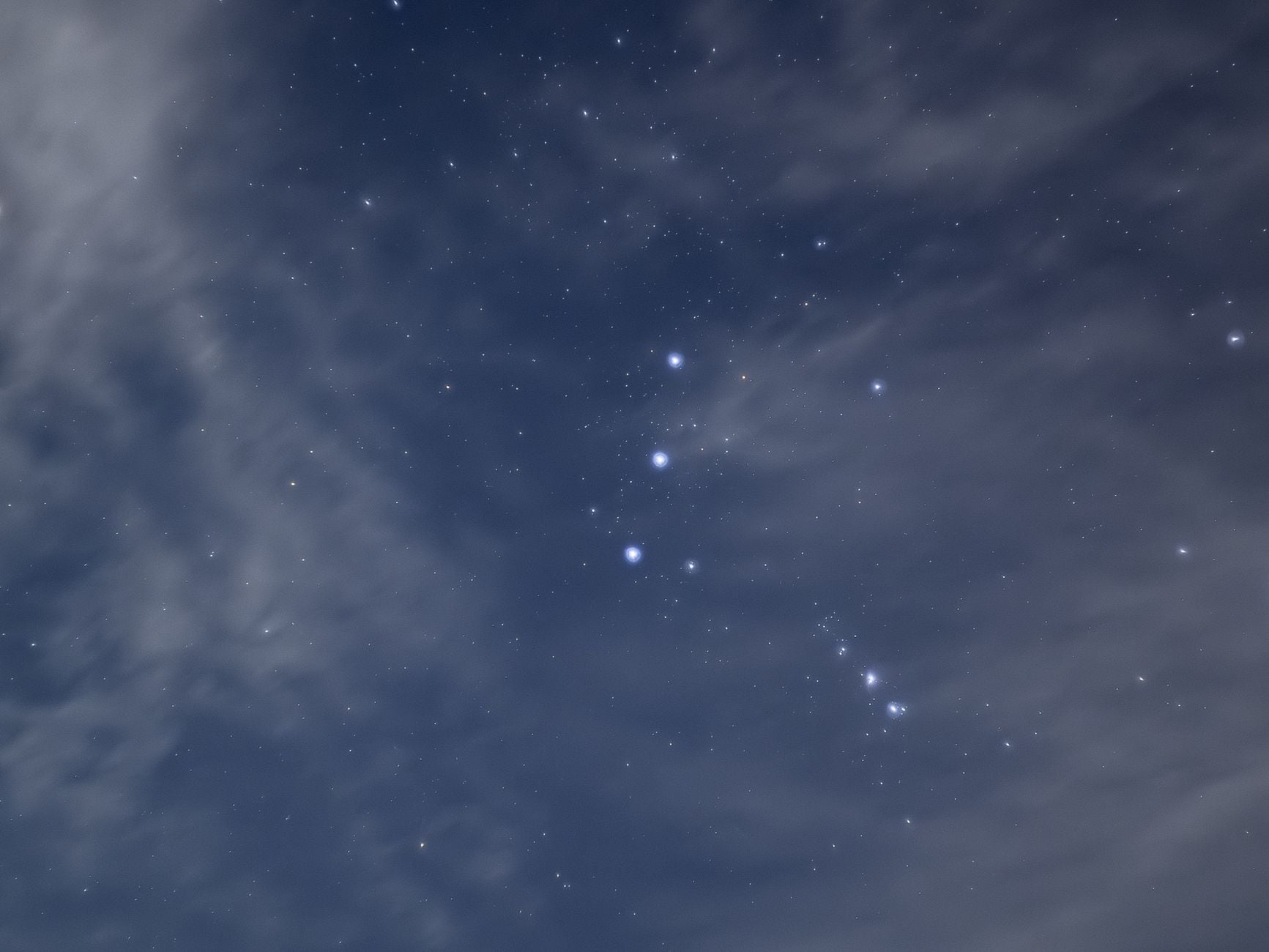
Powerful telescopes really do show stars and galaxies that have long since changed or disappeared. That deep-time truth has been incorrectly pasted onto the unaided eye. When we look at Sirius, Vega, Orion or the Southern Cross, we are looking into the past, but not usually into a graveyard. By the best available estimates, nearly every star in that ordinary sky is still shining somewhere beyond the delay.