

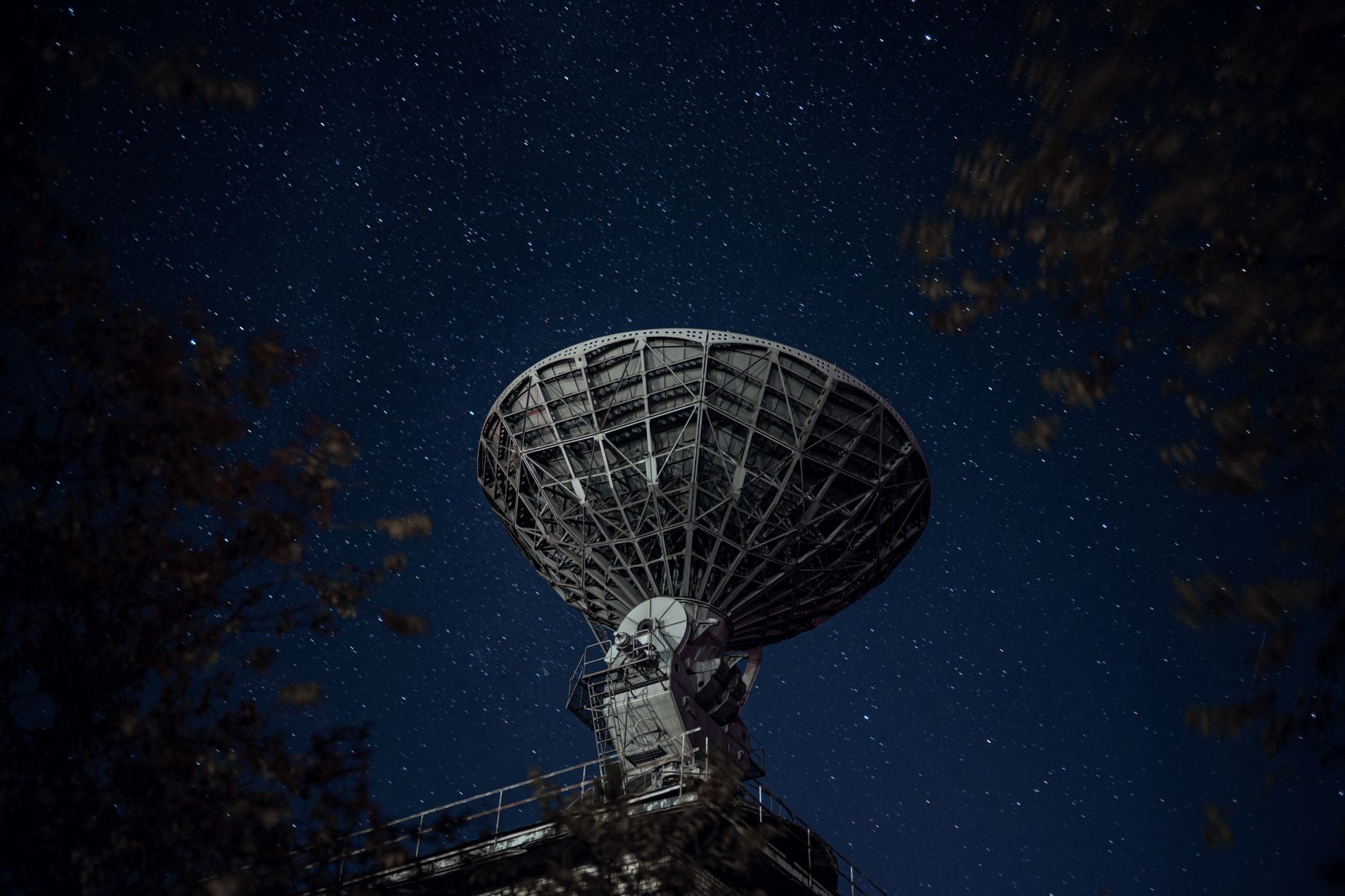
The Wow! signal was not detected again in 2025. Astronomers returned to the paper record of the 1977 observation and reconstructed how Ohio State University’s Big Ear radio telescope converted receiver noise into a physical signal strength. Their result was a peak flux density of at least 256 plus or minus 63 janskys, well above the 54-jansky figure most often repeated in popular accounts.
This is one preprint, not settled consensus. The 2025 Arecibo Wow! II reanalysis, led by Abel Méndez of the University of Puerto Rico at Arecibo, remains labelled for submission to the Astrophysical Journal. It revises the signal’s strength, frequency and possible positions. It does not turn one observation into a repeat detection, and it does not identify what produced it.
The distinction is central to reading the result. A stronger reconstruction raises the energy that any explanation must supply. It does not make an extraterrestrial transmission more likely by itself, nor does it prove the authors’ favoured natural alternative.
Stronger means a recalibration, not a second detection
Big Ear’s computer did not print a measurement in janskys on 15 August 1977. It printed 6EQUJ5, six characters encoding how far one narrow frequency channel rose above the estimated background noise in successive 12-second samples. The famous sequence records signal-to-noise ratio. Converting it into flux density requires a separate calibration of the telescope.
Earlier reconstructions differed sharply. Jerry Ehman, the astronomer who found and annotated the printout, estimated about 54 janskys. Russ Childers later arrived at about 212 janskys. Neither derivation was fully documented in the published literature, according to the new team.
The researchers rebuilt the conversion by comparing known radio sources at the same declination and examining a noise tube that injected a calibration signal before and after the event. Multiplying their estimated noise in one channel by a fitted peak signal-to-noise ratio of 30.1 gave at least 256 plus or minus 63 janskys.
“More than four times stronger” is therefore true relative to the commonly cited 54-jansky value. It is not true against every previous estimate. The new lower limit remains consistent with Childers’ 212-jansky figure once the uncertainty is included, and the exact noise level at the moment of detection is still unknown.
The frequency revision implies a faster Galactic source
The reanalysis also changes the frequency from the long-cited 1420.4556 megahertz to 1420.726 plus or minus 0.005 megahertz. The correction arose from reconstructing how the receiver’s second local oscillator and software translated a printed value into the actual observing frequency.
Neutral hydrogen at rest emits at about 1420.406 megahertz, the 21-centimetre line. The new value is not the rest frequency itself. Motion between a source and the telescope shifts the observed line through the Doppler effect. The authors calculate a heliocentric radial velocity of about minus 84 kilometres per second, or roughly minus 74 kilometres per second in the local standard of rest.
That velocity is more compatible with a fast-moving source in the Milky Way than the earlier interpretation, in the authors’ view. Frequency does not disclose the source’s identity, however. It defines a velocity range in which future observers can search for hydrogen structures and possible triggers.
The difficulty of making these corrections is visible in Ehman’s technical history of the detection. Big Ear’s two feed horns, local oscillators, real-time software and line-printer output have to be understood as one 1977 instrument. A modern numerical value rests on that reconstruction.
Two small sky boxes remain instead of one exact point
Big Ear was a drift telescope. Earth’s rotation carried a fixed patch of sky through two feed-horn beams about three minutes apart. The Wow! signal appeared in only one horn, but the system recorded the absolute difference between them and did not preserve which horn had received it. That ambiguity leaves two possible right ascensions.
The new analysis centres them at 19 hours 25 minutes 02 seconds and 19 hours 27 minutes 55 seconds, each with about three seconds of right-ascension uncertainty. Both retain a declination uncertainty of about 20 arcminutes near minus 26 degrees 57 minutes. The fitted source was no more than roughly 1.9 arcminutes across in right ascension.
The signal rose and fell in a pattern closely matching a fixed source drifting through the beam. The SETI Institute’s account of the event treats that shape as one reason the detection remains interesting. The protected observing band, the beam-shaped profile and the lack of a known transmitter all weigh against ordinary local interference. None makes interference logically impossible.
Nor did the narrower coordinates reveal a counterpart. Follow-up observations have not recovered the event, and the same source did not appear in the other horn minutes later. The revised map improves a search problem without removing its defining absence.
Cold hydrogen clouds can produce the right kind of narrow line
The proposed natural explanation predates this recalibration. In Arecibo drift scans made in 2020, Méndez and colleagues found several signals no wider than 10 kilohertz near the hydrogen line. They were about two orders of magnitude weaker than Wow! and appeared in multiple directions. The team associated them with small regions of cold neutral hydrogen in the Milky Way.
That observation challenges an overly simple rule sometimes applied to technosignature candidates: narrow means artificial. Natural masers can concentrate emission into narrow spectral lines when radiation stimulates excited atoms or molecules to emit coherently. The Arecibo clouds demonstrate that compact hydrogen structures can generate narrow features. They do not demonstrate the enormous, short-lived amplification required for Wow!
In the 2024 Arecibo Wow! I preprint, the team proposes the missing trigger. A burst of radiation from a magnetar or soft gamma repeater could pump a suitably placed cloud. Maser amplification or a related process called superradiance might then release a bright, narrow signal lasting seconds to minutes.
The wording needs care. A magnetar would not physically strike the cloud. Radiation from its flare would reach and excite the hydrogen. Depending on the geometry, the neutron star could be near the cloud or far behind it along our line of sight.
The magnetar mechanism is the extraordinary unobserved step
Magnetars are neutron stars with extremely strong magnetic fields and a capacity for short, energetic outbursts. They can supply the kind of transient pump the proposal needs. A hydrogen cloud could supply the 21-centimetre frequency, while a brief amplification episode could explain why later searches heard nothing from the same position.
This is an economical fit to several facts, but it remains a hypothesis. No 21-centimetre atomic-hydrogen maser flare or superradiant burst has been directly observed. No recorded magnetar outburst has been connected to the 1977 signal. The team identified weaker clouds with similar bandwidths, not a smaller version of the complete proposed event.
The project’s current explanation and frequently asked questions say confirmation requires additional similar events. If one were detected with a plausible high-energy trigger and the predicted hydrogen-line behaviour, it would give the mechanism evidence that a retrospective match cannot provide.
Only under that condition could Wow! be described as the first recorded example of such an astronomical hydrogen flare. For now, “first” is a consequence of the hypothesis being correct, not an observation established independently of it.
The signal is better measured, but the case remains open
The Arecibo Wow! project now rates ordinary radio interference as highly unlikely and says an astronomical origin is favoured. That assessment is stronger than saying the signal has been explained. Artificial terrestrial or extraterrestrial origins have not been formally excluded, and the natural mechanism has not been seen in operation.
SpaceDaily previously covered the 72-second detection and the long search for an explanation. The advance here is narrower and more useful than another retelling: recovered calibration records have changed the numerical target that every candidate source must meet.
Further work can now concentrate on two smaller sky regions, a revised velocity and transient hydrogen clouds that earlier searches were not designed to catch. The decisive evidence would be another event whose radio signal, cloud and high-energy trigger can all be observed together. Until then, the 1977 detection is more precisely described, not identified.