

Run a finger across a desk, scoop up seawater, or look at a photograph of a galaxy billions of light-years away. The atoms involved seem to span almost everything that could reasonably be called the universe. Yet in the best-supported cosmic inventory, all familiar atomic matter supplies only about one twentieth of the total. The rest is known through what it does, not what it is.
The five per cent is an accounting result
The familiar number is a share of the universe’s present mass-energy density. It is not a statement that atoms occupy five per cent of space, nor that telescopes have surveyed only five per cent of the sky. NASA’s current summary rounds the balance sheet to 5 per cent ordinary matter, 27 per cent dark matter and 68 per cent dark energy.
Ordinary matter is often called baryonic matter because almost all its mass resides in protons and neutrons, which physicists classify as baryons. Electrons complete atoms, while light and neutrinos add small contributions to the wider cosmic budget. The headline’s five per cent is therefore a useful rounded figure, not a perfectly sealed box. It includes far more than what shines. Cold interstellar gas, dim planets and black holes formed from ordinary matter still belong on the familiar side of the ledger even when no telescope sees them directly.
How the universe was weighed without a cosmic scale
Cosmologists did not total the mass of every galaxy. They fitted a model to several independent traces of cosmic history. The cosmic microwave background preserves tiny variations from when the universe was about 380,000 years old. The relative heights and positions of its acoustic peaks reveal how much ordinary matter and total matter were present. Galaxy clustering supplies a later ruler, while exploding stars trace how expansion changed with time.
The final Planck analysis found that a six-parameter model known as Lambda cold dark matter, or Lambda-CDM, describes more than a billion sky-map pixels remarkably well. In that framework, the ingredients are not arbitrary patches added because most things look black. Their proportions are numbers required for one mathematical history to connect the early universe with the structure and expansion observed today.
Dark matter is unseen, not unsupported
Stars far from galactic centres orbit too quickly for the gravity of visible material alone. Galaxies in clusters also move as if embedded in much more mass than their luminous contents provide. Gravitational lensing adds another test: foreground mass bends the images of background galaxies, allowing astronomers to map matter whether or not that matter emits light.
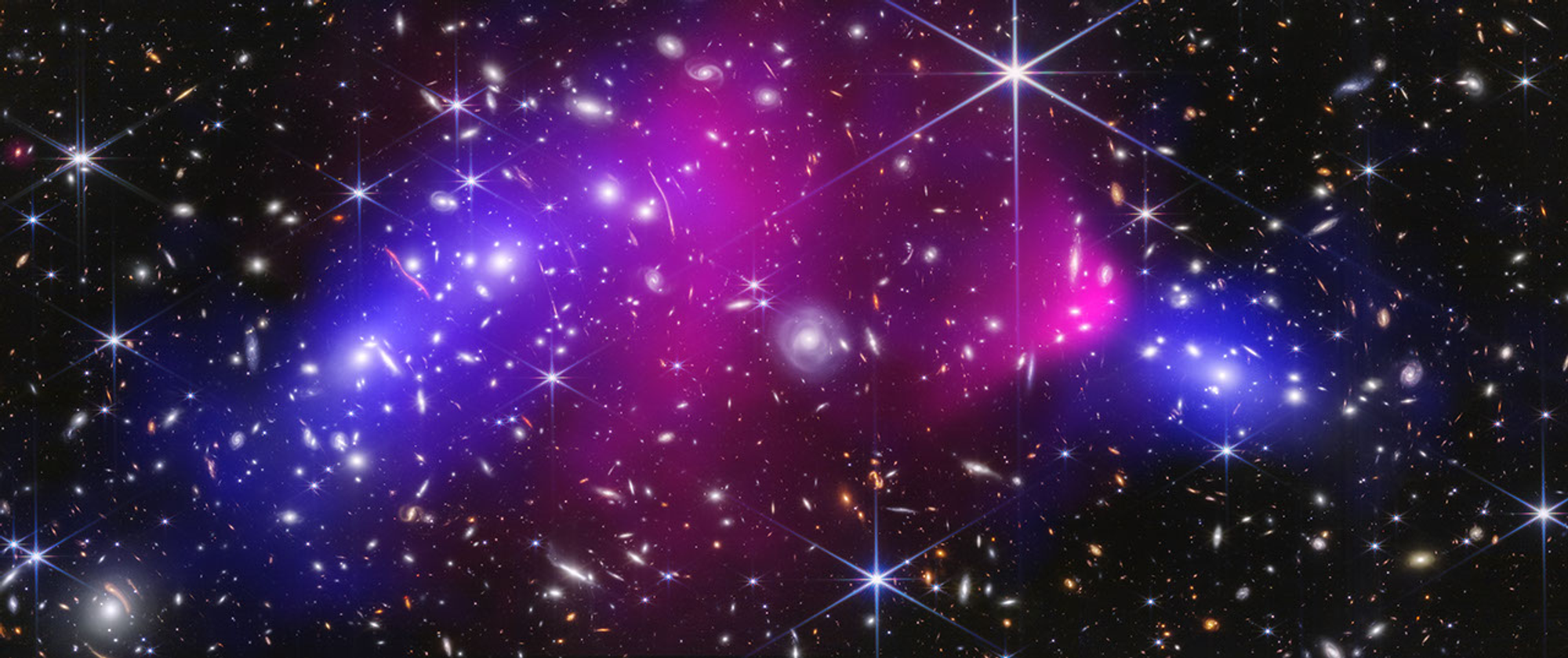
The Bullet Cluster makes the argument unusually vivid. Two galaxy clusters passed through one another. Their hot ordinary gas collided, slowed and glowed in X-rays, while most of the mass inferred from lensing continued farther on. In the 2025 Webb and Chandra composite, pink marks hot gas and blue marks the lensing-derived mass distribution. The blue is a map built from gravity, not a photograph of dark particles. It is powerful evidence that an unseen mass component behaves differently from the gas, while stopping short of telling physicists what particle or field produces it.
Dark energy is a separate and stranger problem
Dark matter attracts and gathers around galaxies. Dark energy is the placeholder for whatever causes the expansion of space to accelerate on the largest scales. The acceleration emerged in the late 1990s from measurements of distant Type Ia supernovae. A larger compilation later gave SpaceDaily readers a view of the transition from matter-dominated to dark-energy-dominated expansion.
The simplest fit treats dark energy as Einstein’s cosmological constant: a fixed energy density of empty space, represented by Lambda in Lambda-CDM. That description works impressively well, but naming a term in an equation is not the same as identifying a physical cause. Vacuum energy, a new dynamical field and a failure of general relativity on immense scales remain among the broad possibilities. Surveys can constrain how the effect behaves. They have not put a sample of dark energy in a detector.
Dark is a label for two kinds of ignorance
The shared adjective can mislead. Dark matter and dark energy are not two shades of one substance. Dark matter has positive mass, gravitates into clumps and appears to have helped seed the cosmic web in which galaxies formed. Dark energy is smooth on large scales and is associated with accelerated expansion. One pulls structures together; the other becomes dominant as the universe dilutes and expansion carries distant structures apart.
Nor does dark mean that there is no evidence. It means the proposed component has no confirmed identity in the known inventory of particles and fields. The 2011 Nobel Prize in Physics recognised the supernova observations behind accelerated expansion, not the discovery of a dark-energy particle. Likewise, repeated gravitational measurements establish a missing-mass problem with extraordinary reach, but they do not select one microscopic solution.
The missing identities survive determined searches
Dark matter candidates include weakly interacting massive particles, axions and other particles beyond the Standard Model. Underground detectors wait for tiny recoils, accelerators search for missing momentum, and telescopes look for possible decay or annihilation products. The CERN overview of the search captures the difficulty: an experiment might create a candidate, but because it would escape unseen, several independent lines of evidence would still be needed to show that it is the matter surrounding galaxies.
Dark energy is tested differently. Astronomers compare standard candles, standard rulers, lensing and the growth of structure across cosmic time. Results from the Dark Energy Spectroscopic Instrument have even strengthened hints that the effect may evolve, but the collaboration stresses that the preference has not reached the threshold for discovery. Its three-year analysis is an invitation to test Lambda-CDM harder, not a confirmed replacement for it.
The visible minority learned to measure the rest
The imbalance is humbling, but the five per cent is not cosmically unimportant. Ordinary matter can cool, collide and build intricate structures. It made stars that forged heavier elements, planets with mountains and oceans, and nervous systems capable of turning faint light into measurements. Dark matter appears to have supplied much of the gravitational scaffolding on which that complexity assembled.
So the strongest version of the mystery is not that 95 per cent of the universe is wholly undetected. Physicists detect its influence repeatedly. The mystery is that effects dominating the cosmic ledger still have no confirmed underlying identity. Every sharper lensing map, cleaner particle search and longer expansion survey turns a poetic word, dark, into a tighter set of measurable questions. The known five per cent has already become precise enough to reveal how much remains unknown.