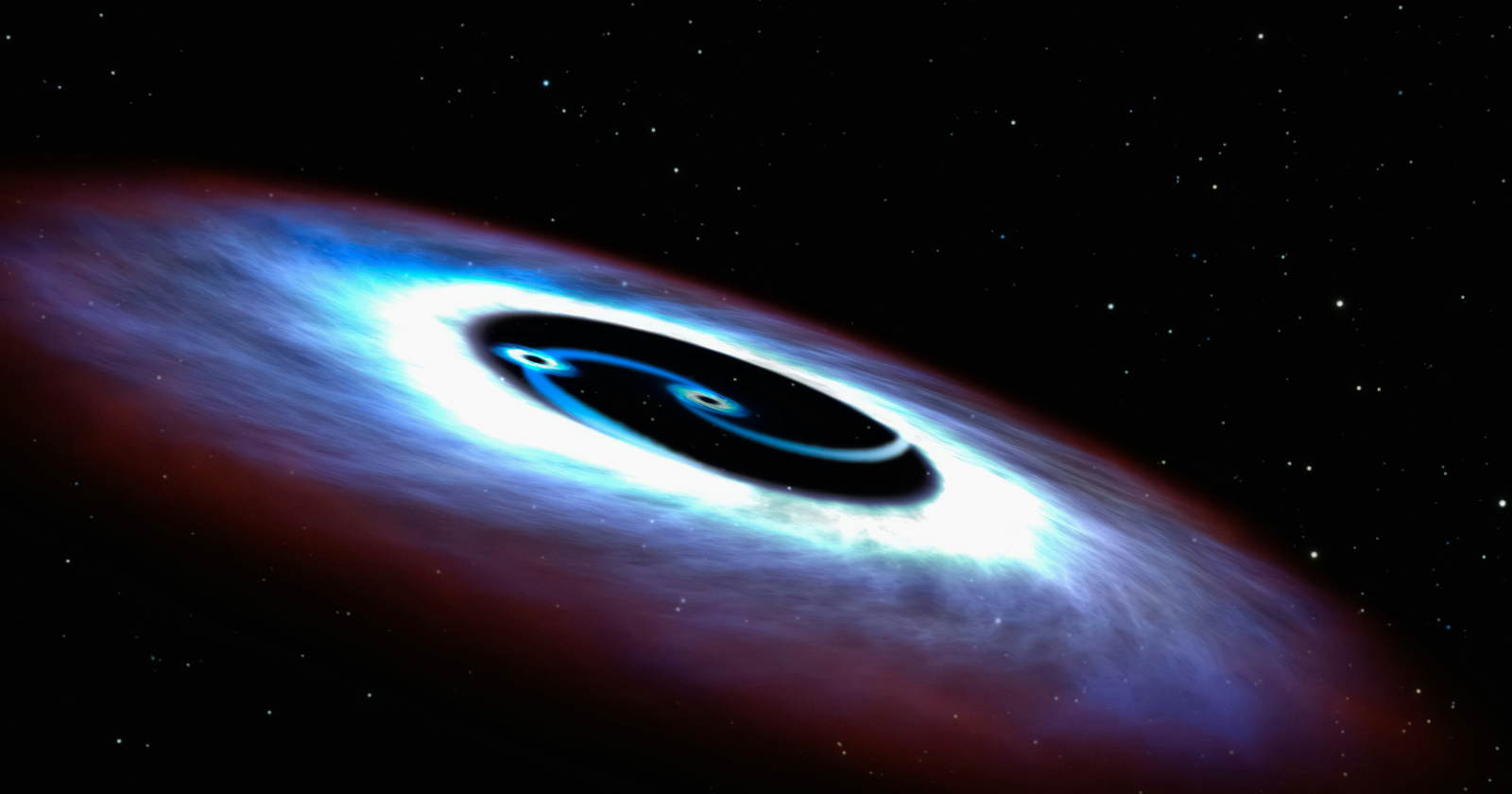
Picture two astronauts saying goodbye near a black hole.
One stays behind on a ship, parked at a safe distance. The other flies in closer, loops around near the edge of the black hole’s pull, and comes back. From the traveler’s own perspective, the whole trip might take a few hours. When they dock back at the ship, though, their friend has aged years.
Neither astronaut’s clock was broken. Both were telling time correctly. Time itself, near that black hole, was simply moving at two different speeds for two different people.
Gravity slows down time, not just objects
This isn’t science fiction taking liberties. It’s a real, measured consequence of general relativity called gravitational time dilation, and it happens everywhere gravity exists, not only near black holes. The stronger the gravity you’re sitting in, the slower your clock runs compared to someone farther away from that gravity.
The effect is real but genuinely tiny at ordinary, everyday strengths of gravity. According to reporting from BBC Science Focus, a clock at sea level runs about one-billionth of a second slower per year than an identical clock at the summit of Mount Everest, purely because Everest sits slightly farther from the center of the Earth’s mass, in slightly weaker gravity. NASA confirmed the underlying effect directly in 1976, launching an atomic clock roughly 10,000 kilometers up specifically to compare its rate against a matching clock on the ground. The measurement lined up with what Einstein’s equations predicted almost exactly.
One billionth of a second a year is nothing anyone would notice in a lifetime. It’s still worth sitting with for a second, because it means the effect isn’t a black-hole-only exotic curiosity. It’s happening constantly, at a tiny scale, everywhere gravity is even slightly different from one spot to another. A black hole doesn’t invent the effect. It just turns the dial up until a mild curiosity becomes something you’d actually notice when you got home.
Near a black hole, the same effect stops being subtle. Gravity there is strong enough that the difference in time between “close” and “far” stops being a rounding error and starts being years.
The mechanism behind all of it is that gravity isn’t a force reaching out and tugging on things from a distance, the way it’s usually taught in school. In general relativity, mass bends the space and time around it, and everything nearby, including light and clocks, has to travel through that bent geometry. Closer to a very massive object, spacetime is curved more sharply, and a clock sitting in that sharper curve simply ticks through fewer seconds for every second that passes somewhere flatter. Nothing about the clock itself changes. The space it’s sitting in does.
Watching each other’s clocks from a distance
If the two astronauts could somehow watch each other through a telescope during the trip, the mismatch would look strange from both directions. The one who stayed back would see their friend’s ship, and everything on it, moving in slow motion the closer it got to the black hole. The traveler, looking back, would see their friend’s ship speeding up, years compressing into what felt like minutes. Both views would be accurate. Neither one would be lying to the other.
What Interstellar actually got right
Brenna Mockler, an assistant professor of physics and astronomy at UC Davis, points to the movie Interstellar as an unusually accurate pop-culture version of this exact idea, where a crew member who visits a planet near a black hole ages barely at all while decades pass for everyone who stayed behind. In her words: “If you get closer to the black hole and then you return to other people, it’s similar to if you’re moving at close to the speed of light, your time is going at a different pace from everyone else’s.”
Mockler’s other point is the one that actually reframes the whole idea: “Your concept of time is going to be different from everyone else’s.” Both versions of elapsed time are equally real and equally correct, measured from two vantage points that were simply never running the same clock to begin with.
Whose clock is the real one?
Neither astronaut in that opening scene is wrong about how much time passed for them. Neither clock needs correcting. The question “how long did that actually take” gets as many correct answers near a black hole as there are observers asking it, each one accurate for the person who asked.
I think about this more than the average person probably does, mostly because I’ve spent years pushing back against the idea that there’s one correct timeline everyone should be running on. My own life has looked, on paper, wildly lopsided at different points: almost entirely ambition in my twenties, much more weighted toward family now, by choice, because that’s what this particular season calls for. Measured against somebody else’s clock, that might look like I’m behind on one thing and rushing another. Measured against my own, both were exactly on time.
Physics doesn’t actually need people to agree on this to be true. Two clocks near a black hole run at different speeds whether anyone likes that or not. It’s a strange kind of comfort, borrowing that logic for the much smaller, much less exotic problem of comparing your own year to somebody else’s.
Other people’s twenties, other people’s thirties, other people’s version of “on track,” were all run on a different clock than mine from the start, the same way the astronaut who stayed on the ship and the one who flew toward the black hole were never going to agree on how long the trip took. Neither of them needed to be corrected. They just needed to stop comparing readings from two clocks that were never synced up to begin with.