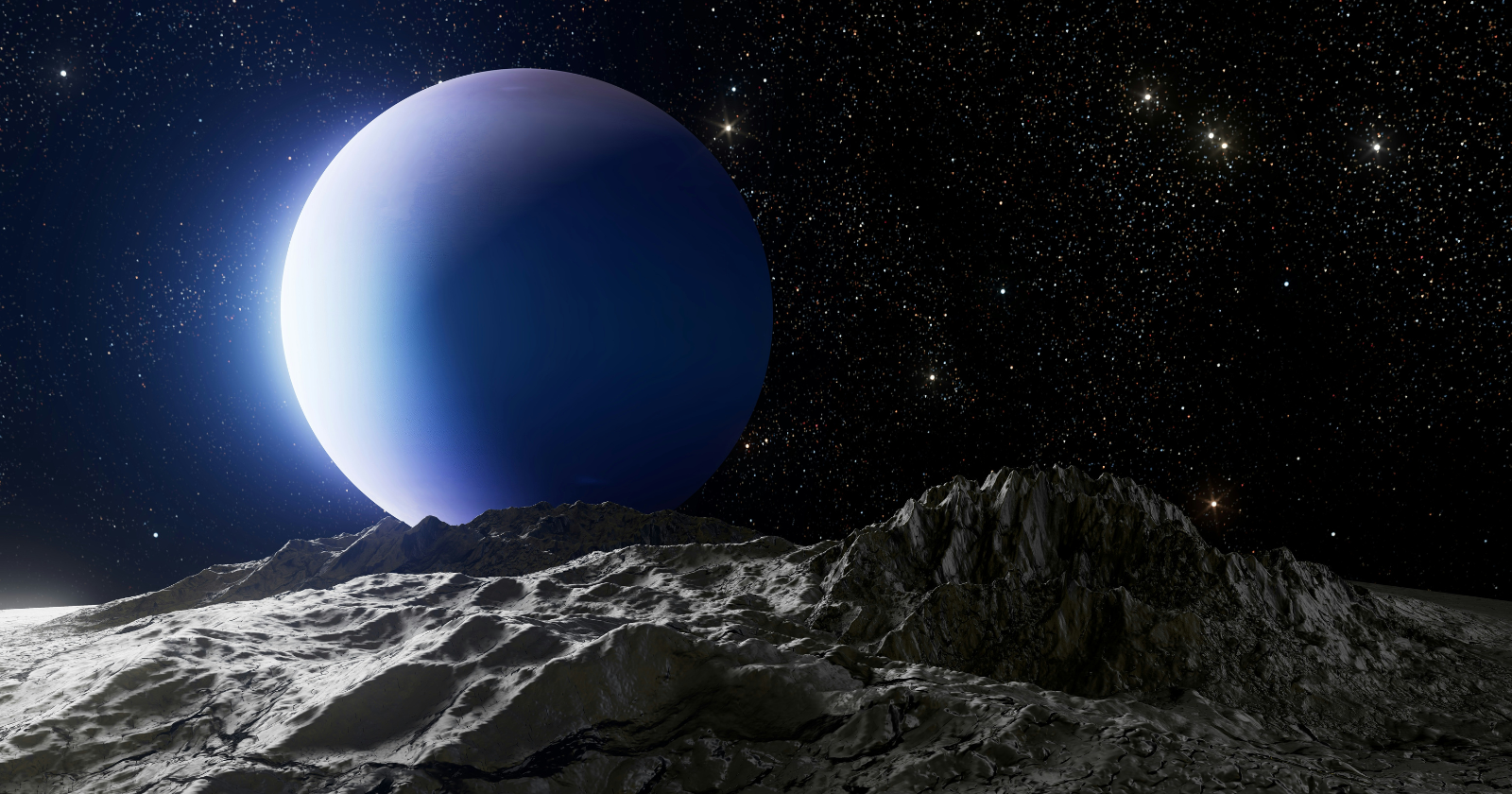
Every large moon in our solar system, without exception, orbits its planet in the same direction the planet spins. Our own Moon does it. Jupiter’s four giant moons do it. Saturn’s do it. It’s such a consistent pattern that it’s basically a rule: moons form out of the same spinning disk of debris that formed their planet, so they inherit its spin direction, the same way a whirlpool’s outer edges spin with its center.
Neptune’s largest moon never got the memo.
The one large moon that breaks the pattern
According to NASA, Triton “orbits in the opposite direction of its planet’s rotation,” a retrograde orbit found in no other large moon in the solar system. It’s also cold in a way that’s hard to picture: surface temperatures run around minus 391 degrees Fahrenheit, making it one of the coldest known objects out there, and yet Voyager 2 found active geysers on its surface in 1989, venting material into space on a world that cold. Triton is a genuinely strange place before you even get to the orbit.
NASA’s own explanation for the backwards orbit is blunt: Triton is likely “a Kuiper Belt Object captured by Neptune’s gravity millions of years ago,” not a moon that formed in place. It shares enough in common with Pluto, the best-known resident of the Kuiper Belt, that scientists suspect the two came from a similar population of icy bodies out past Neptune’s orbit, long before either ended up where it is now.
How do you actually capture a moon?
Simple capture is harder to pull off than it sounds. An object drifting past a planet on its own doesn’t usually get caught, because there’s nothing to slow it down enough to stay. It needs somewhere to shed the extra energy, or it just swings past and keeps going. For decades, that basic physics problem was the biggest hole in the “Triton was captured” idea: astronomers agreed the orbit looked captured, but nobody had a clean mechanism for how a lone object could actually lose enough speed to get stuck.
Craig Agnor, a researcher at UC Santa Cruz’s Center for the Origin, Dynamics, and Evolution of Planets, along with Douglas Hamilton at the University of Maryland, proposed a mechanism for exactly this problem in a 2006 paper in Nature: Triton probably arrived as part of a binary pair, two icy bodies orbiting each other the way Pluto and its moon Charon still do. When that pair passed close enough to Neptune, the planet’s gravity could pull the two apart, flinging one companion away while capturing the other into orbit. Agnor summed up what the model solved: “We’ve found a likely solution to the long-standing problem of how Triton arrived in its peculiar orbit.”
Hamilton pointed out that the mechanism isn’t some rare cosmic fluke either. Binary objects, pairs of similarly sized bodies orbiting a shared center of mass, turn out to be common among small, icy bodies at the edge of the solar system, which means the kind of close encounter that could have delivered Triton to Neptune had plenty of opportunities to actually happen.
Voyager 2 is the only spacecraft to have ever flown close enough to photograph Triton up close, back in 1989, on its way out of the solar system. Almost everything specific we know about the moon’s geysers, its nitrogen ice, and its oddly young-looking, crater-light surface traces back to that one flyby. Nobody has been back since, and nothing is currently scheduled to go.
What the geysers add to the story
None of this explains, on its own, why a moon that cold is still geologically active. At minus 391 degrees Fahrenheit, Triton’s geysers aren’t erupting molten rock the way Earth’s volcanoes do. The leading explanation involves sunlight, thin as it is that far out, warming trapped nitrogen ice just enough below the surface to build up pressure until it vents. It’s a small, slow process by volcanic standards, running on a fraction of the sunlight Earth gets, on a world that arrived from somewhere else entirely and still hasn’t fully settled into its new home.
An orbit that’s already writing its own ending
Being captured backwards isn’t a one-time cosmic accident that then settles down. Because Triton orbits against Neptune’s spin, tidal forces are slowly dragging it inward instead of pushing it outward, the way a normal moon like ours drifts slowly away from its planet. Over a very long timescale, on the order of billions of years, Triton is expected to either be torn apart by Neptune’s gravity or spiral in and collide with it. A moon that arrived from somewhere else is, very slowly, on its way out again.
None of that is happening on any timeline a person needs to worry about. It’s just a strange bit of context for an already strange moon: not only does Triton not belong to Neptune’s original family of moons, its whole orbit is basically a long, slow-motion argument with the planet that caught it, one that Neptune is eventually going to win. Every other large moon in the solar system is slowly settling into a more comfortable, permanent relationship with its planet, drifting a little farther out with each passing millennium. Triton is the one exception quietly working toward the opposite ending, a little closer in with each pass, on a schedule measured in eons rather than anything a human calendar could usefully mark.
I’ve moved between three continents in my life, and landing somewhere you weren’t originally headed, then slowly building an entire life there anyway, carries its own specific kind of disorientation. Triton isn’t going anywhere by choice, obviously, and I’m not about to compare a jettisoned icy world to a human immigration story. But something oddly familiar sits in an object that got folded into a system it wasn’t born into, kept its own separate history the whole time, and never quite stopped moving in a way that gave that history away.