
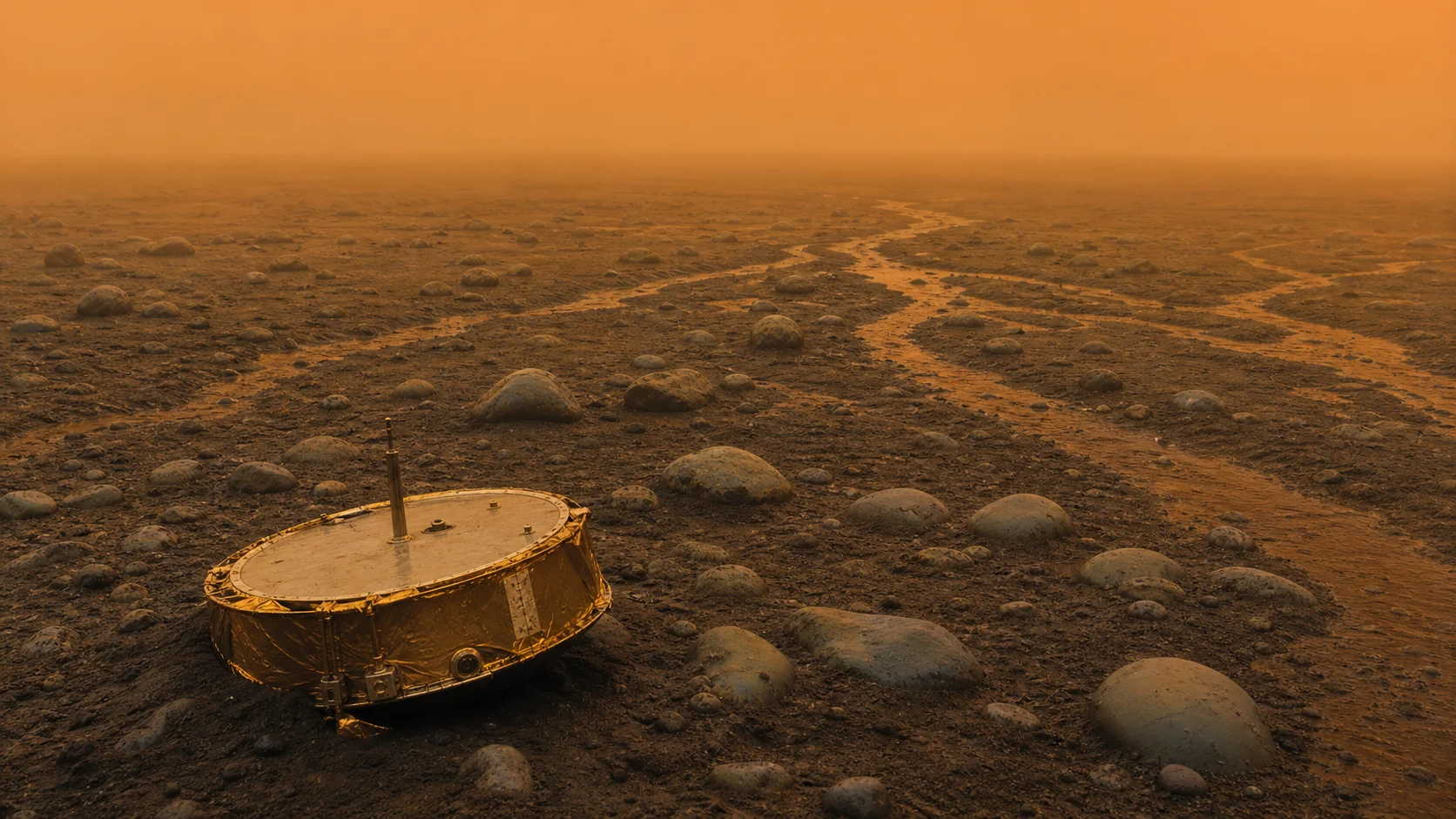
On 14 January 2005, a wok-shaped probe about 2.7 metres across drifted down through the orange smog of Titan on a parachute, took pictures of a shoreline that had never been photographed, and landed on a plain of rounded ice pebbles that looked, unnervingly, like a dry riverbed on Earth. It kept talking for another 90 minutes from the surface. The Huygens probe remains the most distant landing humans have ever pulled off, and it happened on a moon whose surface no telescope had ever seen through the haze.
The descent lasted 147 minutes, according to the imaging team at NASA. The transmission from the surface lasted roughly another hour and a half before the batteries gave out and Cassini slipped below Titan’s horizon.
What Cassini let go of on Christmas Day
Huygens separated from Cassini on 25 December 2004. The separation event was mechanically simple and operationally terrifying: three springs pushed the 320-kilogram probe away at about 30 centimetres per second, giving it a slow spin for stability, and then Cassini turned and fired its thrusters to get out of the way. From that moment, Huygens was on its own. No thrusters. No commands from Earth. Just a clock.
The clock was the whole plan.
Huygens had been asleep for the seven-year cruise from Cape Canaveral, waking briefly every six months for a health check. Its internal timer was set to switch the probe on 15 minutes before atmospheric entry. If the timer failed, there was no backup. If it fired early, the batteries would drain in vacuum. If it fired late, the probe would slam into the atmosphere unpowered.
It fired on time.
The 22 days of silence
Between separation and entry, Huygens coasted for about three weeks toward a moon larger than Mercury. Cassini, meanwhile, performed a deflection manoeuvre to avoid following the probe into Titan’s atmosphere, then repositioned itself as a relay antenna. The whole architecture depended on Cassini being in the right place, pointed the right way, at the right moment, to catch a faint radio signal from a lander it could not see.
The mission had already survived one near-catastrophe. Years before launch, ground testing revealed that the Doppler shift caused by Huygens’s descent speed would push its transmission outside the bandwidth Cassini’s receiver could lock onto. The receiver had been designed without enough margin. The fix — reprogramming the mission profile so Cassini flew a trajectory that reduced the relative velocity — was worked out mid-cruise, years after the spacecraft had left Earth.
Without that fix, the descent data would have been lost the moment it was transmitted.
Two and a half hours through orange air
Entry began about 1,270 kilometres above the surface at roughly 6 kilometres per second. A heat shield slowed the probe through the upper atmosphere. At about 160 kilometres altitude, a pilot chute pulled out the main parachute, an 8.3-metre canopy that slowed the descent enough for the heat shield to drop away and the science instruments to start sampling the air.
Then the main chute was cut loose and a smaller 3-metre chute took over, so the probe would reach the surface within the battery’s endurance rather than drifting for hours.
The ESA rendering of the descent, built from the actual instrument data years later, shows what the probe saw. For most of the fall, the view was fog. The haze started to clear only at about 60 kilometres altitude, and features 100 metres across began to resolve. Channels appeared. Bright highlands. Dark plains that looked like they had been shaped by a fluid — but the fluid could not be water, because the surface temperature was minus 179 degrees Celsius.
It was liquid methane, and the channels were riverbeds.
The pebbles at the landing site
Huygens hit the surface at about 4.5 metres per second — a firm thump, roughly what you would feel jumping off a chair. The instruments registered a brief crunch, then a settling, then stillness. The penetrometer suggested a texture something like wet sand or lightly packed snow. The lander’s downward-facing camera showed a flat plain scattered with rounded, cobble-sized objects between 5 and 15 centimetres across, casting shadows in a dim, sepia light.
They were not rocks. At Titan’s surface temperature, water ice is as hard as granite, and the pebbles were water ice, rounded by liquid methane the way river stones on Earth are rounded by water. The first NBC coverage of the images captured the shock of it: an alien world that looked, at ground level, like a familiar streambed on a wet morning.
The probe kept transmitting for about 90 minutes after touchdown. It was designed for three minutes on the surface. The batteries lasted much longer than the engineers had promised themselves.
What the data showed after the batteries died
The instruments Huygens carried were modest by modern standards — a gas chromatograph, a mass spectrometer, an aerosol collector, an imager, a surface science package — but the environment they measured had never been touched. The Nature papers that followed, including the Niemann and Tomasko results from 2005, described an atmosphere thick with nitrogen and methane, a haze of complex organic molecules, and a surface chemistry that hinted at a methane cycle roughly analogous to Earth’s water cycle.
Two years later, Cassini’s radar found what Huygens had missed by thousands of kilometres. A 2007 Nature commentary described the discovery of hydrocarbon lakes and seas near Titan’s north pole — the missing reservoirs that fed the methane cycle Huygens had sampled from the air. Titan had rivers, lakes, rain, and shorelines, all in liquid natural gas.
Space Daily has covered how Titan’s hydrocarbon reserves dwarf every known oil and gas deposit on Earth, and how none of it can burn — the atmosphere has almost no free oxygen.
The 25 years it took to get there
Huygens was proposed to ESA in 1982 and selected in 1988. Cassini-Huygens launched in October 1997. The probe reached its target in January 2005. From the first sketches to the first surface image, the mission spanned more than two decades — long enough that some of the engineers who designed the descent sequence retired before it flew.
The reason Huygens went to Titan at all traces back to the Voyager encounters. In 1980, Voyager 1 flew close enough to Titan to confirm the thick nitrogen atmosphere, but the flyby geometry left the moon’s surface completely hidden under haze. That single observation — and the trade-off it forced on Voyager 1’s onward trajectory — is what made Titan a priority target for a dedicated mission. Cassini could carry the orbiter. ESA built the lander.
The two agencies celebrated the tenth anniversary of the landing together in 2015, and Space Daily’s report on the anniversary event noted that Huygens still held the record for the most distant landing ever attempted. It still does.
The record it still holds
Every other landing humans have pulled off has been closer. The Moon is about 384,000 kilometres away. Mars, at closest approach, is about 55 million kilometres. Venus, where the Soviet Venera probes landed in the 1970s, sits at roughly 40 million kilometres at its closest. Titan was about 1.2 billion kilometres from Earth on the day Huygens touched down. Light from the probe took about 67 minutes to reach the Deep Space Network.
By the time controllers in Darmstadt heard that the descent had begun, it was already over. Huygens had landed, transmitted for 90 minutes, gone quiet, and been dead for hours before the first bit of its signal arrived on Earth.
The team’s account of the landing day describes the delay as a kind of enforced calm. Nothing anyone did in Germany could change what had already happened at Saturn. The probe was either alive or it wasn’t. The data was either in Cassini’s memory or it wasn’t. All they could do was wait for the signal.
Why the surface still matters
Huygens has been silent for more than 20 years. Cassini itself was deliberately steered into Saturn’s atmosphere in September 2017 to avoid any chance of contaminating Titan or Enceladus with terrestrial microbes — a decision Space Daily covered in its reporting on Cassini’s Titan observations.
Nothing has landed on Titan since.
NASA’s Dragonfly rotorcraft, currently scheduled for a 2028 launch and a 2034 arrival, will be the second. It is designed to fly between sites on Titan’s surface, sampling the organic chemistry that Huygens only glimpsed. When it lands, it will touch a moon that human instruments have visited exactly once, for two and a half hours of falling and 90 minutes of sitting still, in the middle of one particular afternoon in 2005.
The pebbles Huygens photographed are still there. The methane still rains on the highlands sometimes, drains through the channels, pools in the northern seas. The orange haze still hides everything from telescopes. The probe itself sits on the plain where it landed, a small metal disc slowly being buried by the sand it once measured, waiting on a shoreline no one has been back to see.