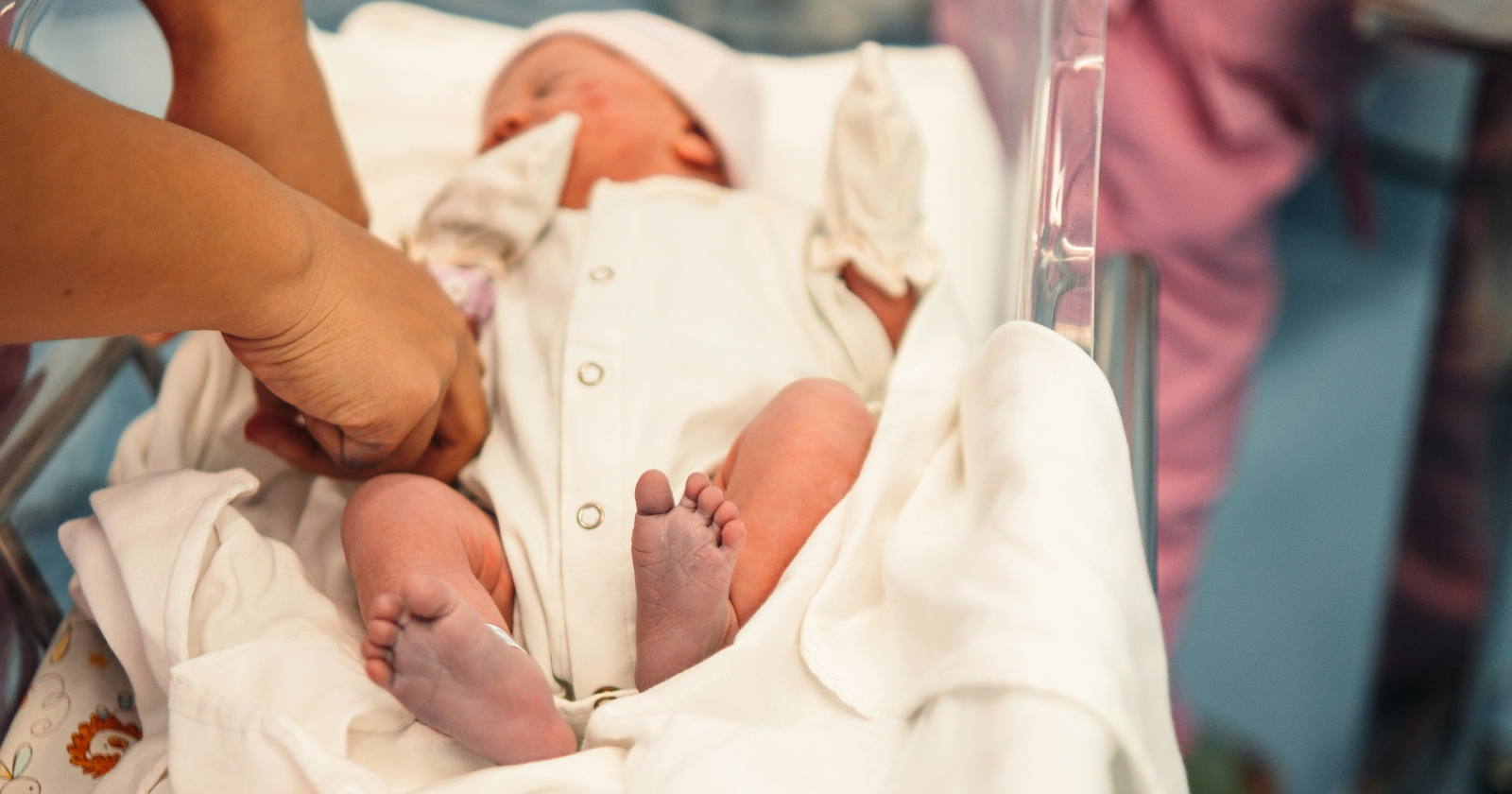
My two daughters were born less than two years apart, and yet only one of them arrived with a faint blue-grey patch spread across her lower back. My older daughter had it from her first day. My second daughter, born this past July, doesn’t have it at all. Same parents, same city, same general recipe, and one very visible difference between them before either one could hold up her own head.
I didn’t think much of it with my first until a nurse mentioned it by name almost in passing, the way you’d mention a birthmark anyone in the ward had seen a hundred times before. It’s common enough to have its own clinical shorthand and, unfortunately, its own history of being misread as something it isn’t.
What that mark actually is
The medical explanation has nothing to do with bruising, injury, or anything that happened during delivery. Cleveland Clinic explains that the marks form when “some melanocytes, the cells that give skin its color, don’t move to the surface of the skin as they normally do” while a baby is still developing in the womb. Instead of migrating up into the outer layers of skin the way they usually do, a cluster of them gets left behind deeper down, and the tissue above them scatters light in a way that reads as blue-grey rather than brown or tan. Nothing is wrong with the skin. The pigment cells are simply parked in the wrong layer.
These marks are also, by every account, completely harmless. Cleveland Clinic is blunt about it: the birthmarks need no treatment and tend to fade on their own as a child grows, with many fading substantially within the first year and the majority gone somewhere between ages six and ten, though larger or darker patches can occasionally last into adulthood.
The name people reach for, and the legend that comes with it
Search for this mark online and the Genghis Khan story comes up almost immediately, the idea that it marks out the bloodline of the Mongol Empire, passed down through the centuries to anyone who carries it. It’s a good story, and it’s almost entirely a modern piece of internet folklore rather than a documented belief with any real age to it.
The actual history behind the clinical name is stranger and less flattering. It traces back to the 1880s and a German physician named Erwin Bälz, who was working in Japan at the time and documented the mark in Japanese infants. He borrowed the label from an outdated racial classification system from the century before, one that had lumped a wide range of Asian and Indigenous populations together under the single, since-abandoned category of the “Mongolian race.” The name was never really about the nation of Mongolia or any specific bloodline. It was a leftover from a scientific framework doctors gave up on generations ago, which is exactly why dermatology has been quietly moving away from it. A 2021 review in the medical journal Cureus put the broader principle plainly: “Terms that stigmatize a culture, region, people, country, communities, and ethnic group should be replaced by their more descriptive counterparts,” which is why you’ll increasingly see the mark called congenital dermal melanocytosis or a slate-grey nevus in clinical settings instead.
Why it shows up on some babies and not others
None of that explains why my older daughter has it and her sister doesn’t, but the biology does. The marks are simply far more common in babies with more heavily pigmented skin. Cleveland Clinic notes they turn up more often in babies of Asian, Black, or Hispanic ancestry, though any baby, of any background, can be born with one or without one. It comes down to how much melanin a particular baby’s skin was already producing and exactly how much of it got trapped on the way to the surface, a small, essentially random variation in a process every fetus goes through. Two children from the same two parents can land on different sides of that variation the same way they can end up with different eye colors or different amounts of hair at birth.
A small irony sits in my own case. I grew up in Central Asia, not far at all from the region the outdated name technically points to, and my husband is Chilean, which puts a decent amount of Indigenous Latin American ancestry somewhere in our daughters’ family tree as well. Both backgrounds are commonly cited as ones where this mark shows up often. And it still only showed up in one of our two children. Shared ancestry raises the odds. It doesn’t hand down a guarantee, and it certainly doesn’t sort itself along any bloodline neat enough to make a good legend.
The one clinical detail worth knowing
The part of this that actually matters for a new parent isn’t the legend, it’s a practical one: these marks are frequently mistaken for bruises, and that mistake has occasionally triggered real child-abuse investigations for entirely innocent families. Physicians have known about this risk for decades. Writing in the journal Contemporary Pediatrics back in 1999, a team of dermatologists advised that “to minimize confusion, it is wise to document the presence and location of Mongolian spots in the patient record,” so that a mark noted at birth doesn’t get mistaken for a fresh injury months or years later by someone seeing a child for the first time. Most hospitals do exactly this now as a matter of routine. It’s worth asking about if you notice one on your own newborn and nobody brings it up first.
What I make of it now
No hidden meaning explains which of my daughters has the mark and which one doesn’t, no ancestral message waiting to be decoded. It’s melanocytes settling in slightly different places during two otherwise very similar pregnancies, nothing more mystical than that. What I do find worth sitting with is how easily a mark like that gets a legend attached to it, and how the real explanation, the quieter, more mechanical one, tends to arrive later and get repeated far less often. My older daughter’s mark is already noticeably lighter than it was a year ago. It will likely be gone before she’s old enough to ask me what it was, and when she does, I’d rather have the real answer ready than the one that just sounds better in a headline.