

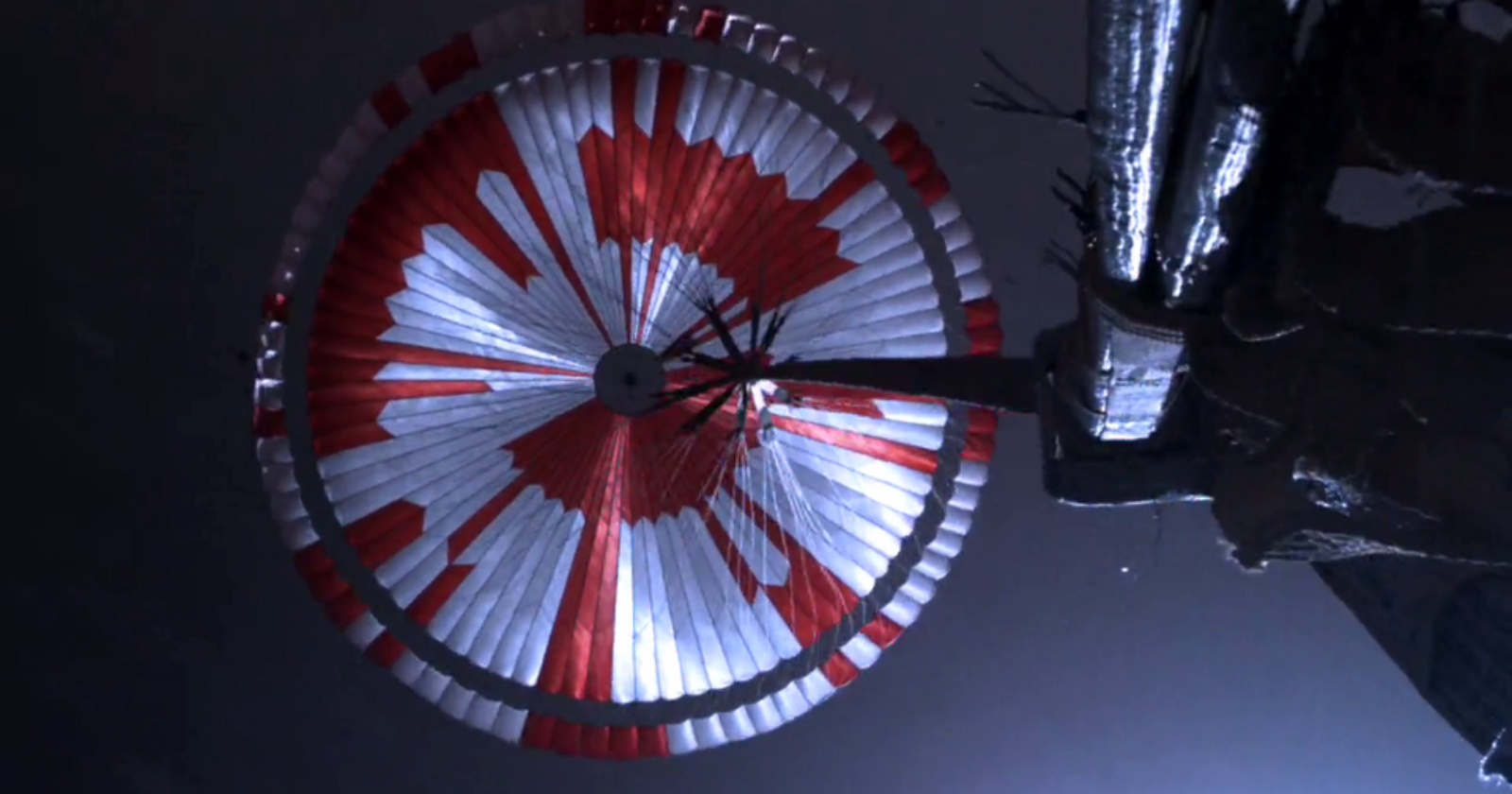
A parachute about 70 feet across has to snap open at faster-than-sound speed in Mars’s thin air. When the first images come back, you need to answer one plain question fast: is the canopy sitting the way it should, or has it twisted? A plain white parachute is far less useful for that. You want a pattern you can read at a glance.
That is what the orange-and-white pattern on Perseverance’s 70-foot-diameter supersonic parachute was for, first of all. It looked decorative, almost festive but it was doing a job.
The real job: reading a parachute at a glance
Allen Chen, who led the entry, descent and landing team for Perseverance, explained it plainly. “Distinct patterns are useful” he said, “in helping us determine the clocking orientation of the parachute.” In plain terms, that means how far the canopy has rotated relative to the spacecraft hanging below it. You can only judge that if there are markings on the fabric to track.
The pattern helped a second way too, in the split second when the chute billows open. “The contrasting sections can be useful” Chen noted, “in tracking different portions of the parachute as it inflates.” Give the high-speed cameras something with contrast, and you can watch the canopy fill and spot if any part of it is lagging or tangling.
What most people missed, watching the first-ever video of a spacecraft landing on Mars, is that the exact arrangement of those sections was not random. That left one systems engineer some room to be clever.
The hidden layer, hiding in plain sight
That engineer was Ian Clark, a crossword hobbyist. He treated the rings like binary code, with the orange and white sections standing for ones and zeros. Read the pattern and it stops being decoration and starts being text.
The trick he set himself was making the code real without making it a billboard. Clark described the challenge as “trying to come up with a way of encoding it but not making it too obvious.” He had reportedly been sitting on the idea for a couple of years before launch, and by his account only about six people knew it was there before the rover touched down.
What it actually said
Decoded, the message comes in two parts.
The three inner rings spell out “Dare Mighty Things,” JPL’s motto, an abridgement of a line from Theodore Roosevelt’s “Strenuous Life” speech.
The outer ring is where it gets sly. It hides a set of GPS coordinates, 34°11’58” N 118°10’31” W, pointing not to anywhere on Mars but back to Earth, to the Jet Propulsion Laboratory in Pasadena, California, landing roughly 10 feet from the entrance to the lab’s visitor center. A parachute drifting down onto Mars carried, woven into its pattern, the address of the lab where the rover was built.
Why the internet cracked it in hours
During the February 22 news conference, Chen did not just confirm the message existed. He dared people to read it. “Sometimes we leave messages in our work for others to find for that purpose,” he said. “So we invite you all to give it a shot and show your work.”
They did. People online had the binary translated and the coordinates plotted within a few hours. Perseverance’s chief engineer, Adam Steltzner, watched it happen and reacted the way you would to a party trick landing perfectly: “It looks like the internet has cracked the code in something like 6 hours!” he tweeted. “Oh internet is there anything you can’t do?”
The speed says something about the design. A code meant to defeat everyone is a different thing from a code meant to be beaten. Clark’s “not too obvious” was aimed at people who would recognize an orange-and-white ring pattern as binary. Once “Dare Mighty Things” falls, the rest of the code follows, and the outer ring of coordinates is just arithmetic. The puzzle was hard enough to be satisfying and easy enough to be solved by dinner.
Clark seems to have enjoyed being caught out. Asked about doing it again, he said, per one account, that “next time” he’d have to be “a little bit more creative.”
Read by cameras, meant for people
There is a quiet irony in all of this. The pattern was built to be read by cameras looking up into the Martian sky, checking the canopy’s orientation and inflation during a descent that lasted seconds.
But the message inside it was for people standing on the ground, squinting at a still image and doing binary by hand.
A parachute pattern works either way. Threading a motto and a home address through it costs almost nothing, and it turns a diagnostic tool into an invitation, a way of pulling strangers into the work and letting them feel, for an afternoon, like they were part of the mission. The engineering pointed at Mars. The message pointed home.