

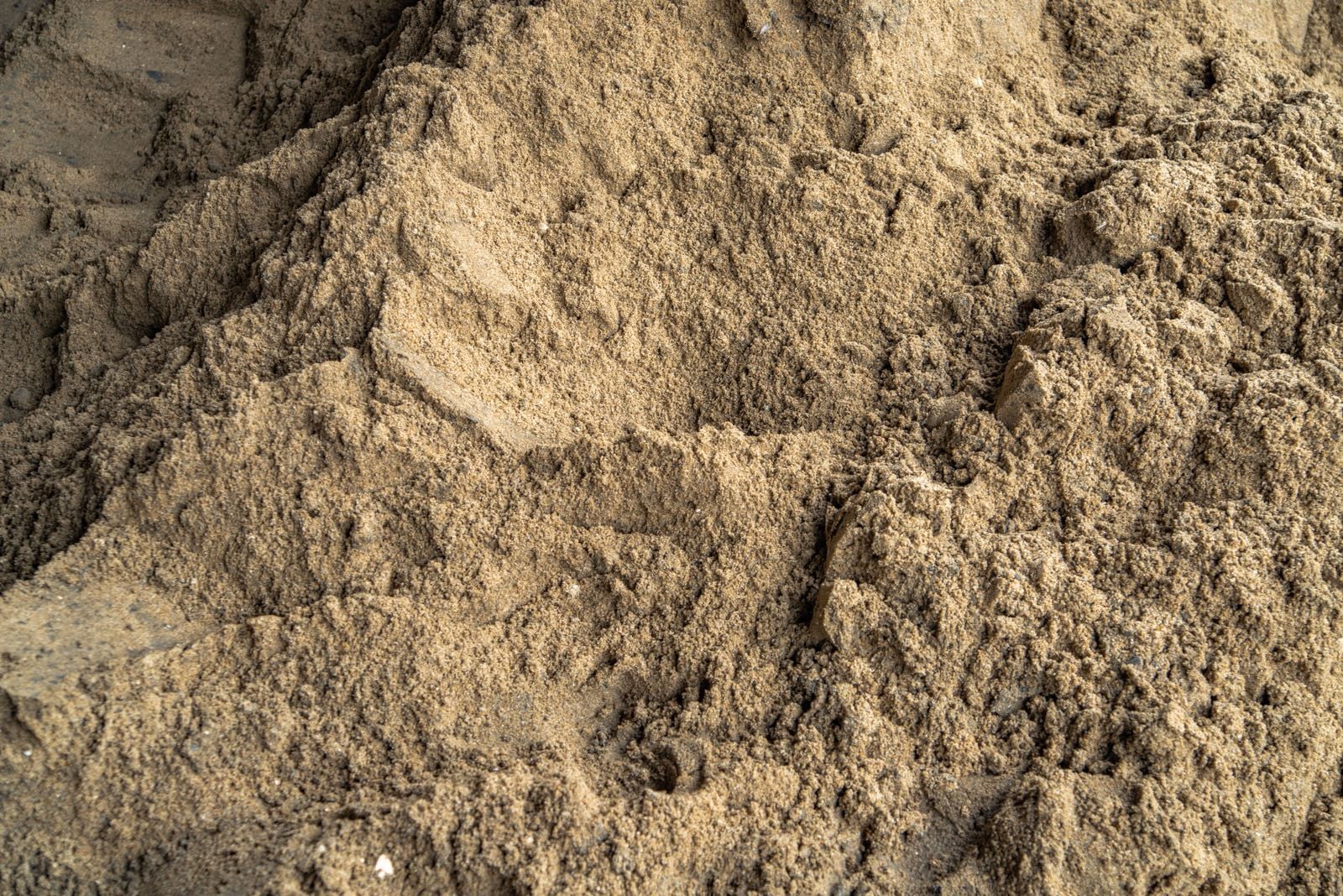
Saudi Arabia sits on the Rub’ al Khali, an unbroken sea of dunes larger than France, and still puts sand on ships out of Fremantle to pour into its concrete. In 2023, according to World Bank WITS trade data reported by Autonocion, the kingdom bought around $138,600 worth of Australian construction sand, about the price of a mid-range pickup truck, hauled across the Indian Ocean because the grains under Saudi feet are the wrong shape to hold a building up.
The problem is not the quantity. It is the geometry of each grain.
Why desert sand fails the concrete test
Concrete is mostly aggregate, sand and gravel, held together by a thin film of cement paste. For the paste to lock, the grains have to bite against one another edge to edge, wedging into the cement and into each other like pieces of a rough jigsaw. River sand and crushed quarry sand do this well because they are geologically young: recently broken from larger rock, jagged, angular, sharp-faced.
Desert sand behaves in the opposite way. Wind does not fracture grains; it polishes them. Over thousands of years of rolling and bouncing across dunes, each grain wears down into a smooth, near-spherical pellet. Dropped into a wet concrete mix, the grains act like ball bearings, sliding past one another instead of interlocking. The cured block ends up riddled with microscopic voids and weak seams.
Roundness is only the first half of the geometry problem. Because wind sorts grains by weight as it moves them, a great dune sea ends up dominated by grains of almost exactly one diameter, a property engineers call monomodal grading. That sounds tidy and is in fact fatal. Good concrete needs a spread of sizes, with small grains slotting into the gaps between large ones so that very little empty space is left for the paste to bridge. Desert sand arrives pre-sorted into a single size, with nothing to fill the voids. Even before the polish ruins the grip, the uniformity leaves the mix full of holes.
Shape is not the only failing. Desert sand is also unusually fine, and fineness causes its own problems in a mix. Ren Wei, a postdoctoral fellow at the Norwegian University of Science and Technology, described that second half of the problem in a EurekAlert release on his team’s work: “The challenge is that desert sand is so fine-grained that it is not suitable as a fastener in concrete. In other words, the concrete will not be hard enough to be used in various construction projects.” His team has been trying to give the useless stuff a second life by binding it with wood lignin under heat and pressure, a workaround that only exists because ordinary Portland cement will not do the job.
You can build a garden wall with it. You cannot build a supertall tower.
If you enjoy our articles, check out our YouTube channel – we post videos on the most unusual aspects of the world and space.
Click here to view our growing collection.
The scale of what sits under Saudi feet
The Empty Quarter covers roughly 650,000 square kilometres of the southern Arabian Peninsula. Some of its dunes climb more than 250 metres, taller than most skyscrapers the kingdom is trying to build. Every major construction site in Saudi Arabia sits within trucking distance of a dune field that could, in raw volume, bury the project many times over.
And yet the trade ledgers keep filling. The same World Bank data show Saudi Arabia imported roughly $1.22 million in non-metal-bearing natural sands in 2023, with the Australian line item nested inside. A separate category, silica and quartz sands used mainly in glass and specialist applications, brought in about $5.23 million, sourced from China, Belgium, the United States, India and the UAE.
The ledger also runs the other way, and this is the part usually left out of the viral version. In the same year Saudi Arabia exported roughly $43 million in natural sands, most of it silica and quartz. The kingdom is a substantial net seller of sand. What it buys is narrow, specific and small, which is precisely the point. The question was never whether a country has sand. It is whether it has the particular grain a given job requires.
The dollar figures are almost comically small. That $138,600 from Australia is not a fortune. What matters is that a budget code exists at all. A country sitting on one of the largest sand deposits on Earth has a purchase order for sand shipped from Fremantle.
Salt, corrosion, and the second reason engineers refuse dune sand
Shape and size are not the only objections. Desert and beach grains often carry enough chloride to slowly corrode the steel reinforcement inside concrete, a slow-motion disaster for anything load-bearing. Reporting on the paradox by Ecoticias notes that salt content is one of the reasons even coastal sand cannot simply be substituted in.
Engineers have spent years trying to make dune sand behave. A team at Imperial College London developed Finite, a concrete alternative made from desert sand. There are patents for crushing and re-fracturing dune grains under enormous pressure just to give them edges again. None of it has displaced the cheapest fix on the table: put good sand on a boat.
What Dubai’s palm actually stands on
The clearest illustration is next door in the Emirates. The Palm Jumeirah, finished off the Dubai coast in 2006, was built out of roughly 94 million cubic metres of sand and rock. That sand did not come from the desert a few miles inland. It was dredged from specific patches of Persian Gulf seabed where the grain size was right, placed by GPS-guided vessels using a technique called rainbowing, spraying sand in an arc through the air onto the growing island. Dutch and Belgian dredging firms ran the operation around the clock for years.
The Burj Khalifa tells the same story going up. Its roughly 330,000 cubic metres of concrete were mixed with sand widely reported, by Forbes and others, to have come from outside the UAE because the local dunes could not deliver the required strength. The paradox of desert cities importing the material they appear to be standing on is baked into every Gulf skyline.
A global shortage of the ordinary
Saudi Arabia’s predicament is a sharper version of a shortage the whole planet now shares. Humans pull about 50 billion tonnes of sand and gravel out of the Earth every year, making them the most-extracted solid materials on the planet and, by UN accounting, the second-most-exploited natural resource after water. Our use of it has tripled in two decades. Fifty billion tonnes is a number too large to picture, so Pascal Peduzzi, who directs the UN’s GRID-Geneva team, offers a way to see it: take one year of sand and gravel and build a wall 27 metres high and 27 metres wide, running the entire way around the equator. That is the annual dig. Research led by Xiaoyang Zhong at Leiden University, published in Nature Sustainability, projects building sand use rising from about 3.2 billion tonnes a year in 2020 to about 4.6 billion by 2060. The headline increase is around 45 percent, but that average hides the real story: in low and lower-middle-income regions, where cities are going up almost from nothing, the projected rise is closer to 300 percent.
Nature replaces sand through erosion on geological timescales, far slower than construction crews dig it out. The UN Environment Programme calls the difference the sand gap, and it now stretches from Cambodian riverbeds to Sicilian beaches, with organised sand-mining operations documented across India and West Africa.
The mining is not a small business, and the damage is not abstract. A recent Eos editors’ vox on river-sand mining lays out the mechanism: channel incision, collapsed banks, saltwater intrusion into aquifers, and delta shorelines that stop being replenished from upstream. The Mekong Delta in Vietnam shows what that looks like on the ground. Extraction there runs at roughly six to fifteen times the rate the river resupplies sediment, and across about 65 percent of the delta’s channels the bed is now dropping by around a tenth of a metre a year. A river that cuts downward undermines its own banks. Between 2018 and 2020, official Vietnamese statistics recorded 1,808 houses collapsing into the rivers and the sea. The deepened channels also let the dry-season ocean push further inland than it used to, and salt water seeps into the rice paddies and drinking wells of a region known as Vietnam’s rice basket. UNEP adds one more uncomfortable figure: about half the world’s dredging companies operate inside Marine Protected Areas, accounting for roughly 15 percent of the volume pulled up. The concrete in a Gulf tower is often paid for, ecologically, by a river mouth several thousand kilometres away.
Space Daily has covered the same paradox from the angle of Arabian geology, tracing how thousands of years of aeolian polishing wore the grains beyond usefulness, and has now told the story on film in The World Is Running Out of Sand, following a single grain from the wind that polished it to the dredger pulling its replacement out of a living river. What changes when the story is told through trade data is the scale of the workaround: every megaproject is, somewhere in its bill of materials, a sand story with a very long supply line.
Why the Empty Quarter’s sand ended up so smooth
The Arabian Peninsula was not always this dry. Research published in the Nature family of journals has documented recurrent humid phases across Arabia over the past 8 million years, with rivers, lakes and grasslands appearing and disappearing on cycles tied to orbital changes. During dry stretches, including the last several thousand years, wind takes over as the dominant sculptor of the surface, and the grains it moves get progressively rounder.
The Empty Quarter’s sand is the end product. Sediment reworked so many times by wind that its edges have worn down to almost nothing. The same grains that make the dunes photograph beautifully at sunset are the grains that will not bond to cement.
One honest qualification, because the paradox is usually told too absolutely. In Vanishing Sands, the coastal geologist Orrin Pilkey and his colleagues point out that desert sands vary by age, by origin, and by how long the wind has worked them, and that genuinely angular desert sand does exist in places, parts of Jordan among them. The accurate claim is narrower than the viral one and stranger for it: it is the great wind-worked dune seas, the classic endless deserts, that produce grains too round and too uniform for structural concrete.
The workarounds nobody has scaled yet
Ren Wei’s team at NTNU and the University of Tokyo have made a prototype they call Botanical Sand Concrete, or Sandcrete. Desert sand and powdered wood are combined under heat and pressure in a hot-pressing machine, with the researchers testing a range of temperatures, mix ratios, pressures and pressing times. At around 180°C the lignin in the wood, the same natural polymer that stiffens tree trunks, softens and glues the smooth grains together. New Atlas reported on the material in February, noting the blocks meet the strength requirements for pavement blocks.
It is not a structural concrete. Wei has been careful about that. The team envisions indoor use and pavement stones, and points out that any environmental gain evaporates if Sandcrete itself has to be shipped across continents. “The production process is relatively simple, so in principle the material can be made in many places,” he said. “But we need to test more, including how it can withstand cold, before it can be used out in Norway.”
Manufactured sand, crushed rock milled into angular fragments, behaves more like river material and is expanding inside Saudi Arabia’s domestic supply chain. Recycled concrete from demolished buildings can be crushed and reused. Neither has yet displaced the bulk carrier.
There is a larger point buried in the Leiden research. About half the projected demand for building sand could be avoided outright, not by finding new sand but by needing less of it: buildings designed to last longer, concrete recovered from demolition, lighter structures, and more construction in timber. The cheapest sand is the sand nobody digs up.
Where the sand actually comes from now
Australia ranks as the world’s second-largest sand exporter behind only the United States, shipping roughly $273 million worth in 2023 by the Observatory of Economic Complexity’s accounting. Ports like Jebel Ali in Dubai and Dammam in Saudi Arabia handle graded construction and silica sand quietly, in bulk carriers that look no different from the ones bringing in cars and electronics.
The rest of the ledger points in several directions at once rather than to any single supplier. China, Belgium, the United States, India and the UAE all appear against Saudi silica and quartz imports, sand graded for glass and specialist industrial use rather than for structural concrete. The trade is less a single dependency than a set of narrow, technically specified purchases.
The pressure on riverine sources has begun to reach places that once looked untouched. A 2026 explainer in the Milwaukee Independent describes Great Lakes deposits being eyed as global sand shortages ripple into North America, with infrastructure projects from Southeast Asia to the Middle East pulling on inland reserves that were previously considered safe.
NEOM and the sand appetite still to come
Saudi Arabia’s ambitions are not slowing the appetite. NEOM, the Red Sea Project, Qiddiya, the Diriyah Gate redevelopment, each is one of the largest construction sites on the planet, and each is hungry for the angular, water-eroded sand the region does not have in quantity. The Red Sea Project’s plan for a large archipelago along the coast will need dredged marine aggregate on a scale that rivals the great Gulf reclamation schemes.
THE LINE, NEOM’s proposed 170-kilometre mirrored city, would be one of the most concrete-intensive projects in human history if built anywhere near its original specification. Every cubic metre of that concrete needs grains with corners.
The supply lines lengthen with the ambition. The polished dunes stay where they are, drifting slowly in the wind, useless to a cement mixer and unlikely to change.
A material paradox that keeps repeating
Saudi Arabia’s sand imports get passed around online as a fun bit of trivia, the kind of fact that sounds invented. It stops being a paradox the moment you understand how sand actually forms. Wind makes beautiful dunes and terrible concrete. Water makes ugly gravel and skylines.
Life Signs has spent time this year on other quiet contradictions in the natural world, honey that stays edible for three thousand years because of the chemistry of its own preservation, or sharks that will not breed until the 22nd century. The desert-sand paradox belongs on the same shelf. The material that seems most abundant is exactly the material that will not do the job, because the process that piled it up is the process that ruined it.
The ships keep coming. Sand loaded in Fremantle crosses into Dammam and Jeddah, offloaded after spending geological ages tumbling in rivers or sitting in a quarry, and poured into towers rising a few kilometres from dunes 250 metres tall. Somewhere in the Empty Quarter tonight, wind is rolling another grain half a millimetre across the crest of a dune, wearing off another layer, making it that much smoother, and that much more useless for the city being built next door.
Watch: The World Is Running Out of Sand on the Space Daily channel.