

Honey, once sealed in a clean jar, does not really spoil. Jars recovered from Egyptian burial contexts and stored for thousands of years have been reported as still liquid, still sweet, still fit to eat — a claim that circulates constantly in food writing and archaeology magazines, and which has hardened into folklore even where the specific 1000 BCE jar of the story is hard to pin to a single museum catalogue entry. The chemistry underneath the folklore, though, is unambiguous. Honey is one of the most hostile edible substances on Earth for microbial life.
The reason sits in three numbers: water content around 17 per cent, a pH between roughly 3.2 and 4.5, and a slow trickle of hydrogen peroxide produced by an enzyme the bee itself adds to the nectar. Together they build an environment where no known food-spoilage bacterium can grow.
What the bees are actually doing
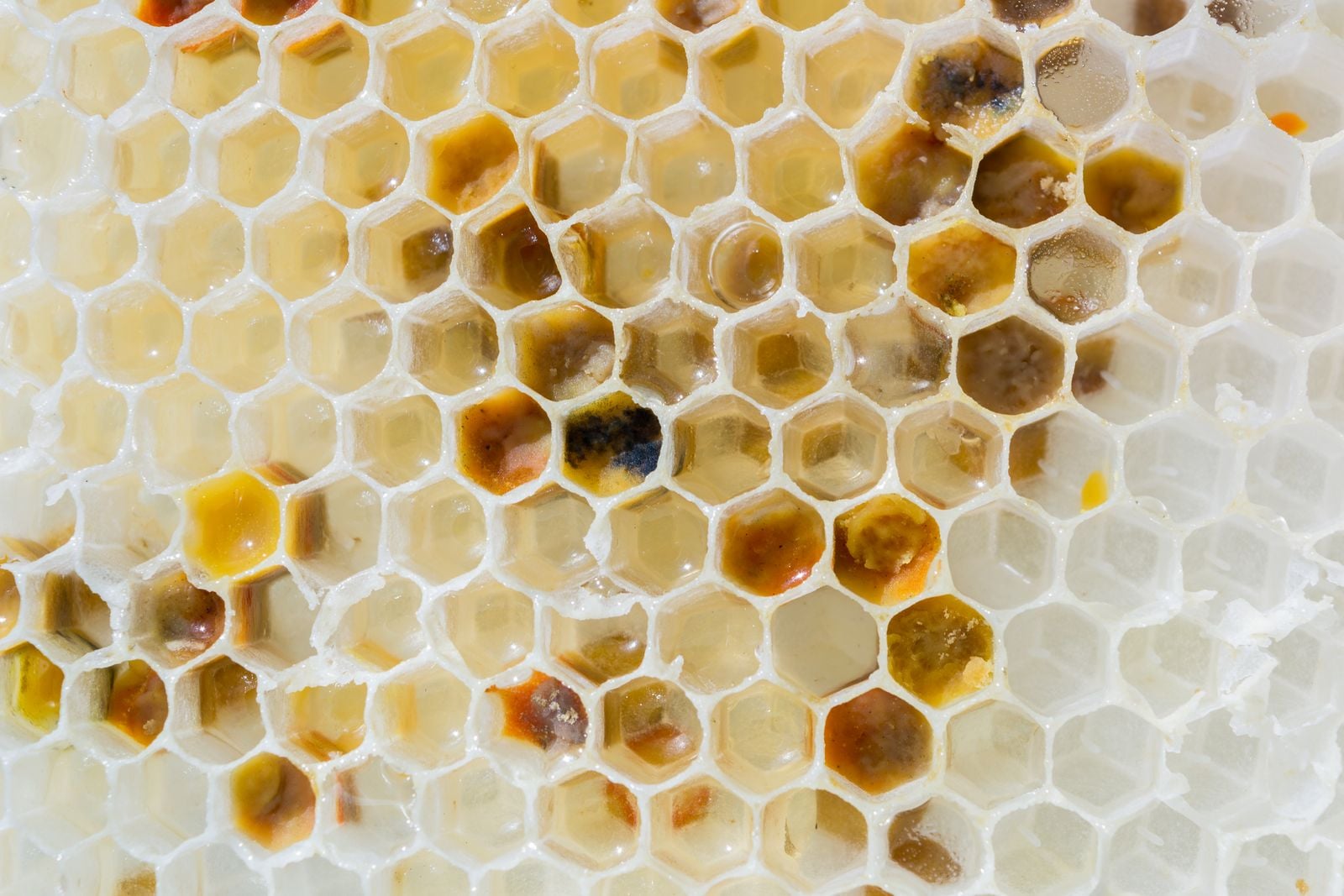
Nectar, as a flower produces it, is mostly water — often 70 to 80 per cent. A honeybee draws it up, mixes it with an enzyme called glucose oxidase from her hypopharyngeal glands, and returns to the hive. Other workers pass the droplet mouth to mouth, and then fan it with their wings inside the comb until the water content falls below about 18 per cent.
That final water figure is the first line of defence. As a review of honey’s chemical composition in The Malta Independent notes, the sugars — mostly fructose and glucose — bind almost every available water molecule. Any bacterium or yeast landing on the surface is drawn dry by osmosis before it can divide. The technical term is low water activity. The practical term is that the microbe dehydrates faster than it can reproduce.
The enzyme the bee added does the second job. Glucose oxidase, once the honey is diluted even slightly by moisture, catalyses a reaction that produces gluconic acid and hydrogen peroxide. The gluconic acid drops the pH into the range of vinegar or orange juice. The peroxide, released continuously in small amounts, keeps sterilising the surface layer for as long as there is any water to react with.
If you enjoy our articles, check out our YouTube channel – we post videos on the most unusual aspects of the world and space.
Click here to check out our collection so far.
Why no bacterium seems able to live in it
Most food-spoilage organisms need a water activity above about 0.85 and a pH above around 4.6. Honey sits comfortably below both. A 2024 review summarised at News-Medical found that fresher honey shows the strongest antibacterial activity, with the peroxide output falling gradually over months and years but never quite reaching zero in a sealed jar.
Clinical work on manuka and other medical-grade honeys has extended the point into surgery. Research published on manuka honey microneedles for wound healing found the honey active against methicillin-resistant Staphylococcus aureus, one of the more stubborn hospital pathogens. If MRSA cannot establish itself in a honey matrix on a wound bed, a tomb spore is not going to fare better in a sealed jar.
There is one microbial exception worth naming. Clostridium botulinum spores can survive in honey — dormant, not growing — which is why paediatric guidance in most countries warns against feeding honey to infants under twelve months. The spores don’t germinate in the honey itself. They germinate in an infant gut. In an adult, they pass through.
The tomb jar, and what the record actually shows
The specific story — a sealed jar dated to around 1000 BCE, opened by a 20th-century archaeologist, tasted and found palatable — is one every food writer has repeated and very few have footnoted. The best that can be said is that honey residues have been identified in Egyptian burial vessels going back much further than 1000 BCE, and that the anecdote of edibility is repeated in decades of popular writing without a single citation to a specific excavation report.
The famous claim about archaeologists tasting 3,000-year-old tomb honey is mostly folklore — the chemistry that would make such a jar edible is real and well-documented, but the specific tasting event has never been sourced to a named archaeologist and a named tomb in a way that survives scrutiny.
Which is fine. The chemistry does not require the anecdote to be true.
As ECOticias notes in their summary of tomb-honey chemistry, honey recovered from Egyptian tombs can remain edible because the three protective mechanisms operate independently and reinforce each other. Break the seal, let atmospheric moisture in, and you weaken the osmotic barrier. Leave it sealed in a cool dry place and there is no obvious mechanism by which it should ever become inedible.
What the honey does over three thousand years
What it does not do is stay clear and pourable. Glucose falls out of solution over time, forming crystals. In an old jar those crystals may fill the whole vessel, leaving a pale, granular solid that looks nothing like the amber liquid a modern shopper expects. Gentle warming reverses the change. The molecules have not degraded — they have simply rearranged.
Browning chemistry works slowly on honey at room temperature. Very old honey darkens. Its aroma compounds shift. Some of the delicate floral notes fade. The sugars themselves remain sugars.
Enzyme activity does drop. The Times of India lifestyle desk summary of honey shelf life notes that commercial guidance treats honey as effectively non-perishable when stored sealed and dry, though its enzyme profile and antibacterial punch fade with age. A jar from a pharaoh’s storeroom would be edible in the strict food-safety sense and dull in the culinary sense.
The bee’s other contributions
Honey is roughly 80 per cent sugars, about 17 per cent water, and the remaining 3 per cent is where the interesting chemistry hides — proteins, enzymes, organic acids, minerals, flavonoids, phenolic compounds, and trace vitamins. A Frontiers review of honey bees as a zootherapy keystone species catalogues the range of bee products used medicinally across human cultures, from propolis to royal jelly, and traces the antimicrobial reputation of honey back through Sumerian, Egyptian, Greek and Ayurvedic pharmacopoeias.
Different floral sources produce different honeys with different antibacterial profiles. Manuka, from Leptospermum scoparium in New Zealand, carries an additional non-peroxide activity attributed to methylglyoxal. Buckwheat honey is darker and higher in phenolics. Acacia is paler and slower to crystallise. All of them share the underlying osmotic and acidic defences.
The details of testing this activity in a laboratory are messier than the folklore suggests. As a Frontiers editorial on in vitro honey testing observes, biological functionality varies with the assay chosen, the honey’s origin, its age, and even the way it was diluted before the test. A single antibacterial number for honey in general is not a meaningful figure.
How the preservation compares to other ancient foods
Grains from Egyptian tombs are found intact but inedible — the starch matrix survives, the flavour and nutritive value do not. Dried fish and salt-preserved meats degrade to leather. Wine sealed in amphorae oxidises through the ceramic and turns to something closer to varnish. Beer residues survive as chemical traces, not as drinkable liquid.
Honey is the outlier. A Nature review of biological preservation technology for aquatic products discusses the underlying principle — reducing water activity, adjusting pH, adding antimicrobial compounds — which is exactly what the honeybee does before any human touches the jar. The bees built a food-preservation system a hundred million years before humans invented pottery.
What breaks the spell
Three things.
Water — a leaky seal, condensation from a temperature swing, a wet spoon. Above about 18 per cent water content, wild yeasts already present in the honey can begin to ferment the sugars. The result is a slow production of alcohol and carbon dioxide, and eventually a jar that hisses when opened. This is how mead was invented, probably by accident, thousands of years ago.
Heat — sustained high temperatures degrade the enzymes, drive off the aromatic compounds, and accelerate the browning reactions. Honey heated hard enough to sterilise it also loses much of what made it interesting.
Time in air — an open jar left uncovered will absorb ambient humidity, especially in a damp climate. The osmotic barrier weakens from the top down. Left long enough, mould can find a foothold on the surface layer even while the bulk of the jar remains inhospitable.
A sealed jar in a dry stone chamber at roughly constant temperature has none of these problems. Which is, roughly, the environment inside an Egyptian tomb.
The scale of the preservation
Put the numbers next to other things humans have tried to keep. A tinned food from the 1940s is considered a curiosity if it survives. A frozen mammoth carcass from 40,000 years ago is edible only in a stunt sense. A wine from the 1800s is a collector’s item mostly for the label. A jar of honey sealed properly could, in principle, outlast any of them — not because anyone treated it carefully, but because the bees built it that way.
The ECOticias summary of the tomb-honey chemistry makes the point that the preservation is not a matter of ancient technology or ritual — it is a matter of a food that was already, at the moment it was jarred, a hostile environment for every organism except the bees that made it.
The specific 1000 BCE jar of the story may or may not have existed. The chemistry that would have made it edible is sitting in the pantry of anyone who keeps honey. Open a jar bought last year. Leave it sealed. In three thousand years, in a dry cool room, someone could still spread it on bread.