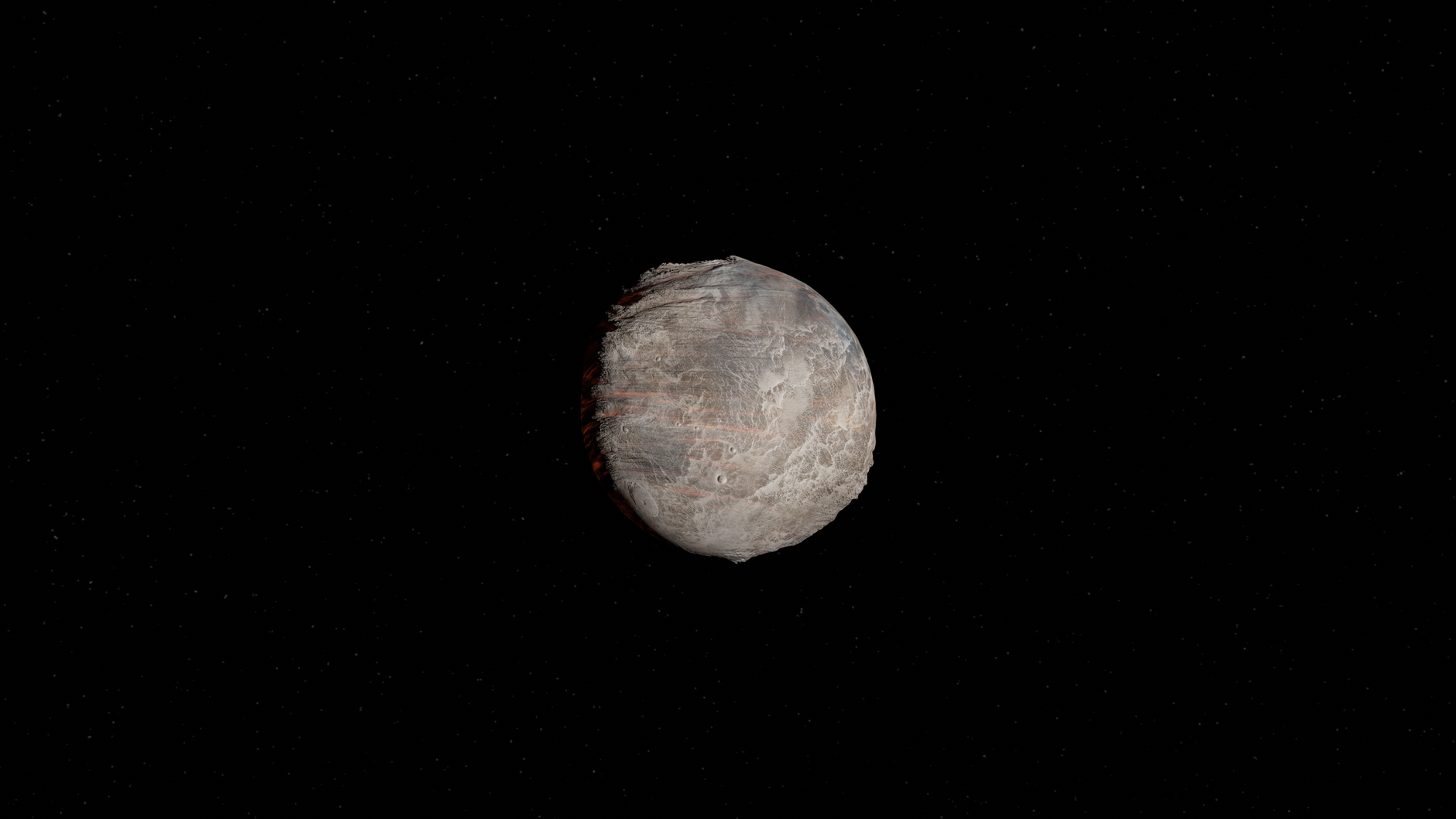
Mercury is the smallest planet in the Solar System, but most of the distance from its centre to its surface passes through metal. NASA puts the radius of Mercury’s metallic core at about 2,074 kilometres, compared with a planetary radius of 2,440 kilometres. That is roughly 85 per cent of the planet’s radius.
The percentage needs reading carefully. It describes radius, not volume, and it does not mean the remaining 15 per cent is all crust. NASA estimates that Mercury’s combined rocky mantle and crust are about 400 kilometres thick. There is also evidence that part of the core remains molten or liquid, which helps explain how such a small world still generates a magnetic field.
I find the surface consequence more revealing than the ratio itself. As Mercury lost interior heat, the planet contracted. Its rigid outer shell had to fit around a slightly smaller interior, so parts of the crust broke and were pushed over neighbouring ground. The result is a global population of long, curved cliffs that record the cooling of the planet below them.
A small planet built around a large core
Mercury’s bulk density is second only to Earth’s among the planets. Yet Earth gains much of its density from the intense pressure produced by its greater mass. Mercury is genuinely rich in metal for its size.
Its internal arrangement is not simply a solid iron ball wrapped in stone. Measurements of Mercury’s gravity, rotation and magnetic field from NASA’s MESSENGER spacecraft indicate a layered interior, including a metallic core that is at least partly liquid. The exact composition and boundaries of those layers remain subjects of active modelling.
The reason Mercury ended up with so much metal is also unsettled. Proposed explanations have included the loss of rocky material during an early collision, extreme heating near the young Sun and formation from unusually metal-rich starting material. None has closed the case by itself. The core size is measured far more securely than the story of how it formed.
Cooling turned contraction into cliffs
Materials generally contract as they cool. On Mercury, that gradual loss of interior heat reduced the planet’s volume enough to deform its outer shell. Because the crust could not slide neatly into a smaller sphere, compression forced blocks of rock up and over one another along thrust faults.
Planetary geologists call many of the resulting landforms lobate scarps. “Lobate” describes their rounded, lobe-like shape, while a scarp is a steep slope or cliff produced by fault movement. These are not mainly cliffs carved by rivers, waves or glaciers. They are the surface expression of crustal shortening.
The scale can be hard to read in spacecraft photographs with no trees or buildings for comparison. NASA reports that the largest scarps extend for hundreds of kilometres and rise more than 1.5 kilometres in places. A traveller approaching one would face a landform longer than many terrestrial mountain ranges, even though Mercury’s entire diameter is only 4,880 kilometres.
MESSENGER found a larger contraction than expected
Mariner 10 revealed Mercury’s great scarps during three flybys in 1974 and 1975, but it photographed less than half the planet. MESSENGER changed the picture after becoming the first spacecraft to orbit Mercury in 2011.
Using global photographs and topographic measurements, the mission team mapped almost 6,000 ridges and scarps. A 2014 analysis concluded that Mercury’s radius had decreased by as much as seven kilometres as the interior cooled, a substantially larger contraction than researchers had inferred from the incomplete Mariner 10 coverage. NASA’s global map of those structures shows them spread across the planet rather than confined to one basin or hemisphere.
Seven kilometres is small beside Mercury’s present radius, about three-tenths of one per cent. Across a whole planet, however, that change is enough to build thousands of faults and folds. The cliffs are an accumulated record of strain, not evidence that the planet suddenly collapsed.
Some faults may be geologically young
The broad contraction began billions of years ago. The harder question is when it stopped, if it has stopped at all.
During MESSENGER’s final 18 months, the spacecraft flew lower and returned sharper images. Researchers identified small, crisp scarps that should not have survived for billions of years under constant impacts from meteoroids. A 2016 study interpreted some as younger than 50 million years, a short interval in planetary geology.
A later 2023 paper in Nature Geoscience, led by Benjamin Man, mapped small troughs called grabens on top of larger contraction structures. The researchers identified 190 examples they regarded as certain. They measured them at roughly 10 to 150 metres deep, generally less than one kilometre wide and tens of kilometres long.
The team estimated that the grabens were about 300 million years old or younger because continued impact debris would otherwise have softened or buried such shallow features. Their distribution was consistent with prolonged contraction and activity on the larger faults into geologically recent times.
This is evidence, not a direct measurement of a fault moving today. The 2023 result is one study, not settled consensus about present activity, and no seismometer has yet recorded a Mercury-quake. The careful claim is that the planet appears to have cooled and contracted for much longer than an old, small world might suggest.
BepiColombo is almost ready to take the next look
MESSENGER ended with a planned impact on Mercury in April 2015. The next orbital investigation is now approaching. According to the European Space Agency’s current mission schedule, BepiColombo’s European and Japanese orbiters are due to enter Mercury orbit together on 21 November 2026 and separate in December.
The mission carries a laser altimeter, cameras, a magnetometer, radio-science equipment and instruments designed to examine surface composition and temperature. Combining topography with gravity and magnetic measurements should improve estimates of the core’s structure and Mercury’s rocky shell. Higher-resolution surface observations may also reveal whether the smallest scarps and grabens are more widespread than MESSENGER could see.
BepiColombo will not make billions of years of cooling easy to reconstruct. It will give researchers a second global orbital dataset, collected with different instruments, for testing whether Mercury’s thin shell is still adjusting to the metal-rich world beneath it.
The cliffs make the interior visible
Mercury’s core cannot be photographed directly, and the planet’s surface gives few obvious hints of an interior that fills 85 per cent of its radius. The cliffs connect the two. Their lengths, heights, ages and fault geometry preserve part of the history of heat leaving the core and mantle.
That history is still incomplete. The measured contraction is real, the young-looking structures are real, and the possibility of present tectonic activity remains open. Mercury’s grey surface is not merely an old impact record. It is also the outer skin of a planet that has spent billions of years fitting itself around a slowly cooling core.