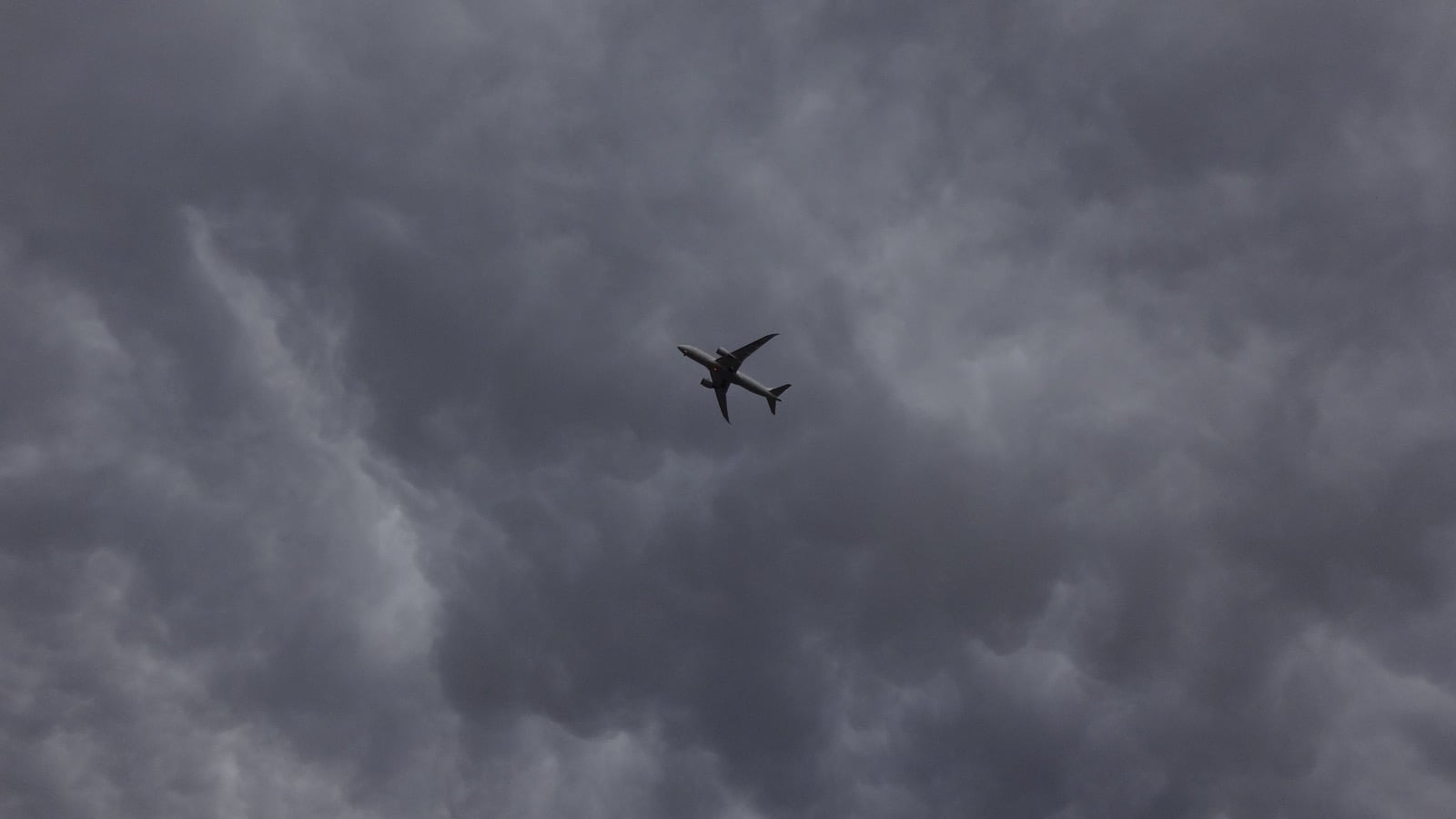
A modern airliner can become part of a lightning channel, carry an enormous pulse of current across its exterior and continue flying normally. That sounds like a lucky escape. In practice, it is a routine event for which transport aircraft are deliberately engineered.
The headline needs two qualifications. The once-a-year figure is a fleet average, not a guarantee that every commercial jet is struck every calendar year. And 200,000 amperes describes the upper end of the lightning range and a severe design case, not the current in every encounter. The US National Weather Service puts a typical flash near 30,000 amperes.
The direction is not fixed either. A strike may attach at the nose, a wingtip or a tail surface, then leave through a different extremity. The tail is a common exit area, but it is not the only one.
Once a year is an operational average
Decades of airline experience show how common these encounters are. The US Federal Aviation Administration says a transport airplane is struck once or twice a year on average. Airbus gives a similar figure of about one strike per aircraft each year, or roughly one every 3,000 flight hours.
Actual exposure varies with routes, seasons, climate and flight hours. An aircraft working frequently in storm-prone regions may be struck more often than one flying shorter schedules through quieter weather. It is more accurate to say that lightning is normal across an airliner’s service life than to imagine every jet receiving one annual appointment with a storm.
The aircraft can help start the strike
Airliners generally avoid the most dangerous parts of thunderstorms because turbulence, hail, icing and wind remain serious threats. Lightning can still occur near convective weather, and an aircraft does not always intercept a bolt that was already on its way to the ground.
In a strong electric field, conductive aircraft extremities can launch small leaders into the charged air. These connect with other developing leaders, placing the moving aircraft inside the channel. The FAA notes that initial attachment points are usually at the nose, wingtips or tail surfaces.
Because the aircraft keeps moving while the flash continues, the attachment can sweep rearward and reconnect at several places. What sounds like a single clean path may leave multiple small marks along the skin.
Why the current stays mainly outside
On a conventional aluminium airframe, bonded metal panels provide a continuous conducting route around the cabin. The broad idea resembles a Faraday cage: charge travels largely along the exterior rather than through the people inside.
Composite aircraft need additional conductive layers. Metal mesh, foil, strips, fasteners and bonding leads create deliberate paths across materials that would not otherwise conduct like aluminium. Wiring is shielded, sensitive systems are protected against induced voltage, and fuel-system details are designed to prevent a spark from igniting vapour.
This is not left to optimism. US transport-aircraft rules require that an airplane be protected against the catastrophic effects of lightning. Separate requirements cover electrical and electronic systems needed for safe flight and landing and lightning protection for transport-airplane fuel systems.
Two hundred thousand amperes is the harsh case
Lightning varies enormously. National Weather Service figures range from about 10,000 to 200,000 amperes, while Airbus says successive discharges within a severe strike can reach the upper value. The peak is also brief. It is not a steady 200,000-ampere flow lasting through the flight.
Engineers nevertheless have to account for severe waveforms and for more than direct heating. A large current crossing the skin generates electromagnetic fields that can induce transient voltages in nearby wiring. Protection therefore includes shielding, grounding, surge suppression and system redundancy, not merely a thick metal shell.
Minor physical damage is still possible. Entry and exit points can show pitting, scorch marks, tiny holes or damage to composite layers. A strike that does not threaten the flight may still create maintenance work after landing.
Passengers may notice, but the aircraft is inspected
A nearby strike can produce a brilliant flash and a sharp bang. Passengers seated near a window may see it, while others may mistake the sound for turbulence or never register the event. There appears to be no strong dataset showing that most passengers remain unaware, so that part of the headline should be read as a description of how uneventful many encounters are, not a measured statistic.
The crew may see or hear the strike, receive a report from the cabin or notice no indication at all. Boeing has noted that lightning strikes can occur without an indication to the flight crew. When a strike is known or suspected, it is entered in the aircraft log and the applicable maintenance inspection follows.
Technicians look for attachment and exit marks, examine vulnerable surfaces and check systems according to the aircraft’s maintenance manual. Most inspections find limited damage, but the inspection matters precisely because a safe flight is not proof that every protective feature is ready for the next one.
The remarkable part is therefore not that lightning somehow misses the people onboard. It is that a phenomenon violent enough to carry tens of thousands of amperes has been turned into an anticipated engineering load, usually leaving the drama outside and the journey intact.