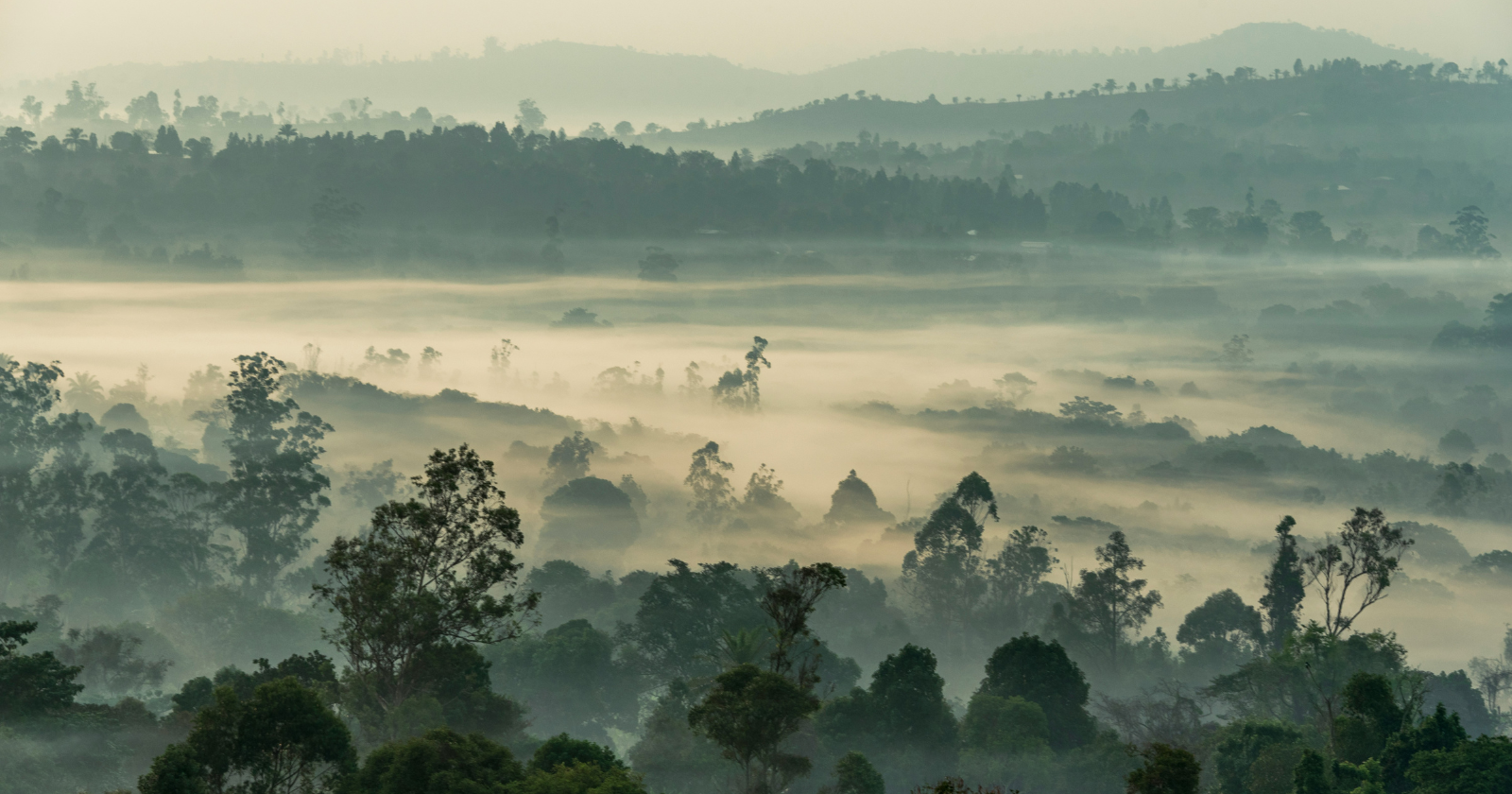
Imagine going to sleep in a quiet farming village, windows open to a warm August night, a lake sitting still in the valley below the way it had for as long as anyone could remember.
Nothing announces itself. No tremor, no smell, no sound loud enough to wake a sleeping household. By morning, nearly everyone in several villages near that lake is gone, along with most of the livestock, and the survivors have no idea what just happened to their home.
That’s roughly what happened at Lake Nyos in Cameroon on the night of August 21, 1986. Around 1,700 people died, along with thousands of cattle, and the strangest part of the story is that the lake itself never did anything violent enough for anyone to see coming. No eruption threw ash into the sky. No wall of water crossed the valley.
Whatever moved through those villages that night left the houses standing and the animals in their pens, which is part of why it took investigators a while to work out that a lake, of all things, was the cause.
What actually came out of the lake
Lake Nyos sits in the crater of a dormant volcano, and volcanic gas had been leaking into the lake’s deepest water for years, dissolving into it the way carbon dioxide dissolves into a sealed soda bottle. Under enough pressure, a lake can hold an enormous amount of gas without showing any sign of it on the surface.
Something, possibly a landslide or a sudden drop in temperature, triggered an overturn that night. Deep water shot upward, pressure dropped, and the dissolved gas came out of solution all at once, the same way a shaken bottle erupts the instant the cap comes off. A cloud of carbon dioxide more than 100 feet thick rolled down the valley at highway speed, silent and invisible, and settled over everything below it. Carbon dioxide is heavier than air, so it hugged the ground and displaced the oxygen in the places people were sleeping.
Scientists who arrived in the aftermath were working almost entirely in the dark, in more ways than one. This kind of event, now called a limnic eruption, had barely been studied before 1986 because it had almost never been documented. Michel Halbwachs, an engineer from the University of Savoy who later helped design the fix, put it plainly about the state of the research at the time: “We were in an area of science little known and dangerous.”
A lake quietly holding a massive reservoir of pressurized gas under a calm surface is a strange enough idea that it sounds more like fiction than geology, and that’s part of why a video we made recently kept coming to mind while researching this. It’s about Titan, Saturn’s largest moon, where entire seas the size of the Great Lakes are made of liquid methane and ethane instead of water. Different planet, different gas, but the same unsettling shape: a lake that isn’t holding what it appears to be holding, until the moment it is disturbed enough to show you.
Why this almost never happens anywhere else
Out of every lake on the planet, only three are documented as capable of this kind of eruption: Lake Nyos, its smaller neighbor Lake Monoun, and Lake Kivu, which sits on the border of Rwanda and the Democratic Republic of Congo. That last one is the detail that should actually keep a person up at night. Lake Kivu holds a similar volcanic gas hazard at a far larger scale, underneath a shoreline where more than two million people currently live.
Nyos and Monoun have since been fitted with degassing pipes, essentially long tubes that let the dissolved gas vent out slowly and safely from deep water instead of building up toward another sudden release. Getting there took over a decade of lobbying for funding after the initial tests worked, since the fix was neither cheap nor politically urgent to anyone outside the region. Lake Kivu’s project is a much bigger undertaking given its size and the population living beside it, and it remains a slower, ongoing effort.
None of this was obvious or fast to figure out. Bill Evans, a geochemist with the US Geological Survey who worked on the response, described arriving in the aftermath and being met with generosity he didn’t expect from people who had lost everything: “Can you imagine that? These people had just lost everything, and they were worried about us.”
That detail has stayed with me more than the science has. I think about it as a parent now, in a season of life where I spend a fair amount of energy trying to protect my kids from things I can actually see coming. Lake Nyos is a reminder that some of the most serious risks in life give no visible warning at all, and that the people closest to a real disaster are still capable of looking outward instead of only inward. Communities absorb the worst news imaginable and, more often than we give them credit for, still find room to worry about somebody else.
A lake that looked exactly like every other lake
The unsettling lesson of Lake Nyos isn’t really about carbon dioxide. It’s about how ordinary the danger looked right up until it wasn’t ordinary at all. A still lake in a green valley is one of the most peaceful images available to the human eye, which is exactly why nobody built an early warning system for it until after the worst had already happened. Some risks come with sirens. This one came with silence, and silence is a much harder thing to prepare for, no matter how many degassing pipes eventually get installed downstream of the tragedy.