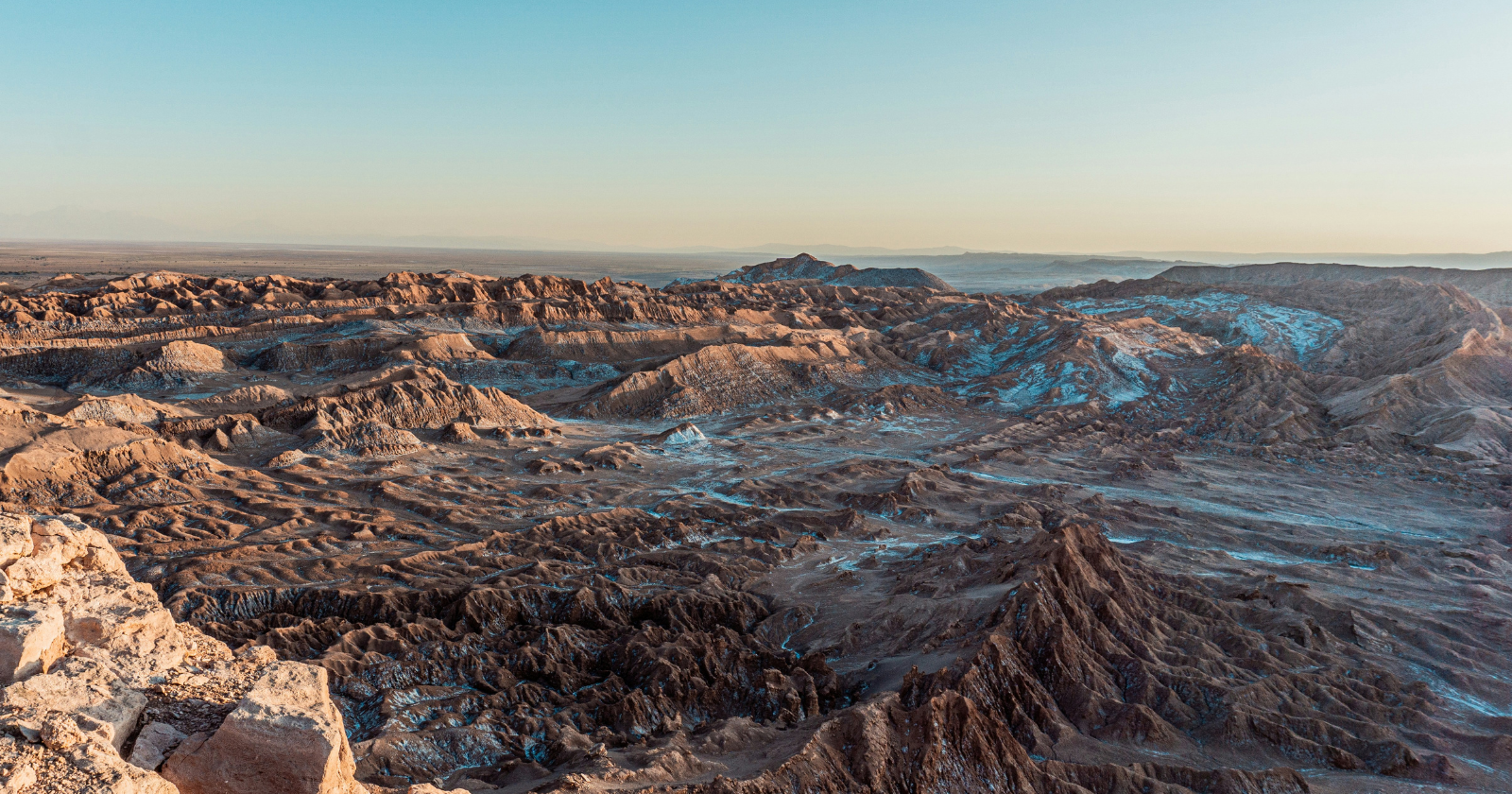
Salt crusts crack like broken glass underfoot. The air carries almost no smell, because there is barely anything alive out there to make one. Above a valley of bleached-white salt flats and rust-colored volcanic peaks, the sky stretches so clear and so dark that stars stop twinkling and just sit there, hard points of light with no moisture left in the air to blur them.
This is the Atacama Desert in northern Chile, generally considered the driest non-polar place on Earth. It looks less like a vacation stop than a set built for a planet nobody has actually landed on yet.
My husband’s family is Chilean, and in 2022 we finally made the trip up to see this part of the country for ourselves. We stayed in San Pedro de Atacama, the small town most visitors use as a base, in a little rented house on the edge of it.
In the evenings we’d sit outside with pisco sours mixed with rica-rica, a wild herb that grows out there and nowhere I’ve tasted it since, and just look up. It was breathtaking in a way that’s hard to explain secondhand. More than once I genuinely felt like I was standing on a different planet, and it turns out that reaction wasn’t just the pisco talking.
Scientists have quietly been using this desert as a stand-in for Mars for decades, and the reasons why are stranger than the landscape itself.
Why NASA treats this desert like practice for Mars
The core of the Atacama gets so little rain that some weather stations there have never recorded a single drop.
That kind of extremity is exactly why NASA has spent years sending scientists, and even prototype rovers, into the desert instead of waiting for an actual Mars mission to tell them what to expect. Chris McKay, a planetary scientist with NASA Ames, has studied the desert’s most extreme core and put it plainly: “The soils in the extreme arid core region of the Atacama appear to be the most lifeless and Mars-like on Earth.”
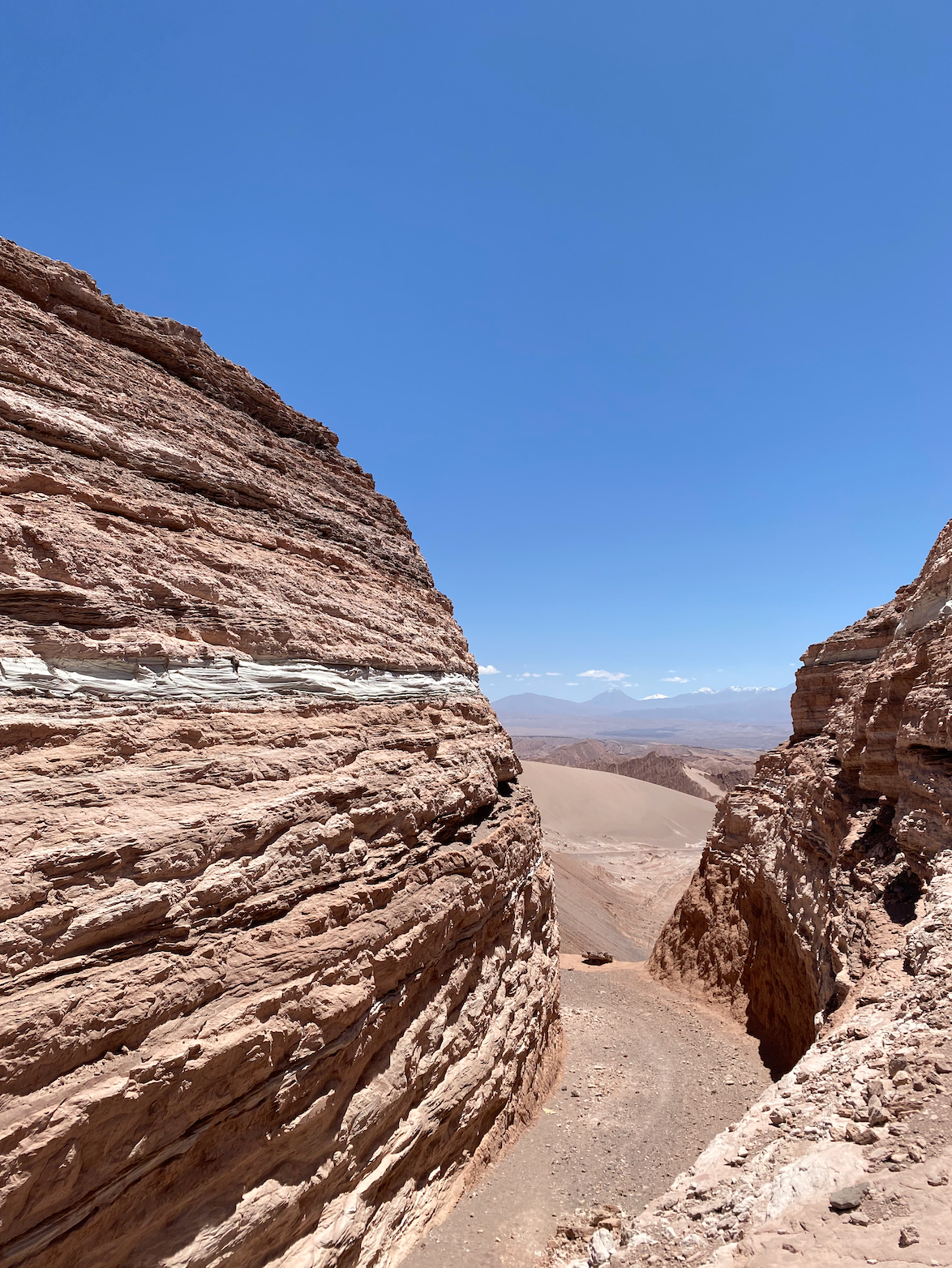
That’s a strong claim, and to their credit, the researchers behind it don’t oversell it. Imre Friedmann, a microbiologist with Florida State University and NASA Ames, was the one who added the necessary caveat: “All our Earth analogies are much weaker than the conditions that are present on Mars. Mars is much drier, much colder, with much more intense UV radiation.” In other words, this is the closest stand-in Earth has to offer, not a perfect one. Even our harshest desert is still a soft landing compared to the real thing.
None of that explains the other reason people go out of their way to reach this particular stretch of desert. The sky above it might be the clearest one left on the planet, and that part of the story is what pulled me into a video we made here at Space Daily. It opens with something that happened in Los Angeles in January 1994: an earthquake cut power across the city, and people came outside to find a strange glowing cloud stretched across the sky. Some called the local observatory. A few called emergency lines. It wasn’t a cloud. It was the Milky Way, visible over a major city for maybe the first time in most of those residents’ lives, purely because the lights happened to be off.
The clearest skies on Earth, and why that’s suddenly rare
The same dryness that keeps the Atacama nearly lifeless also keeps its air free of the moisture and turbulence that blur a telescope’s view almost everywhere else. That’s a large part of why some of the most powerful telescopes ever built, including the European Southern Observatory’s Extremely Large Telescope, sit on ridges above this desert instead of somewhere easier to reach.
But “clearest skies on the planet” turns out not to mean untouchable. Itziar de Gregorio-Monsalvo, ESO’s representative in Chile, has warned that a single badly placed light source nearby can undo decades of careful site selection: “If you place the ELT next to a city, it doesn’t matter that its diameter is 40 meters long. It’s just the same as having a tiny telescope.”
That is the same math the rest of the world already learned the hard way, just on a smaller and more local scale. One in three people on Earth can no longer see the Milky Way at all, and the number keeps climbing every year, according to the global light pollution research covered in our video. The Atacama is one of the last places where nobody needs an earthquake to black out a city before the galaxy shows up overhead. Whether it stays that way isn’t guaranteed. It’s being decided, city ordinance by city ordinance and satellite launch by satellite launch, largely without anyone being asked. A desert can keep its clear skies for centuries and still lose them in a decade if the wrong lights go up nearby.
What it means to look for life in a place built to have almost none
I’ve lived on three continents now, and every move taught me some version of the same small lesson: what feels ordinary depends entirely on where you happen to be standing. Growing up, I never once thought about how much of the natural world I could see just by walking outside at night. It took a landscape like this one, a place built by nature to have almost nothing, to make me notice how much everywhere else has quietly lost without anyone announcing it.
Something almost hopeful is buried in a desert this hostile, once you sit with it long enough. Scientists don’t travel to the Atacama because they expect to find life there. They go because studying a place with almost none teaches them what to look for somewhere else, on a planet nobody has visited yet. The salt flats, the volcanoes, and the sky sitting over all of it point toward the same underlying question: not whether we’re alone, but how carefully we’d even know how to look if we weren’t. That question doesn’t need Mars to matter. It’s worth asking about our own night sky too, while there’s still enough of it left to look up and answer it firsthand.