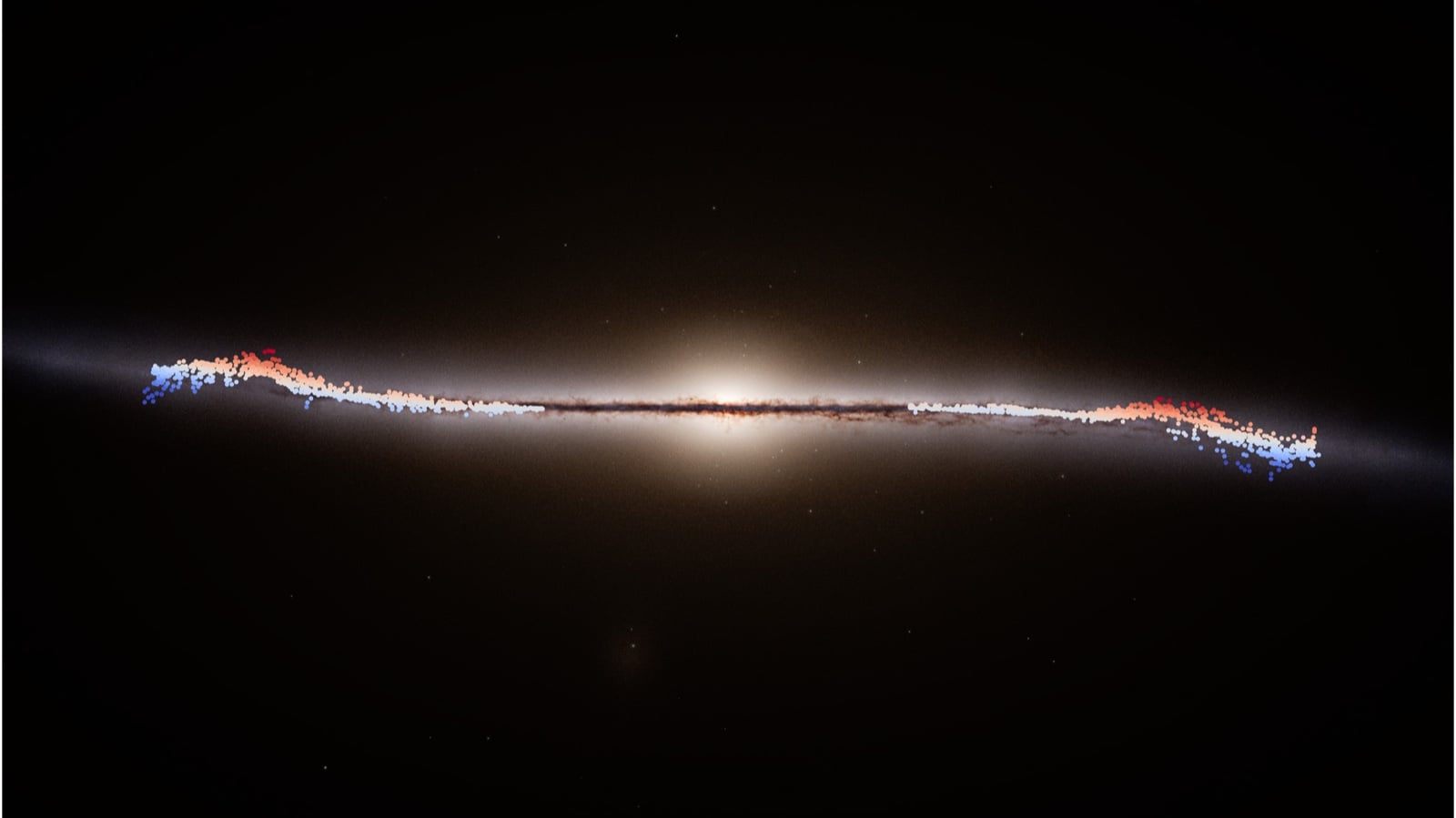
The Milky Way is often drawn as a serene, flat spiral. ESA’s Gaia telescope has left us with a stranger and more honest picture: part of the stellar disc is undulating on a scale so large that we can only recognise it by tracking thousands of stars at once.
In a 2025 study in Astronomy & Astrophysics, researchers reported a vast corrugation between roughly 30,000 and 65,000 light-years from the Milky Way’s centre. The stars in that structure are not only sitting above and below the expected disc. Their motions suggest the pattern is travelling outward.
One scale needs clarifying at the outset. The wave extends for tens of thousands of light-years across the Galaxy, but individual stars have not been hurled tens of thousands of light-years away from their expected positions. The measured vertical displacement is closer to 150 to 200 parsecs, or roughly 500 to 650 light-years. That is still immense. It is simply a different measurement from the wave’s full reach.
This is one study, not a settled account of what happened to our Galaxy. Its most intriguing conclusion is also its most restrained: something appears to have disturbed the Milky Way’s outer disc, and the data do not yet reveal what.
The Milky Way was already known to bend
Our Galaxy’s disc is not perfectly flat. Its outer regions warp upward on one side and downward on the other, rather like the rim of a bent record. Astronomers have known about that broad distortion for decades.
The new feature is smaller than the overall warp and seems to ride on top of it. The research team first modelled the familiar warp, then looked at what remained. According to ESA’s account of the discovery, the residual pattern stretches at least 10 kiloparsecs, about 33,000 light-years, and may continue for twice that distance.
It is better to picture a travelling pattern than a wall physically sweeping the same stars all the way from the Galactic centre. A stadium wave moves around an arena even though each person only rises and sits. Here, stars oscillate above and below the disc while the larger ripple appears to propagate through it.
Gaia saw movement, not just a bent shape
A wavy arrangement of stars alone would not prove that a wave is moving. The more persuasive clue came from velocity.
The crest in the stars’ positions did not line up with the crest in their vertical motion. Instead, the two patterns were offset in the way expected for a travelling wave. A simple model reproduced that relationship when the disturbance was allowed to move outward through the disc. Stars in the region also showed an average outward radial motion of around 10 to 15 kilometres per second.
That combination of position and motion is where Gaia excels. During its observing mission, which ran from 2014 until January 2025, the spacecraft collected about three trillion observations of two billion objects. It repeatedly measured tiny changes in stellar position, brightness and movement, turning a sky map into something closer to a slow-motion record.
Young stars made the ripple easier to see
The team did not use every star in Gaia’s catalogue. It focused on two young stellar populations: nearly 17,000 giant stars and about 3,400 classical Cepheids.
Young stars are useful because they remain relatively close to the gas and dust from which they formed. They preserve a clearer impression of recent structure in the disc than older populations whose orbits have been stirred and mixed over billions of years. Cepheids are especially valuable because their regular pulsations let astronomers estimate their distances with unusual precision.
The result also differs from the Radcliffe Wave, a much more local chain of nearby stellar nurseries announced in 2020. The authors say the two might conceivably be related, but there is not enough evidence to join them into one phenomenon. Similar names should not be mistaken for a demonstrated connection.
A galactic collision is plausible, but unproven
So what struck the disc? One possibility is an encounter with a smaller satellite galaxy. Computer simulations show that a dwarf galaxy passing through or near a larger stellar disc can excite ripples that survive long after the encounter.
The Sagittarius dwarf galaxy is an obvious suspect because it has crossed the Milky Way repeatedly. Earlier Gaia work found signs that its most recent close passage may have affected stellar motion between roughly 300 million and 900 million years ago.
But a plausible mechanism is not an identification. The new paper does not trace this wave back to Sagittarius, nor does it rule out other causes, such as interactions within the Galaxy’s own disc or a different past encounter. The honest answer remains that scientists do not know what started it.
The map is still unfinished
There is something wonderfully humbling about discovering motion on a galactic scale from a viewpoint buried inside the thing being measured. We cannot step outside the Milky Way and photograph its profile. We have to infer that profile one stellar distance and velocity at a time.
Gaia stopped observing in 2025, but its archive is still being processed. ESA currently expects the mission’s fourth major data release in December 2026, with the final catalogue no earlier than the end of 2030. Those releases should provide longer time baselines, more precise motions and fuller stellar information.
They may reveal whether the great wave continues farther around the disc, how quickly its pattern is travelling, and whether its history points to a particular collision. For now, Gaia has shown that the Milky Way is not merely rotating. Parts of its disc are flexing, rising and falling, carrying the memory of an event we have not yet learned to name.