Europa Clipper is no longer a spacecraft waiting on a launch pad. NASA launched it on 14 October 2024, and it is now following a long route through the Solar System towards Jupiter.
That path will cover about 1.8 billion miles, or 2.9 billion kilometres, before the spacecraft reaches the Jupiter system in April 2030. The number describes the full routed journey, not the straight-line distance between Earth and Jupiter.
There is also an important limit to the mission that deserves to be clear from the beginning. Europa Clipper is not equipped to drill through the ice or directly detect organisms in the ocean. Its job is to ask a more basic question: does Europa have places where life could be supported?
The journey uses planets as part of the propulsion system
A direct flight to Jupiter would demand more energy than the spacecraft can conveniently carry. Instead, Europa Clipper is borrowing momentum from planets along the way.
It passed Mars on 1 March 2025, using the planet’s gravity to alter its speed and direction. NASA currently plans an Earth gravity assist for 3 December 2026. That second encounter will send Clipper out towards Jupiter, where it will enter orbit in April 2030.
This explains why a mission to a world hundreds of millions of kilometres away has a total route of 1.8 billion miles. The trajectory bends through the inner Solar System before heading out. NASA’s launch account describes the Mars and Earth assists as essential parts of the journey.
Arrival will not mean an immediate landing on Europa. Clipper will orbit Jupiter and make 49 close flybys of the moon, with its main science campaign beginning in 2031.
A small moon may hold more than twice Earth’s ocean water
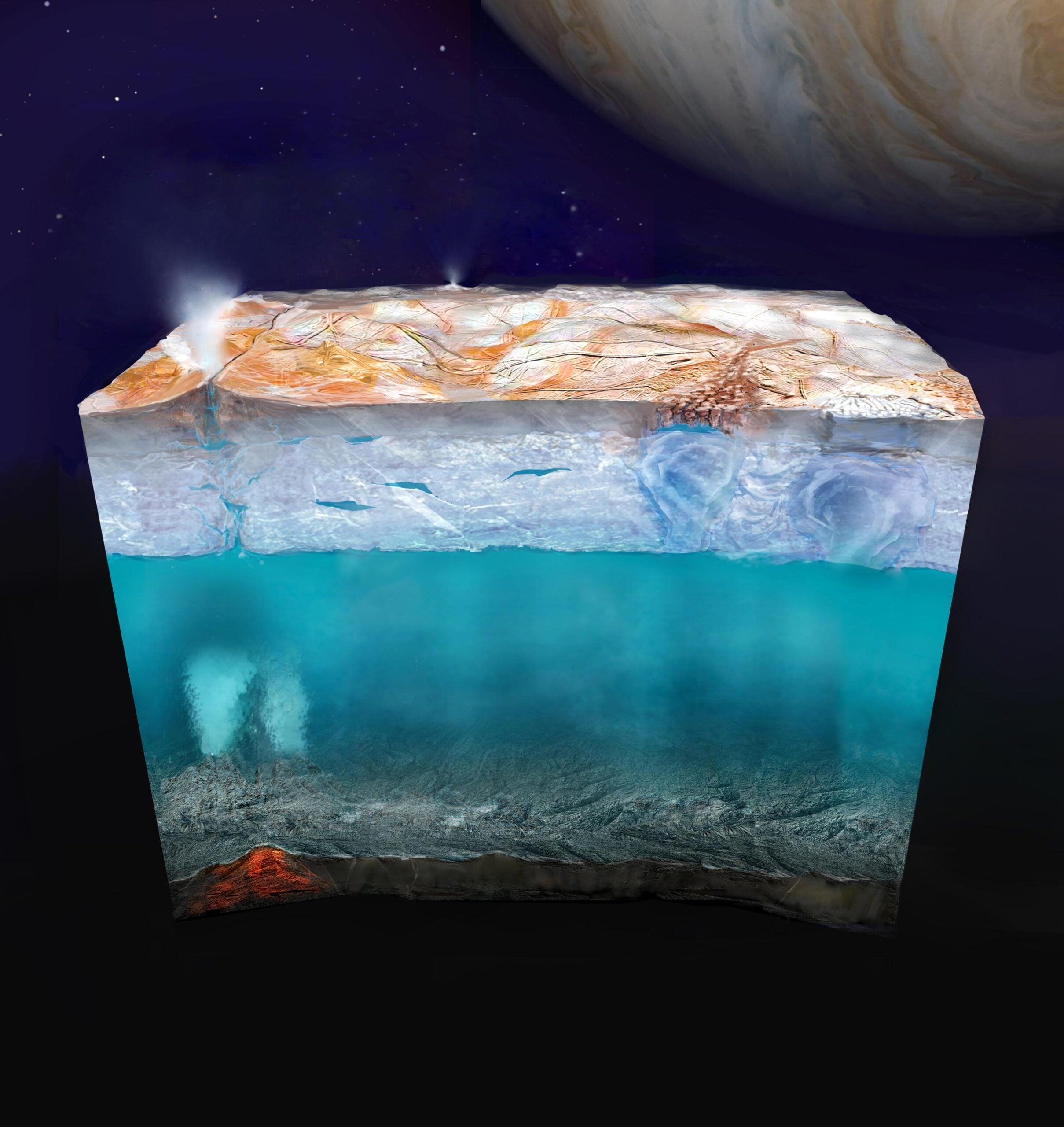
Europa is only about 3,100 kilometres across, making it slightly smaller than Earth’s Moon. Yet multiple lines of evidence point to a global saltwater ocean beneath its frozen exterior.
NASA estimates that this ocean may be 60 to 150 kilometres deep. Because it wraps around the moon, it could contain more than twice as much water as all of Earth’s oceans combined.
No camera has photographed that ocean. The evidence comes from Europa’s disrupted young surface, its response to Jupiter’s magnetic field and the moon’s internal behaviour under tidal flexing. The ocean remains an inference, although a strong one.
It is hidden beneath a formidable barrier. I recently wrote about a Juno measurement that placed the cold, conductive part of Europa’s ice shell at an average of 29 kilometres in the region it sampled, with an uncertainty of about 10 kilometres. That is not a global depth map, but it shows why simply reaching the water is beyond this mission.
Clipper will study the ocean without touching it
The spacecraft carries nine science instruments, along with a gravity and radio science investigation. Together they are designed to work around the fact that the ocean cannot be sampled directly.
Ice-penetrating radar will investigate the structure of the shell. A magnetometer and plasma instrument will help constrain the ocean’s depth and salinity. Cameras and spectrometers will map geology and surface compounds, while a thermal imager will look for warmer areas that may indicate recent activity.
Other instruments will analyse gas and dust around Europa. If material is escaping from the surface, perhaps through a plume, Clipper may be able to examine particles without landing. A detected plume would still need careful interpretation because surface radiation can alter molecules after they leave the ocean or ice.
NASA’s mission science plan groups the investigation around three broad problems: the ice shell and ocean, the moon’s composition, and its geology. None produces a simple yes-or-no life test. Together, they can tell scientists whether the ingredients and physical conditions for a habitable environment plausibly exist.
Forty-nine flybys are safer than orbiting Europa
Europa sits deep inside Jupiter’s powerful radiation environment. A spacecraft parked continuously beside the moon would absorb a damaging dose very quickly.
Clipper’s solution is to remain in a stretched orbit around Jupiter. It will pass Europa briefly, sometimes flying as low as about 25 kilometres above the surface, then spend much of each orbit farther from the harshest radiation.
The flybys will cross different longitudes and terrains. Over time, they should turn separate close looks into a broad picture of the moon. NASA can compare ridged plains, fractured bands and chaotic regions rather than treating one landing site as representative of an entire world.
The approach also leaves time to transmit data and prepare instruments between encounters. It is a cautious architecture for a hostile place, and I think that caution is part of what makes the mission credible.
Habitability is not the same as finding life
The exact wording matters. According to NASA’s mission FAQ, Europa Clipper is not a life-detection mission. It is designed to determine whether environments below the surface could support life.
Liquid water is one requirement, but not the only one. Scientists will also look for useful chemistry, possible sources of energy and evidence that the environment has remained stable long enough for complex processes to occur.
A promising result would not mean that anything is alive inside Europa. It would mean the moon has become a better-defined place to look, and that a future lander or sample mission could be aimed at the most revealing terrain.
A disappointing result would be informative too. Clipper may find an ocean that is isolated from surface chemistry, an ice shell that limits exchange or conditions less favourable than current models allow.
For now, the spacecraft is still years from its target. NASA’s current mission overview places arrival in April 2030, followed by repeated encounters rather than one dramatic moment of discovery.
Europa Clipper will not open the ocean and look inside. It will do something more measured: determine how the ice, water, rock and chemistry fit together, and give us the clearest evidence yet about whether this distant ocean could be a living place.