Most lunar craters arrive without names attached.
A rock crosses space, strikes the surface and disappears into the hole it has made. If the crater survives, scientists can estimate the impactor’s speed, size and direction from the scar. They cannot normally tell us where that particular rock was a year earlier, what its surface was made from or the exact morning it began its journey.
The object that reached the Moon near Einstein Crater on 5 August 2026 was different. It had an international designator, 2025-010D, and a catalogue number, NORAD 62719. SpaceX built it. NASA photographed its launch. Astronomers measured its colour, shape and rotation while it was still moving through cislunar space. Its orbit could be run backwards to the hour it left Florida.
That makes the new impact less like an anonymous puncture in the lunar surface and more like the end of a biography.
There is an important limit to that image. This was not the first human-made object to strike the Moon, nor the first whose mass and trajectory were known. Apollo rocket stages and later spacecraft were deliberately sent into the surface as controlled experiments. What makes 2025-010D unusual is that it was an uncontrolled impactor whose identity and physical character were reconstructed independently before it arrived.
The rocket left Earth carrying two very different lunar stories
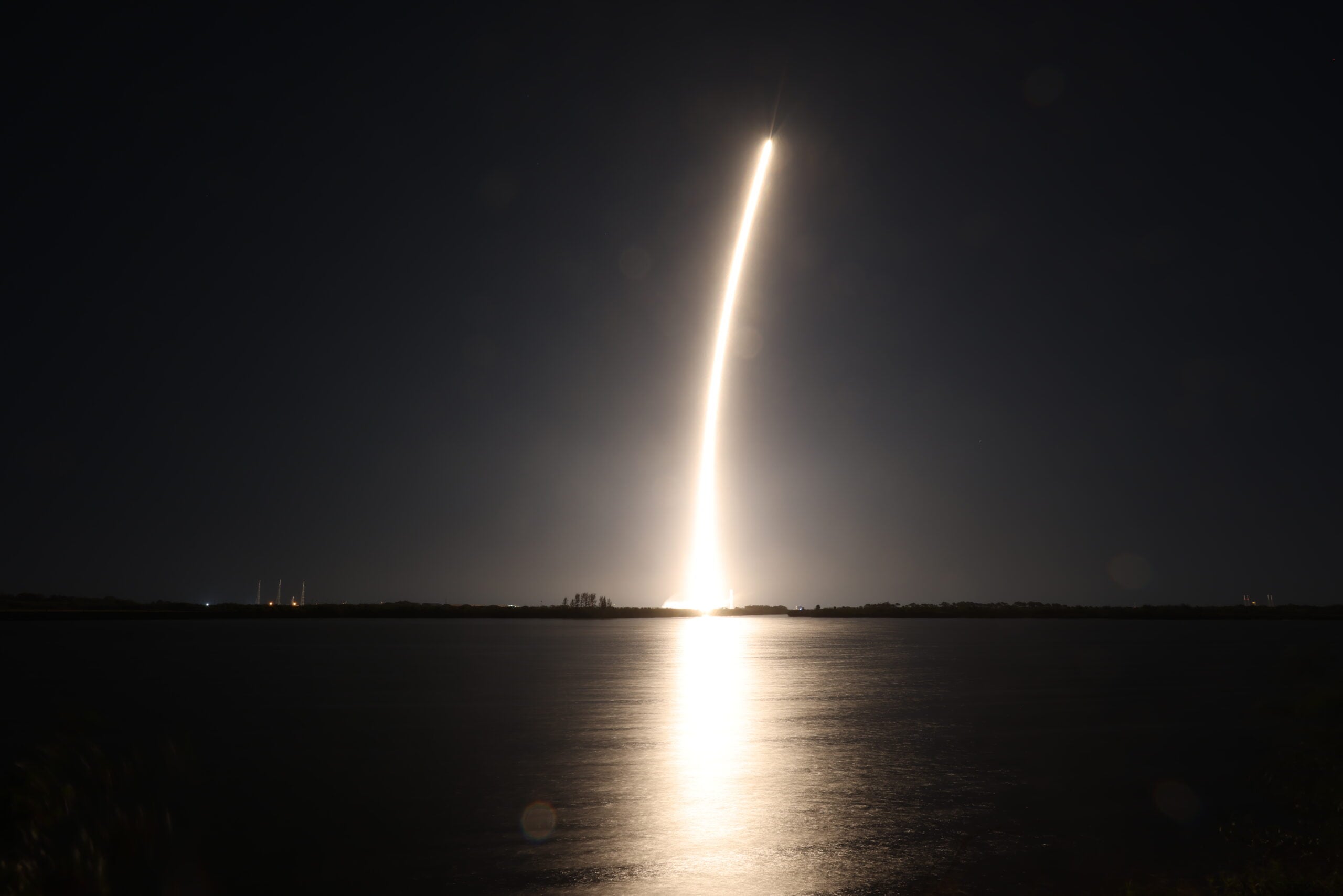
The Falcon 9 lifted off from Launch Complex 39A at NASA’s Kennedy Space Center at 1:11 am Eastern time on 15 January 2025. The launch, known as Ghost Riders in the Sky, carried two commercial lunar landers.
Firefly Aerospace’s Blue Ghost Mission 1 would go on to land successfully in Mare Crisium on 2 March. The other passenger, ispace’s Resilience lander, reached the Moon but crashed during its landing attempt on 5 June. The upper stage that had placed both spacecraft on their way separated from the payloads and remained in a long, looping orbit around Earth that repeatedly crossed the Moon’s distance.
NASA’s launch record gives the departure time and pad. The stage was roughly 12 metres long and four metres wide. Its exact mass at the end was not measured, because the amount of residual propellant was uncertain, but researchers used an estimate of about 4,000 kilograms. Other calculations put it closer to 4,900 kilograms.
That uncertainty matters. A biography is not the same thing as perfect knowledge. We know far more about this impactor than we do about a natural meteoroid, but we do not possess a final fuel gauge reading or a camera view of its attitude at the moment it struck.
Astronomers traced it back to the launch without relying on the label
The most interesting part of the identification is that researchers did not simply trust the catalogue entry. A University of Arizona-led team used optical observations to ask whether the object’s motion and surface really behaved like the Falcon 9 stage they thought it was.
First came the orbit. The researchers fitted a trajectory to hundreds of telescope measurements, then propagated it backwards. Their calculated perigee occurred at 07:12:05.56 UTC on launch day, with a statistical uncertainty of 0.38 seconds. That was within seconds of the estimated end of the upper stage’s final burn and just under five minutes before Blue Ghost separated.
A simplified reconstruction of the ground track also passed within about 66 kilometres of Launch Complex 39A. That is not launch-pad precision, but it is a striking convergence for an object observed hundreds of thousands of kilometres from Earth.
The team then examined its light. Visible and near-infrared spectra did not resemble an ordinary asteroid. They showed absorption features near 1.7 and 2.3 micrometres that closely matched another Falcon 9 upper stage and were consistent with white thermal-control coating. The measurements could not identify SpaceX’s proprietary coating molecule by molecule, but they independently supported the artificial origin.
Its changing brightness also exposed an elongated body with a light-curve period of roughly seven minutes. Curiously, that period shortened by more than eight seconds during observations early in 2026, suggesting the dead stage had spun up. Solar radiation, residual outgassing or a small debris strike are possible explanations, but the data did not identify a cause.
The team’s physical-characterisation paper is currently a preprint, so it has not yet completed journal peer review. Still, the agreement between launch timing, orbital history, spectrum and shape makes the identification far stronger than a label alone.
It also fits a broader problem I have covered before. Objects at lunar distance can be faint and poorly tracked, and artificial hardware sometimes enters catalogues built for natural bodies. An earlier Space Daily article explained how astronomers distinguish space rocks from old rocket hardware. With 2025-010D, those techniques were applied to an object all the way to its final orbit.
The predicted coordinate was precise, but the impact point was not known to metres
Orbital calculator Bill Gray’s 17 July solution for 2025-010D placed the collision at 06:34:32.9 UTC on 5 August, near lunar latitude 19.455 degrees north and longitude 93.594 degrees west. It predicted a speed of about 2.43 kilometres per second, or 8,700 kilometres per hour.
Those decimal places can create a false impression. Gray explicitly warned that the stage was being nudged by solar radiation pressure. Sunlight exerts only a tiny force, but its effect accumulates over months and changes as a long cylinder tumbles. A separate team’s earlier orbital solutions produced location uncertainties measured in fractions of a degree, which translate into kilometres on the Moon, not metres.
So we should distinguish three things. Astronomers knew the predicted coordinate. They knew the stage was on a lunar collision course. They do not yet know the centre of the finished crater to within metres.
That last measurement should come from before-and-after orbital images. NASA’s Lunar Reconnaissance Orbiter and South Korea’s Danuri orbiter were expected to examine the area, although the site’s position close to the lunar limb makes observations from Earth awkward. Until a fresh crater appears in those images, any exact location remains a prediction rather than a surveyed fact.
No camera caught the collision, but a chemical plume appeared
The collision itself seems to have been almost deliberately difficult to watch. It occurred on sunlit terrain, where a brief impact flash had to compete with the bright lunar surface. The stage was also moving slowly by meteoroid standards. Natural impactors commonly arrive at tens of kilometres per second, allowing a larger fraction of their energy to emerge as light.
Several ground observers reported no visible flash. That is not evidence the rocket missed. Its tracked trajectory on the previous night was still carrying it directly towards the Moon, and it could not pass through solid lunar terrain.
The strongest immediate evidence came from the European Southern Observatory’s Very Large Telescope in Chile. Boston University astronomer Carl Schmidt told the Associated Press that the telescope detected sodium and lithium extending tens of kilometres into space for roughly five to ten minutes after the expected collision. Schmidt said his team was certain the signal came from the impact, while stressing that it was not an image of the event.
That distinction is worth keeping. The available evidence strongly indicates that 2025-010D struck as predicted, and the plume gives researchers something physical to analyse. Direct confirmation of the crater and its shape is still to come.
The crater’s size will test models built before the impact
Before 5 August, scientists published a coordinated observing plan and impact simulation. That study estimated a final crater roughly 20 to 30 metres across. The physical-characterisation team gave an upper estimate of about 40 metres, while Gray’s comparison with the accidental 2022 rocket impact suggested something nearer 17 metres.
These are not necessarily contradictions. Crater size depends on the true mass, residual fuel, angle, orientation and the material under the point of impact. A nearly hollow rocket cylinder does not behave exactly like a compact boulder. It may strike end-on, side-on or break apart. Regolith and exposed bedrock also respond differently.
One simulation assumed a vertical, end-on collision into regolith and estimated that about 1.12 million kilograms of lunar material could be excavated, around 150 to 200 times the stage’s mass. The authors were careful about the model’s limits. It did not reproduce the actual oblique geometry, and its resolution missed the smallest and fastest dust grains.
This is where a known impactor becomes scientifically useful. Once orbiters measure the crater, researchers can compare an actual diameter and ejecta pattern with predictions made in advance. A mismatch is information. It can reveal which assumptions about low-speed, hollow spacecraft impacts need to change.
The Moon already has several craters with human histories
The idea of a crater with a biography is evocative, but 2025-010D does not stand alone.
The Soviet Luna 2 probe deliberately struck the Moon in 1959. Apollo-era S-IVB stages and lunar modules were aimed into the surface so seismometers could use the known impact times and energies to probe the lunar interior. Japan’s Hiten and Europe’s SMART-1 were later de-orbited into the Moon.
NASA’s LCROSS mission made the comparison especially clear in 2009. A 2,305-kilogram Centaur stage struck near the lunar south pole at about 2.5 kilometres per second, followed minutes later by the shepherding spacecraft. The mission found water in the excavated material, and later observations placed the crater at about 22 metres across. Space Daily’s archive contains the contemporary account of Hubble’s attempt to observe the LCROSS plume.
The closer precedent for 2025-010D came in 2022, when an unidentified rocket body created a double crater on the lunar far side. Its origin was debated before researchers linked it to China’s Chang’e 5-T1 mission using orbital and spectral evidence. The 2026 stage is only the second rocket body known to have hit the Moon unintentionally when equipment failures are excluded.
What changed this time was the completeness of the work before impact. Astronomers did not merely predict a collision. They assembled the stage’s dynamical and physical identity while there was still time to plan telescopes around its arrival.
There were no people or operating installations near the predicted site, and this single stage posed no meaningful threat to Earth. Natural impacts remain a much larger source of danger on the Moon.
Yet two uncontrolled rocket-stage impacts in about four and a half years are difficult to dismiss as isolated curiosities. The characterisation paper notes that nearly 100 lunar missions are planned over the coming decade. More launches mean more upper stages, failed spacecraft and objects left on complicated Earth-Moon trajectories.
Low-Earth orbit benefits from dense tracking networks. Cislunar space is vastly larger, and radar becomes much less effective at lunar distances. Planetary-defence telescopes and skilled amateur observers supplied many of the positions used to follow 2025-010D. That worked here, but it is not yet the same thing as a complete traffic-management system.
What strikes me is how much knowledge was recovered from an object no one was controlling. Its launch time could be matched to a reconstructed orbit. Its paint could be recognised in infrared light. Its slow tumble could be timed from tiny changes in brightness. Even its final chemical trace could be separated from the Moon’s glare.
That is an impressive piece of astronomy. It is also a reminder that identification after abandonment is not a substitute for responsible disposal.
The Moon has kept the scars of natural impacts for billions of years. This new one will be small, perhaps only a few tens of metres wide. Its unusual feature is not that humanity knows everything about it. We do not. It is that, before an orbiter has even photographed the hole, we can already tell most of the story of the machine that made it.