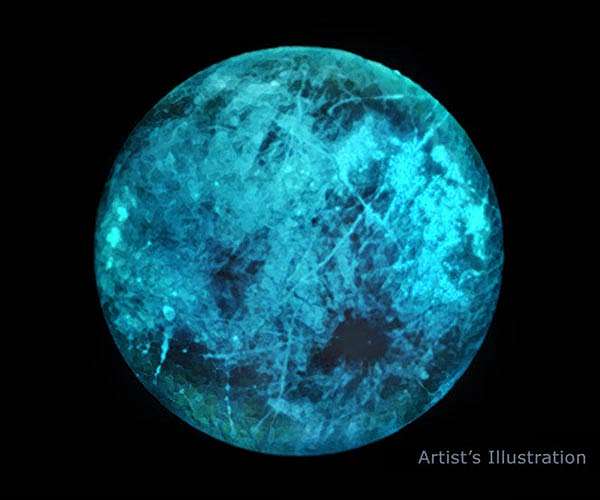
Europa should be dark where the Sun cannot reach it. It has no city lights, no lava fields bright enough to illuminate a hemisphere and no thick atmosphere producing a familiar auroral curtain.
Yet the night side of Jupiter’s ocean moon may give off its own faint light.
In a laboratory experiment, researchers cooled water ice to Europa-like temperatures, mixed it with several salts thought to be plausible on the moon and bombarded it with high-energy electrons. The ice glowed. Depending on its composition, the visible light could appear slightly green, blue or white, and some salts made it much brighter while others suppressed it.
That is not the same as observing Europa glow. It is a prediction made from an analogue experiment. But I think the distinction makes the result more interesting, not less. The work suggests that Jupiter’s punishing radiation environment may turn the dark half of Europa into a very faint, naturally illuminated chemical map.
This is not reflected sunlight
We normally see a moon because sunlight strikes its surface and some of that light is reflected towards us. Turn the moon away from the Sun and the reflected light largely disappears.
The mechanism proposed for Europa is different. Jupiter has an enormous magnetic field that traps and accelerates charged particles. Europa orbits inside this hazardous particle environment, so electrons and ions continually strike its icy exterior.
When energetic electrons penetrate the surface, they transfer energy to molecules in the ice. As those excited molecules return to lower-energy states, part of that energy can be released as visible light. The process is a form of radiation-induced luminescence. It does not require the surface to be warm, and it would continue on the hemisphere facing away from the Sun.
NASA’s Jet Propulsion Laboratory offered a wonderfully plain comparison when it announced the experiment in 2020: without this radiation, Europa’s shadowed side should look dark in the way our own Moon does. Under Jupiter’s particle bombardment, the ice itself may shine.
It is worth separating this from an aurora. An aurora is generally light emitted by atoms and molecules in a tenuous atmosphere after charged particles excite them. The glow described here comes from the solid, salt-bearing ice at the surface. It is closer to the ground lighting up than to a luminous sky hanging above it.
The researchers built a small piece of Europa on Earth
The experiment was led by Murthy Gudipati and Bryana Henderson of JPL with Fred Bateman of the US National Institute of Standards and Technology. Their study was published in Nature Astronomy.
They used a chamber designed to reproduce several important parts of Europa’s surface environment. Crystalline water ice was held at about 100 kelvin, or roughly minus 173 degrees Celsius, and exposed to a beam of 10.5-megaelectronvolt electrons. An optical system recorded the wavelengths of light released as the samples were irradiated.
Pure water ice produced a broad visible emission strongest around 525 nanometres, in the green part of the spectrum. Adding salts changed both the brightness and shape of that emission.
Epsomite, a hydrated magnesium sulphate better known on Earth as Epsom salt, enhanced the glow. Sodium chloride and sodium carbonate strongly reduced it. Mixtures did not simply behave like coloured light bulbs with one obvious salt assigned to one obvious colour. Their spectra contained differences that an instrument could separate even when a human eye might describe the result only as greenish, bluish or white.
That is why the colour matters scientifically. A camera can compare broad colour bands, while a spectrometer can split the light into narrower wavelengths. The resulting pattern is less like a photograph and more like a fingerprint shaped by the substances in the ice.
This is one study, not settled consensus that Europa’s night side has already been shown to glow. The team tested a limited set of laboratory analogues under selected conditions. The real surface is older, messier and exposed to a mixture of electrons and ions across a radiation environment that changes with location.
The brightest and darkest patches may both carry information
The intuitive expectation is that a useful signal must be bright. Here, a darkened patch could be informative too.
If relatively pure ice has a strong green-centred glow, while sodium chloride quenches much of it, a spatial change in brightness may reflect a change in composition rather than a failure of the effect. Epsomite-rich ice could look brighter under otherwise similar bombardment. Sodium-bearing ice could look dimmer.
There are complications. Temperature influences the emission. So do electron energy and flux. Grain size, ice structure, radiation damage and an intimate mixture of several compounds could blur a clean laboratory signature. The radiation responsible for revealing the surface is also chemically changing it.
That last point matters on Europa. In an earlier experiment, JPL researchers showed that irradiating sodium chloride under Europa-like conditions could turn it yellowish-brown, resembling some of the moon’s darker young terrain. The result made processed sea salt a plausible contributor to Europa’s colours, but it did not prove that every reddish fracture is ocean salt. Radiation is part of the history recorded in the material, not merely a lamp that leaves the sample untouched.
A future map would therefore need to combine glow, reflected-light spectra, geology and the local radiation dose. A colour on its own is not a chemical label. A repeatable spectral pattern tied to a particular terrain is much more useful.
A surface salt is not automatically an ocean sample
This is the place where the most exciting interpretation also needs the most restraint.
Europa almost certainly contains a global saltwater ocean below its ice, but no probe has sampled that water. In a recent Space Daily article, I looked at an estimate placing roughly 29 kilometres of solid ice above the ocean, with substantial uncertainty. Even if the exact thickness varies, the central problem remains: a surface measurement and an ocean measurement are not the same thing.
The glow could tell us about salts frozen into the upper surface. It could tell us about the hidden ocean only if at least some of that material travelled upward from below and retained a recognisable chemical connection to its source.
Europa gives scientists reasons to investigate that possibility. Its exterior is crossed by ridges, bands and disrupted regions where blocks of crust appear to have shifted. Some models allow briny pockets, fractures or slow cycling within the shell. Proposed plumes, if confirmed and sampled, could provide another route. But surface material can also be altered by radiation or contaminated by substances delivered from elsewhere in the Jupiter system.
So the careful claim is conditional: the colours may help identify surface salts, and those salts may preserve clues to ocean chemistry where geological exchange has brought interior material upward. The experiment did not reproduce Europa’s ocean, and the glow would not let us read the ocean like an ingredient label.
This is similar to the distinction I explored when writing about whether Europa’s seafloor may be geologically quiet while nutrients still move through its ice. Europa is not a set of isolated layers. The important question is how efficiently the surface, shell, ocean and rocky interior exchange matter and energy.
Europa Clipper carries cameras, but detection is not guaranteed
When this work appeared in 2020, Europa Clipper was still a future spacecraft. It has since launched and is travelling towards Jupiter, where it is due to arrive in April 2030. NASA plans for it to make 49 close flybys of Europa while remaining in orbit around Jupiter.
The laboratory team considered whether the mission’s wide-angle camera might detect nightside emission. That possibility is still best described as an opportunity rather than a promised observation. The paper later received an editor’s note warning readers not to use its original estimate of how many photons would reach the camera pixels because of an error in the conversion. The underlying laboratory spectra remain reported, but the disputed count-rate estimate should not be treated as an established sensitivity forecast.
Europa Clipper’s Europa Imaging System has wide-angle and narrow-angle visible-light cameras with colour filters. Its broader instrument suite will also examine composition, temperature, geology, the ice shell, the ocean and the charged-particle environment. Those measurements can constrain one another even if no single image produces a dramatic glowing crescent.
The mission is not designed to detect life. Its goal is to determine whether Europa has conditions that could support it. NASA’s current mission overview places arrival in 2030, so any serious attempt to match a nightside signal to the laboratory spectra is still years away.
That wait is useful context. No telescope has yet returned a colour map of this predicted surface glow. The green, blue and white description comes from ice analogues and models of what a person or camera might see, not from a hidden Galileo image waiting in an archive.
Jupiter may be making Europa easier to read by making it harder to visit
Jupiter’s radiation is usually discussed as an engineering hazard and a chemical destroyer. It can damage spacecraft electronics, break molecules apart and erase potential biological evidence near Europa’s surface.
The glow experiment adds a more complicated possibility. The same radiation may create a faint signal carrying information about what it is striking.
I like this result because it does not turn Europa into an easy world. The ocean remains hidden. Surface salts remain altered and ambiguous. The predicted glow may be too faint, too variable or too compositionally tangled to produce the clean map imagined from the laboratory samples.
But it gives Europa’s night side scientific value of its own. Darkness would no longer be merely the absence of reflected sunlight. It could be the condition that allows a much weaker signal from the ice to emerge.
If Europa Clipper eventually sees that signal, the first result will not be a direct analysis of an alien ocean. It will be something more modest and still remarkable: evidence that a frozen moon is quietly returning a little of Jupiter’s destructive energy as light, and that the colour of that light contains part of the story of the salts below.