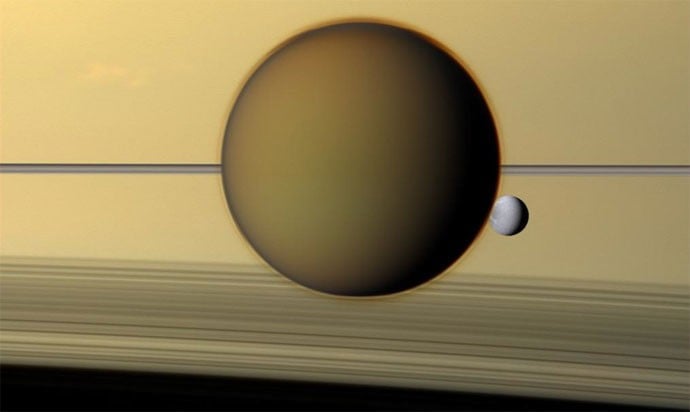
Titan’s clouds, rain, rivers and seas all depend on methane. Yet the same distant sunlight that powers this weather is steadily destroying the gas that makes it possible.
Photochemical models indicate that without replenishment, Titan’s present atmospheric methane would disappear in a few tens of millions of years. That is brief beside the more than four-billion-year history of Saturn’s largest moon.
A 2025 study in Journal of Geophysical Research: Planets tested one possible answer: impacts excavating methane trapped in Titan’s icy crust. The simulations found that a 20-kilometre impactor would release at most about one per cent of the methane currently in the atmosphere. Over time, impacts extended the methane’s atmospheric lifetime by no more than about three per cent.
The finding is worth taking seriously, but this is one modelling study, not a complete inventory of every route methane might take from Titan’s interior. What it does is eliminate a tempting idea as the main answer. Falling objects cannot keep the entire methane system running.
The chemistry that makes the haze also starts a countdown
NASA describes Titan’s lower atmosphere as roughly 95 per cent nitrogen and five per cent methane. At higher altitudes, the methane proportion is smaller, but that is where solar ultraviolet light and energetic particles accelerated in Saturn’s magnetic environment begin breaking molecules apart.
The fragments enter a dense reaction network. They form ethane, acetylene, hydrogen cyanide and increasingly large carbon-rich particles. Some hydrogen escapes into space. The heavier products descend, helping to build the orange haze, dark dune grains and organic coating on the surface.
This is not a closed loop. Methane carbon can end up locked in compounds that do not simply turn back into atmospheric methane. The process is irreversible on the timescale that matters, which is why a moon with five per cent methane in its lower atmosphere needs either a younger atmosphere or an active supply.
A major review of Titan’s atmosphere and climate describes this destruction in detail. The rate varies between models, particularly when methane escape from the upper atmosphere is included, so the lifetime is not one perfectly fixed number. “A few tens of millions of years” is the useful order of magnitude, not a stopwatch.
What the 2025 impact study actually simulated
Shigeru Wakita and colleagues modelled impactors between two and 40 kilometres across striking crusts with methane-clathrate layers five, ten or 15 kilometres thick. A clathrate is water ice arranged in molecular cages that trap methane. On Titan, such a layer could function as a vast frozen gas store.
An impact heats, crushes and excavates the crust. Some clathrate dissociates, freeing methane into the atmosphere. The amount depends on impactor size and the thickness and physical condition of the clathrate layer.
In the simulations, a 20-kilometre object released up to one per cent of the current atmospheric methane mass. Oblique impacts into porous crust could multiply that release by two or three compared with a vertical impact into non-porous material. Even with those more favourable assumptions, the long-term impact supply remained below the methane loss rate.
A very large, Menrva-forming impact could directly liberate about 15 per cent of the current atmospheric inventory. But rare ancient catastrophes cannot provide the continuous balance required today. Across the scenarios studied, impacts added no more than roughly three per cent to methane’s lifetime.
There is an important limit. The model concentrated on methane freed directly from the crust. A large impact also heats the atmosphere and surrounding terrain, potentially releasing additional gas. The paper identifies that pathway without claiming to have settled it.
Titan’s rivers and seas recycle methane, but they do not create it
The surface weather can disguise the scale of the problem. Methane evaporates, condenses into cloud, falls as rain and returns through channels to lakes and seas. That looks like a durable cycle because it resembles Earth’s water cycle.
But evaporation only returns an existing methane molecule to the atmosphere. It does not replace one that ultraviolet chemistry has converted into ethane or a haze particle.
I explored one part of that system in an earlier Space Daily article about why only about 1.3 per cent of Titan’s large rivers appear to form deltas. Those rivers reveal how methane moves across the present surface. They do not tell us where the atmosphere’s net replacement comes from.
Before Cassini, researchers proposed widespread hydrocarbon seas hundreds of metres deep as a long-lived reservoir. Cassini did discover seas and lakes, concentrated mainly in the polar regions, but not the global store required by those early versions of the idea.
The most plausible reservoir is hidden inside the moon
A 2006 Nature model proposed episodic outgassing from methane clathrates in Titan’s icy shell, above an ammonia-enriched water ocean. Interior evolution could destabilise parts of that store. Methane might then seep through fractures or arrive in bursts associated with cryovolcanism.
Several observations make interior exchange plausible. Huygens measured radiogenic argon-40, an isotope produced by potassium decay in rocky material. Its presence in the atmosphere indicates that material or gases from inside Titan have reached the exterior at some point. Cassini’s gravity measurements and Huygens radio data also support the existence of a buried liquid-water ocean.
What they do not provide is a measured present-day methane flow. Candidate cryovolcanic landscapes have been debated for years, but no active methane eruption was confirmed during Cassini’s mission. NASA still describes the ultimate source as unknown.
The isotopes imply that today’s methane cannot be primordial
Cassini and Huygens gave researchers another clock by measuring carbon isotopes in methane. Molecules containing the lighter carbon-12 isotope are processed slightly faster than those containing carbon-13. Over time, that difference should change the ratio.
Models built from those measurements placed a ceiling of about 1.6 billion years on a single methane release under baseline assumptions. When substantial atmospheric escape was allowed, the compatible age could be as short as ten million years. A separate analysis placed the duration of a replenished methane system below about one billion years, because a longer-running supply would leave more methane and photochemical products than observed.
Those estimates are model-dependent. Continuous replenishment can keep the isotopes looking young, and escape rates remain uncertain. Still, they point away from an atmosphere that has sat unchanged since Titan formed.
Dragonfly will land in the chemistry, not drill to the reservoir
NASA’s Dragonfly mission will move between sites on Titan and analyse the organic material produced by this atmospheric factory. As I wrote in a recent piece on the car-sized nuclear-powered rotorcraft, its central purpose is to examine chemistry that may precede biology.
Dragonfly can investigate how atmospheric products have been altered on the surface, particularly around the Selk impact structure. It cannot bore through tens of kilometres of ice to inspect a hypothetical deep clathrate reservoir. The methane-source problem may therefore outlive the next mission.
That is what makes the 2025 impact result useful. It closes off one relatively simple supply route while leaving the harder possibilities in place. Titan’s rivers and rain are visible consequences of methane. The mechanism that keeps putting that methane back remains buried somewhere beneath a surface humanity has sampled only once.