
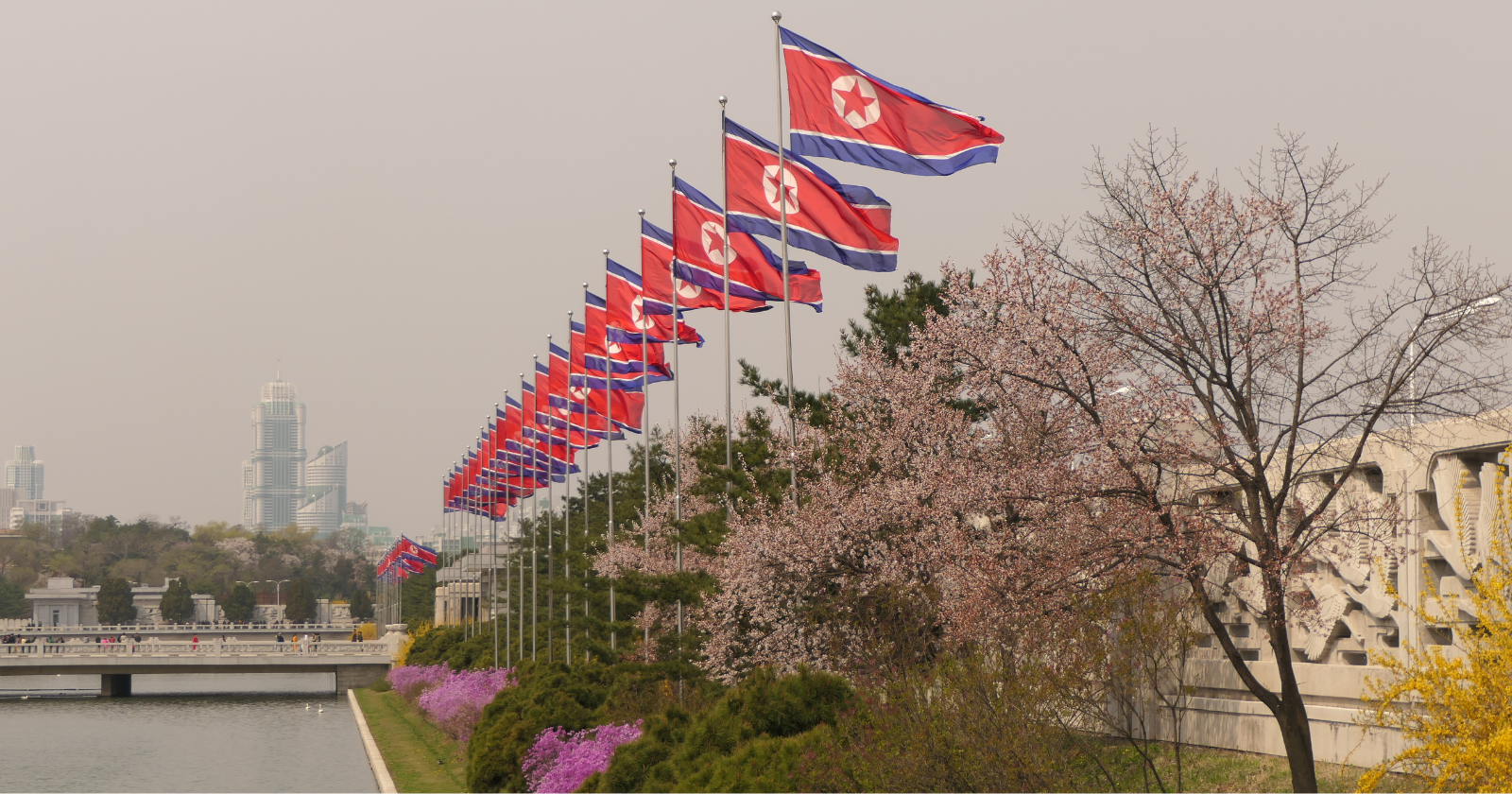
Every evening, lights come on in a town where nobody has to find the switch.
Kijong-dong sits in the northern half of the Korean Demilitarised Zone, a couple of kilometres from the South Korean farming village of Daeseong-dong. Pyongyang calls it Peace Village and describes a collective farm of roughly 200 families, serviced by a childcare centre, schools and a hospital. Through binoculars from the southern side, it certainly looks the part: blue roofs, multicoloured walls, tidy streets, power lines, a water tower.
Then you notice how the light falls.
How the buildings give themselves away
Minjeong Kim, an Amsterdam-based architect, laid out the tells in a piece for Failed Architecture: some windows are painted straight onto the concrete, others are openings with no glazing at all, and the lights run on a timer that has nothing to do with when people go to bed. When the lights do come on, though, they glow dimmer towards the bottom of each block, which is the behaviour you would expect if there were no floors and no interior walls to catch and bounce the light.
These are envelopes. Poured concrete, painted cheerfully, hollow all the way down.
The architect describes the place as a full-scale model of prosperity rather than a settlement, and the labour that keeps the illusion running is minimal: caretakers sweeping footpaths, timers doing the rest. Farm workers do turn up in the surrounding fields during planting and harvest, which is the closest the village gets to a population. Whoever works those fields by day doesn’t appear to sleep in the village by night.
The flagpole contest of the 1980s
How do you win an argument with a neighbour you refuse to speak to? In the 1980s, both Koreas tried altitude. Seoul put up a 98-metre flagpole in Daeseong-dong. Pyongyang responded with a 160-metre pole in Kijong-dong flying a substantially heavier flag, and as documented by Atlas Obscura, it held the record as the world’s tallest for years afterwards.
The village on the southern side of that stand-off is real, though the terms of living there are strange. Its small resident population is exempt from taxes and compulsory military service. In exchange, they accept an 11pm curfew, restricted movement and no right to relocate.
Seventy years of noise, then quiet
“Neither side is listening, but both continue to project into the void,” the architect writes of the loudspeaker war that ran along the border for decades. Anthems and denunciations went north to south; K-pop, weather reports and defector testimony went the other way.
That changed in mid-2025. South Korea switched its speakers off on 11 June, and the following day South Korea’s Joint Chiefs of Staff reported that the North’s broadcasts had also gone quiet, as reported by NBC News. By August, Seoul had started physically removing the hardware. David Choi and Yoojin Lee of Stars and Stripes wrote that the defence ministry framed the removal as a practical de-escalation measure, taken without consulting Pyongyang. The same report noted that the South’s military had picked up static from the northern speakers, a sign the equipment was still being maintained.
Lim Sang-soon of Pyeongtaek University told the same reporters he did not expect the North to reciprocate, partly because defectors have described the broadcasts as an unusually effective psychological weapon. Silence from Pyongyang, on that reading, buys time rather than signalling commitment.
What is going up now
Barriers, mostly. In 2024, satellite imagery from Planet Labs, first reported by BBC Verify, showed three sections of what appeared to be new wall near the eastern end of the border, along with cleared ground and a fresh access road. Dongsei Kim, an academic at the New York Institute of Technology who researches the border, confirmed to CBS News that the clearing and the road sit inside the original DMZ, while noting that both sides have nudged into that zone repeatedly over seven decades. This is one imagery-based assessment of one stretch of border, not a survey of the whole 250 kilometres.
The direction of travel still says something. A regime that once built a town to be admired from a distance now seems more interested in structures that stop people looking, and stop them crossing.
The tenants nobody planned for
Something eventually moved into the neighbourhood, though it skipped the apartments. Because civilians have been shut out of the four-kilometre strip since 1953 and soldiers stay on assigned posts, the DMZ has quietly become one of the most biodiverse places on the peninsula. Minjeong Kim’s piece counts more than 5,000 species of plants and animals along it, including over 100 considered endangered, with red-crowned cranes breeding in the wetlands and Asiatic black bears turning up on surveillance cameras. The same ground holds an estimated two million landmines.
Seven decades of effort went into making one small grid of concrete look inhabited. Life arrived instead in the strip of ground around it, drawn there by mines, rifles and the total absence of a building permit, and it has never once needed the lights.
