
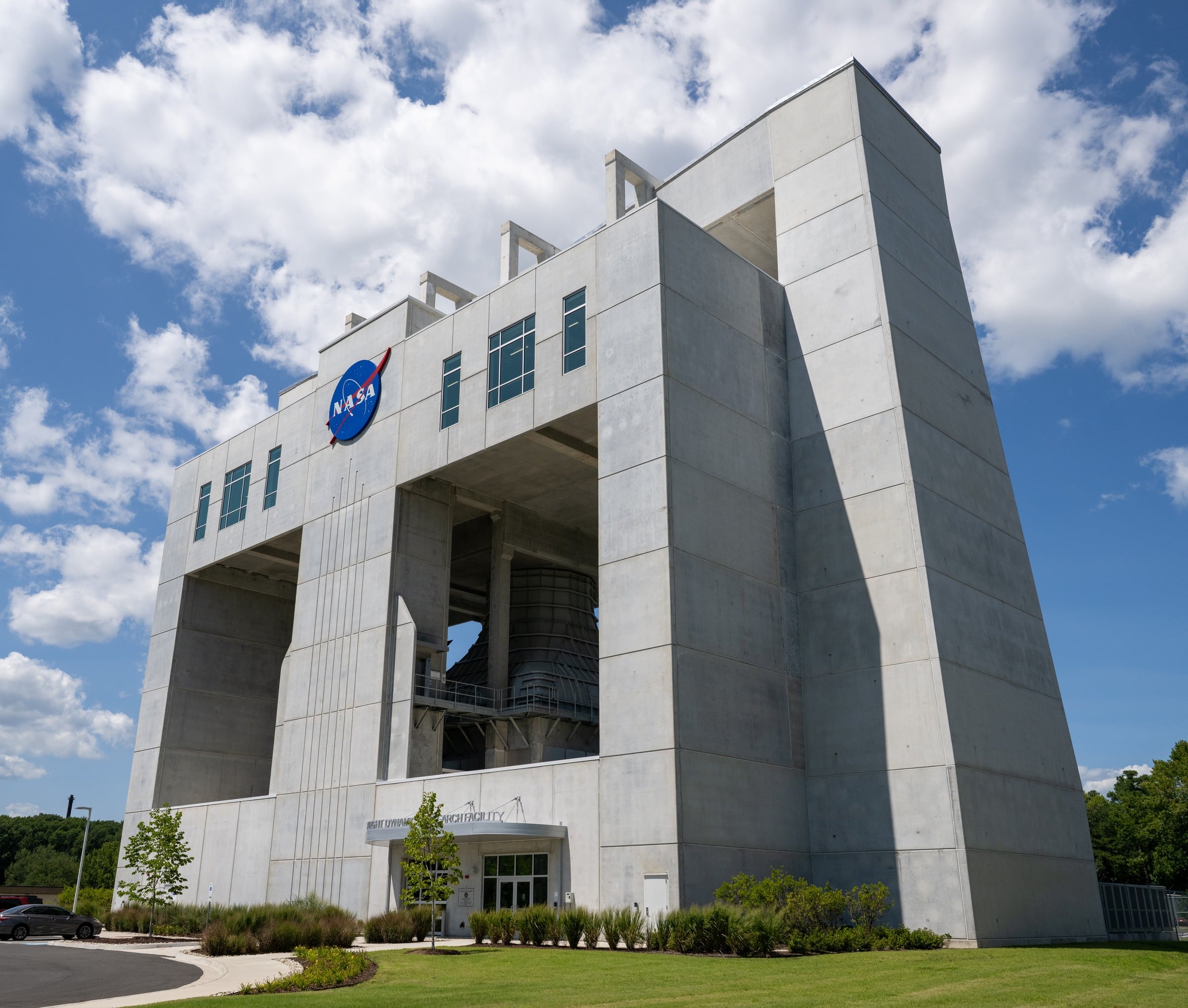
NASA cut the ribbon on the Flight Dynamics Research Facility at Langley Research Center in Hampton, Virginia, on 31 July 2026, according to the agency’s own announcement. It is the first new wind tunnel added to NASA’s holdings in more than four decades.
The facility replaces two much older tunnels on the same site: the 20 Foot Vertical Spin Tunnel and the 12 Foot Low Speed Tunnel, both of which dated to the 1930s and 1940s. NASA says components from the legacy tunnels were incorporated into the new facility’s design rather than discarded outright, though the agency’s release does not specify which parts or how much of the original equipment survived the transition.
What the new facility can do that the old ones could not
The Flight Dynamics Research Facility occupies a 25,000 square foot building with a 20 foot diameter test chamber, larger than either of the tunnels it replaces. According to NASA and reporting from WTOP, the facility can generate airspeeds up to 117 miles an hour, roughly double what the old tunnels could manage, using four 750 horsepower motors driving 14 foot diameter, eight bladed carbon fibre fans. It is built to support both free flight testing, where a scale model is released to fly unconstrained inside the chamber, and conventional mounted testing, where a model is held in the airstream on a support structure.
Construction ran from June 2022 to March 2026 at a cost reported as $53 million by WTOP; other outlets covering the same opening have cited $57 million, and NASA’s own release does not state a total project cost. NASA’s groundbreaking announcement for the project in 2022 had pointed to completion by late 2024. The roughly fifteen month gap between that original target and the facility’s actual opening is not addressed directly in NASA’s announcement, and the agency has not said what specifically caused the delay.
The contraction that came before it
The “first new tunnel in forty years” framing only makes sense against what happened to the rest of Langley’s wind tunnel fleet in the meantime. In 2011, NASA ran a Facilities Reduction Program at the centre that demolished four wind tunnels outright, including the 30 by 60 foot Full Scale Tunnel and the 16 Foot Transonic Tunnel complex, along with two smaller 8 foot tunnels and ten associated support buildings, according to reporting on the programme by the US Army, which managed the demolition contract. NASA’s own justification at the time was that the removed tunnels used older technology that no longer matched the aeronautics questions the agency was trying to answer, and that keeping them running cost more than the research they produced was worth. The work came in at $3.75 million against an original agency estimate of $8.4 million.
Langley’s tunnel count, in other words, has been shrinking for most of the past fifteen years, not growing. The Flight Dynamics Research Facility is the first reversal of that trend, and it replaces capability rather than adding to it: NASA frames it as consolidating what the 20 Foot Vertical Spin Tunnel and 12 Foot Low Speed Tunnel used to do into a single, faster, larger facility, not as expanding Langley’s overall wind tunnel footprint.
Why a physical tunnel still matters alongside simulation
Computational fluid dynamics has taken over a large share of aerodynamic design work that used to require a wind tunnel, and NASA’s own technical literature acknowledges as much. But CFD has known limits.
Scott Imlay, chief technical fellow at the simulation software company Tecplot, told Aerospace America in a 2018 feature that computational models “work really well for problems that are nice,” such as steady cruise conditions, but perform poorly outside them, and that turbulent flow in particular remains difficult to model reliably “on computers we have or will have in 20 years.”
High angle of attack conditions, the kind an aircraft experiences on landing, and aeroacoustic effects are two more areas where simulation still struggles to match physical measurement. David Schuster, a NASA technical fellow quoted in the same reporting, put it plainly: CFD “is still not in any position to do a full flight analysis of aircraft and spacecraft.” That is the practical case for building a new physical tunnel in 2026 rather than retiring the concept altogether.
What it is actually going to be used for
NASA’s stated list of programmes expected to use the facility spans several parts of the agency’s current portfolio. It includes the X-66 Transonic Truss-Braced Wing, an experimental aircraft project aimed at more fuel efficient commercial aviation, which is scheduled to be the first test campaign run in the new chamber. Beyond aviation work, NASA lists testing tied to the Orion spacecraft’s Launch Abort System, aerodynamic analysis for the Space Launch System rocket, and work supporting the DAVINCI mission, an unrelated NASA probe under development to study Venus’s atmosphere.
The breadth of that list is worth noting on its own terms. A single test facility supporting a commercial aviation demonstrator, a crewed lunar rocket’s abort system, and a Venus atmospheric probe is a reminder that Langley functions as shared aerodynamic testing infrastructure across NASA’s aeronautics and exploration lines, not as a facility dedicated to any one programme. The agency’s announcement frames the facility as forward looking infrastructure rather than describing detailed test schedules for any of the programmes listed, and specific dates for when those programmes will actually begin using the chamber have not been published.
The administrator’s framing, and what is not yet known
NASA Administrator Jared Isaacman, confirmed by the Senate in December 2025, was quoted in coverage of the opening saying the facility “gives the talented team at Langley… the tools to keep pushing the boundaries” of aviation and exploration work. It is the kind of line agency leadership offers at most ribbon cuttings, and it does not commit NASA to any specific test outcome or timeline beyond the facility’s existence.
What the announcement does not include is a breakdown of ongoing operating costs, staffing levels for the new facility relative to the two tunnels it replaces, or a public test schedule. NASA’s release also does not explain how test time in the new chamber will be allocated across the aeronautics and exploration programmes competing for it, a detail that will matter more once the X-66 campaign and any Artemis related testing are both underway.
What to watch next
The facility itself is open, but NASA has said it will spend time on data collection and certification runs before beginning the X-66 test campaign, without giving a specific date for when that work concludes. The more informative marker will be the first published test results, whichever programme they come from, since those will show whether the facility’s higher airspeed and larger test chamber translate into the kind of aerodynamic data Langley’s older, slower tunnels could not produce.
